It fell out of The Oxford Book of American Literary Anecdotes edited by Donald Hall published in 1981 by OUP. This book on my bookshelf was obviously second hand and is a collection of short, often amusing, paragraphs about well-known American authors. When I bought it I have long forgotten, most probably at some Church Bazaar or other as that is the first stall I head to when supporting such church fund-raising efforts.
I grabbed this book the other night when on my way to bed. I had just finished reading a thriller and I thought something light, with short disconnected paragraphs would be a nice way of separating the novel I had just finished from the next one I hoped to read. So, lying in bed I started this book at the beginning but found that reading about 17th century unheard of American authors was a bit boring so I flicked further into the book and came across Gertrude Stein and Robert Frost and it was at this point that it fell out of the book.
It was a ‘With compliments’ card from Syfrets Bank printed on a good quality cream paper. Besides the Syfrets Logo and the bank’s contact information – no email yet and telephone numbers only nine digits so before the introduction of the South-African-wide ten-digit number- there was a message typed on it by an electric type writer. A ‘With compliment’ card was and perhaps still is, a smallish piece of paper – in this case it was A6 size – which is attached to some other documents when sent to a third party. This must have been the case for this card, because there was typed across the middle of the sheet was this note. As per our telephonic discussion herewith enclosed are an application for a farm-bond as well as farming cash flow projections and statement of assets and liabilities form to be completed.
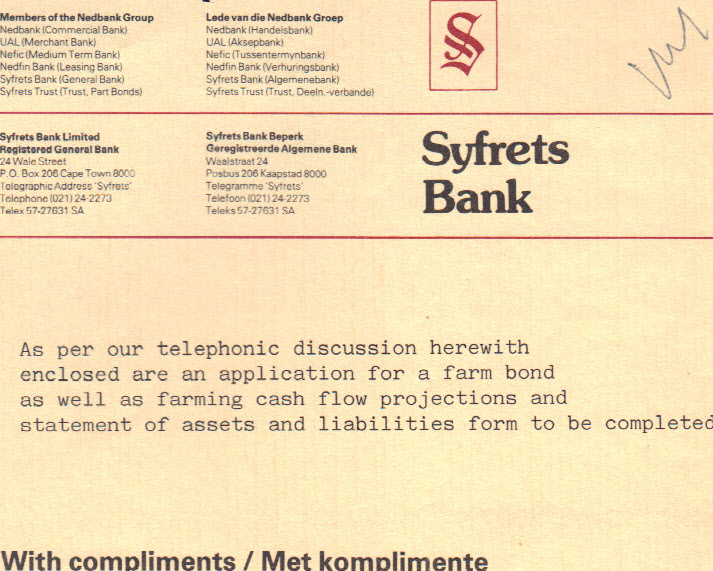
This stopped my reading immediately and it started me thinking about the original receiver of this note. Was he/she a farmer in need of further funding to keep going? Or perhaps he/she was a typical South African who felt the connection with the land and hoped, sometime in their lives, to become farmers.
In the top right-hand side of the card was a squiggle in blue ballpoint. Was the receiver starting to fill in the form and his pen wasn’t working as well as he hoped and so he placed the squiggle on the nearest available piece of paper in this case, the ‘With compliments’ card?
When did this card become merely a bookmark? This was by no means been the first time that I have come across the weird and wonderful items used as bookmarks. As a lover of second-hand books bought at church bazaars, charity bookshops or posh rare bookshops, I am fascinated by these accidentally left behind bookmarks.
The first ones I remember was when I signed up to the South African Navy (to avoid being sent to do National Service in the Army). I was issued with a loan book, The Seaman’s Manual. In the book, unbeknown to the storemen who issued it to me, was an envelope containing a collection of black-and-white photographs of a group of young men, presumably national service men, who were part of the crew of a ‘Ton’ class minesweeper. When I left the navy and handed back my Seaman Manual, I kept those photos thinking that maybe sometime in the future I would find the owners. Looking through my numerous box-files of personal memorabilia today, I could not find the photos. Perhaps when downsizing to retire I threw them out thinking that the young men in the photos, if still alive, would be well into their seventies. I wonder what they did with their lives after leaving the navy. Did they end up as rich and successful? Or did they die young?
In one book I found a bookmark which was dry-cleaners slip. I wonder if the person ever picked up that suit that was being cleaned. Bus and train tickets also make excellent bookmarks and as I come across them and see that the book in question must have been read on a train trip between Ilfracombe and Exeter. I wonder if they saw a murder as Miss Marple’s friend did in the Agatha Christie novel The 4:50 from Paddington?
By far the most common bookmarks I have found are the stubs of airline boarding passes. In the past when booking in, manually of course in those days, you received a stiff card with the end stub easily detachable. When going through the boarding gate the official would tear of the bigger section and leave you with the stub which gave you your seat number. Once seated the traveller would start reading a book, perhaps bought at the airport bookshop, and use that ticket stub as a bookmark. I am usually rude about great big thick novels which travellers seem to buy to read on the flight and perhaps on holiday and because they have paid so much for it they cannot merely throw it away. They bring it back home and put the book, with the boarding pass stub still in it, on their bookshelf and later when asked for a donation for the church bazaar, off the book with boarding pass stub goes to be sold to people like me.
Another thing that I find fascinating with second hand books is something that book dealers hate, the message from the person giving the book to the receiver of the gift. Bookdealers hate it because it reduces the value of the book but I love them because I can then imagine all sorts of adventures the unknown named characters partook in. Some are very personal and vaguely mysterious which enables people like me with vivid imaginations to fabricate all sort of stories to fit the message. Others unfortunately are boring merely saying ‘Happy Birthday, Dad, love John.’
The Oxford Book of American Literary Anecdotes had a simple message: Johannesburg Aug 84. To Patrick, love Moggily. I wonder if it was Patrick was planning to buy a farm? I wonder if he ever did?
