Baptism

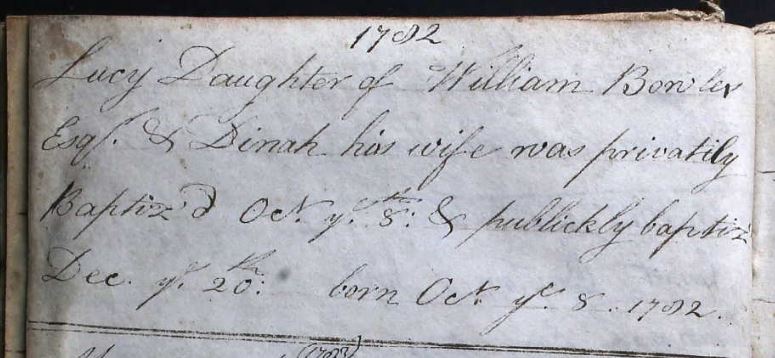
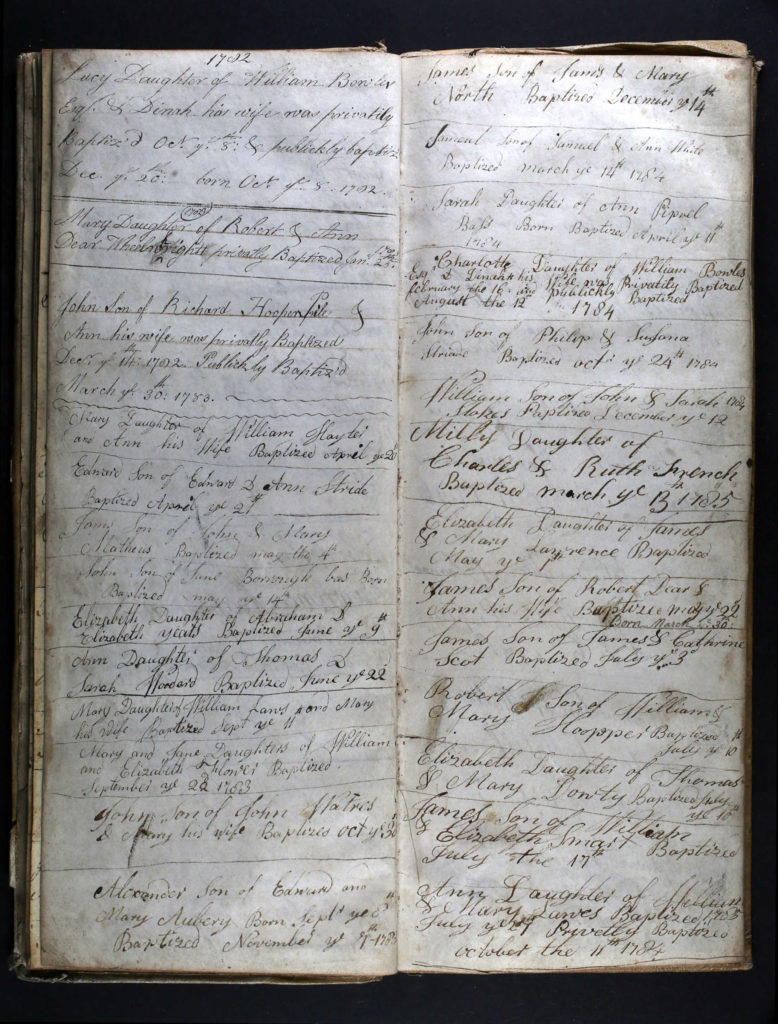
While searching for the BOWLES family of Woodford, Wiltshire, I found a few of the children of William and Dinah BOWLES whose entry into the Baptism Register of the local parish read the same as this entry for Lucy BOWLES.  I am just giving hers as an example:
Lucy daughter of William BOWLES Esq., and Dinah his wife was privatily baptized Oct. 8th and publickly baptized Dec. 20th  born Oct 8th 1782.

Now, this is not a blog-post to argue for or against infant baptism.  Infant baptism is the norm in Anglicanism, in this case the Church of England.  In those days (1780s) so often children died before reaching adulthood and confirmation or what we might call today ‘believers’ baptism’, that parents would have their children baptised as soon as possible.  Private Baptism does occurs when a child is sickly and could die before the parents could bring the child to baptism in the church.  Lucy was at least the third child to be baptised privately on her day of birth and a couple of months later ‘Publickly’.  I wonder why?

I have thought of a few reasons. 

  1. The entry in the baptism register does not show a hand of a hugely educated person. Lucy’s entry is one of the neater ones.  Was the local vicar a poorly educated cleric who did not have enough theology to know that one cannot be baptised twice?
  2. The BOWLES family lived in the local ‘big house’, Heale House.  Was the ‘living’ owned by William BOWLES and so the poor cleric did whatever he was asked to do by William?  Was William the squire and so able to throw his weight around. 
  3. Did the cleric just misuse the term ‘publikly baptised’ to mean ‘welcomed into the church’?
  4. Perhaps this was a common feature – a two-fold baptism months apart – at that time?
  5. Was William BOWLES away? He was a Royal Navy officer and might have been ‘at sea’ with an unknown return date so Dinah BOWLES went ahead and had a baptism on the day of birth and then a public baptism (if the child survived) when the child’s father had returned.

So many possible.  Which reason do you like?  Do you have any further suggestions?  Add a comment or email me via “Contact”

Bookmarks

It fell out of The Oxford Book of American Literary Anecdotes edited by Donald Hall published in 1981 by OUP.  This book on my bookshelf was obviously second hand and is a collection of short, often amusing, paragraphs about well-known American authors.  When I bought it I have long forgotten, most probably at some Church Bazaar or other as that is the first stall I head to when supporting such church fund-raising efforts.

I grabbed this book the other night when on my way to bed.  I had just finished reading a thriller and I thought something light, with short disconnected paragraphs would be a nice way of separating the novel I had just finished from the next one I hoped to read.  So, lying in bed I started this book at the beginning but found that reading about 17th century unheard of American authors was a bit boring so I flicked further into the book and came across Gertrude Stein and Robert Frost and it was at this point that it fell out of the book.

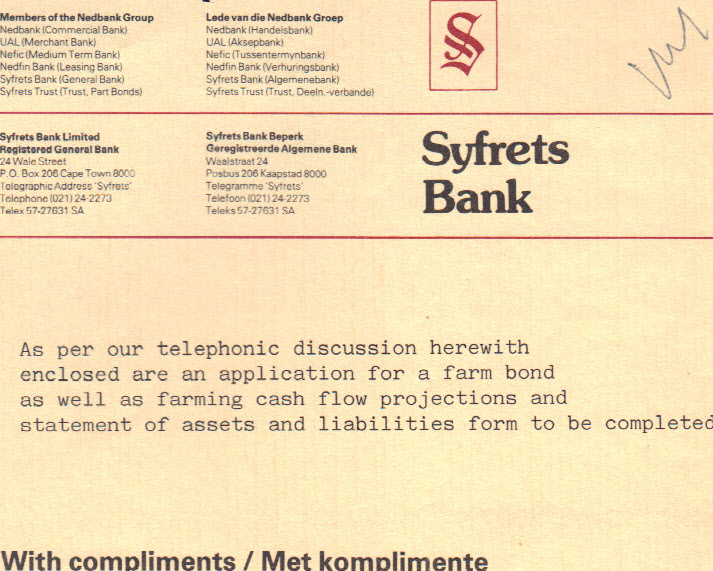
It was a ‘With compliments’ card from Syfrets Bank printed on a good quality cream paper.  Besides the Syfrets Logo and the bank’s contact information – no email yet and telephone numbers only nine digits so before the introduction of the South-African-wide ten-digit number- there was a message typed on it by an electric type writer.  A ‘With compliment’ card was and perhaps still is, a smallish piece of paper – in this case it was A6 size – which is attached to some other documents when sent to a third party.  This must have been the case for this card, because there was typed across the middle of the sheet was this note.  As per our telephonic discussion herewith enclosed are an application for a farm-bond as well as farming cash flow projections and statement of assets and liabilities form to be completed.

This stopped my reading immediately and it started me thinking about the original receiver of this note.  Was he/she a farmer in need of further funding to keep going?  Or perhaps he/she was a typical South African who felt the connection with the land and hoped, sometime in their lives, to become farmers.

In the top right-hand side of the card was a squiggle in blue ballpoint.  Was the receiver starting to fill in the form and his pen wasn’t working as well as he hoped and so he placed the squiggle on the nearest available piece of paper in this case, the ‘With compliments’ card?

When did this card become merely a bookmark?  This was by no means been the first time that I have come across the weird and wonderful items used as bookmarks.   As a lover of second-hand books bought at church bazaars, charity bookshops or posh rare bookshops, I am fascinated by these accidentally left behind bookmarks. 

The first ones I remember was when I signed up to the South African Navy (to avoid being sent to do National Service in the Army).  I was issued with a loan book, The Seaman’s Manual.   In the book, unbeknown to the storemen who issued it to me, was an envelope containing a collection of black-and-white photographs of a group of young men, presumably national service men, who were part of the crew of a ‘Ton’ class minesweeper.  When I left the navy and handed back my Seaman Manual, I kept those photos thinking that maybe sometime in the future I would find the owners.  Looking through my numerous box-files of personal memorabilia today, I could not find the photos.  Perhaps when downsizing to retire I threw them out thinking that the young men in the photos, if still alive, would be well into their seventies.  I wonder what they did with their lives after leaving the navy.  Did they end up as rich and successful?  Or did they die young?

In one book I found a bookmark which was dry-cleaners slip.  I wonder if the person ever picked up that suit that was being cleaned.  Bus and train tickets also make excellent bookmarks and as I come across them and see that the book in question must have been read on a train trip between Ilfracombe and Exeter. I wonder if they saw a murder as Miss Marple’s friend did in the Agatha Christie novel The 4:50 from Paddington?  

By far the most common bookmarks I have found are the stubs of airline boarding passes.  In the past when booking in, manually of course in those days, you received a stiff card with the end stub easily detachable.  When going through the boarding gate the official would tear of the bigger section and leave you with the stub which gave you your seat number.  Once seated the traveller would start reading a book, perhaps bought at the airport bookshop, and use that ticket stub as a bookmark.  I am usually rude about great big thick novels which travellers seem to buy to read on the flight and perhaps on holiday and because they have paid so much for it they cannot merely throw it away.  They bring it back home and put the book, with the boarding pass stub still in it, on their bookshelf and later when asked for a donation for the church bazaar, off the book with boarding pass stub goes to be sold to people like me.

Another thing that I find fascinating with second hand books is something that book dealers hate, the message from the person giving the book to the receiver of the gift.  Bookdealers hate it because it reduces the value of the book but I love them because I can then imagine all sorts of adventures the unknown named characters partook in.  Some are very personal and vaguely mysterious which enables people like me with vivid imaginations to fabricate all sort of stories to fit the message.  Others unfortunately are boring merely saying ‘Happy Birthday, Dad, love John.’

The Oxford Book of American Literary Anecdotes had a simple message: Johannesburg Aug 84.  To Patrick, love Moggily.  I wonder if it was Patrick was planning to buy a farm?  I wonder if he ever did?

The Wedding Banquet: Matthew 22:1-14

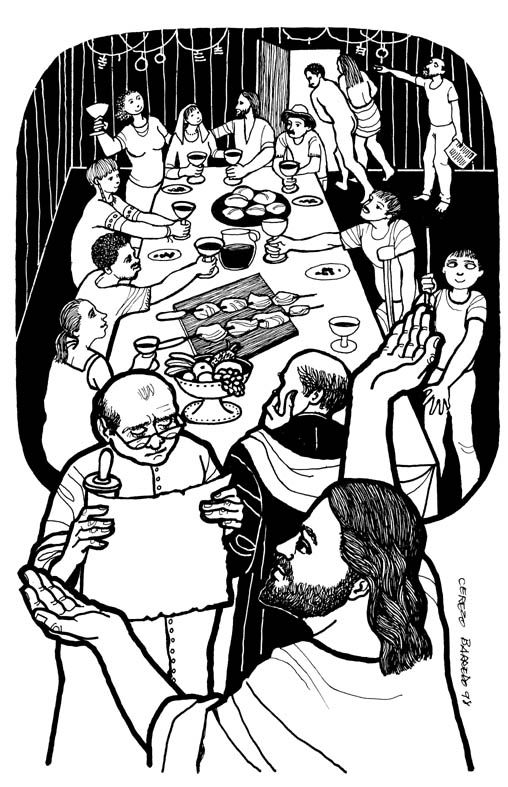
Last Sunday’s gospel has the Parable of the King giving a Wedding Banquet and when the invited guest decline to attend he destroy them and their city and then invites all and sundry but the unfortunate one without a wedding garb is thrown out.  I heard at least three sermons on this Gospel from Deans, Canon Chancellors and Precentors from large Cathedrals in the UK that I’ve been watching on a Sunday during this pandemic.  They all presented different o=points and meanings to this parable, which fitted in to their own context and situation.  However, my mind kept on going back to my mother and how she felt it was unfair on the poor man, fetched from the byways and hedges rows but gets throw out.

Paul J. Nuechterlein, the pastor from Prince of Peace Lutheran Church, in Portage, Minnesota, who runs a website for discussion on the Girardian mimetic theory of interpreting the Scriptures, presented a view I had never thought of before and I’m sure would have pleased my late mother.1

Paul started with an old story of the pastor who was giving a children’s sermon.  Each week the children anticipate him making a new point about Jesus. This particular week he began by holding up a stuffed squirrel and asking, “Boys and girls, do you know what this is?” There was silence from the children. So, he asked again. Silence. Finally, one little boy is bold enough to shyly raise his hand and suggested, “Gee, I know I’m supposed to say Jesus, but it sure looks like a squirrel to me.”

Paul thinks that something like that is happening to us in our hearing of the parable from Jesus in last week’s Gospel reading.   In his parables, Jesus tends to use kings or lords as symbols for God.  So as soon as he begins, “The kingdom of heaven may be compared to a king…,” our immediately thought is. “This king as God.” But Jesus goes on with parable and describes hideous behaviour on the part of this king.  Some folks don’t come when he throws a wedding banquet for his son, so he blows them all away – literally. He sends soldiers who kill them all and destroy their city to boot.   When the rest of the citizens left in his kingdom hear what this king had done to people who turn him down, small wonder that the king’s servants have success in filling his banquet hall the second time around.

But that’s not all. The parable goes on with one more act of horror. The king comes in inspecting his guests and notices one who didn’t fear the king enough at this point to dress in his best clothes possible, in his wedding garment. This crazy king goes off again and throws the man out into the darkness, bound hand and foot, vulnerable to any creature that comes upon him out there in the dark.  Jesus added a near onomatopoeic image about weeping and gnashing of teeth and this portrays the character of this king to good effect.

But where does this leave us.  We want to see and hear about this King as God, but we hear instead the picture of a king which doesn’t in anyway fit the picture of the God we see in the Crucified Jesus.  In fact, the crucified Jesus looks much more like the guy at the end of the parable: the one who is silent before his accuser, then bound up and thrown out.  What happens to that man in the parable is what is about to happen to Jesus.   Matthew’s Gospel emphasizes Jesus’ silence before his accusers more than any other Gospel.  We started by hearing the king as God, but by the end of the story, as disciples of the crucified Christ, we are, like my mother, more sympathetic to the guy thrown out of the party.

So, is this a case like with the Children’s Sermon of expecting to see Jesus but instead seeing a squirrel? Is it a case, in other words, of expecting to see God when we hear “king” but Jesus instead giving us something very different?  The Rev Paul Nuechterlein think that it is, and believes that this is the only way to take seriously all the terrible details about how this king behaves. Sometimes a king is simply a king. Thinking about it, in our human world of politics and authority, this is the king we expect to find because all human reigns are based on the authority of violence.  Even at “peaceful times,” the “peace” is maintained through the threat of an army or police force. We can see the king in this parable as the tyrant he is, a king who rules with the worst kind of brutality and terrorism.

The trouble is Jesus introduced this parable comparing what follows to the “kingdom of heaven.”  If Jesus is telling a parable about the way in which our earthly, violence-based authority is on display, then where do we see the kingdom of heaven? The Kingdom of heaven looks like what this king does to the man who stands silently before him at the end of the parable.  In short, it looks like what happened to Jesus when he stood silently in the face of his accusers and let them throw him out into the darkness of death.

The Rev Paul does use another verse from Matthew’s Gospel to prove what he is saying is correct.  Jesus says plainly – without imagery or parable: “The kingdom of heaven has suffered violence, and the violent take it by force.” (Matt 11:12).  Our human, earthly kingdoms operate by the threat or use of force; they dish out the violence.  But Jesus here is telling us straight out, that the kingdom of heaven is about suffering the violence instead of dishing it out.  It believes steadfastly, in other words, in the power of love and forgiveness as the greatest powers on earth. So, if we keep this clue in mind from chapter 11 of the Gospel, it helps understand these strange parables at the end of the Gospel, which Jesus tells in Jerusalem just as he himself is about to suffer their violence in love and forgiveness. This gospel passage about the violent king and the man not dressed in a wedding garment is about the collision of a typical earthly kingdom and the kingdom of heaven.

But what does this all mean for us?  Will we suffer the same fate? Maybe not exactly the same one. But we should probably expect to suffer for standing up to this world’s violent ways. In one of the other readings for last Sunday St. Paul, in Philippians wrote from prison [extemporize]:    rejoice in the Lord always   follow his example — Euodia and Syntyche should be in the same mind in the Lord.

Where do we see such examples of the kingdom of heaven today? Through those who stand against the evil, violent ways of human kingdoms.

How can we rejoice in the Lord always, like St. Paul? Because each week as we are able, we are invited to a banquet celebration of the victory of God’s kingdom: the cross and resurrection of Jesus Christ….

An abridgement of a sermon by Paul J. Nuechterlein, delivered at Prince of Peace Lutheran, Portage, MI, October 12, 2008.

  1. http://girardianlectionary.net/reflections/year-a/proper23a_2008_ser/ []