
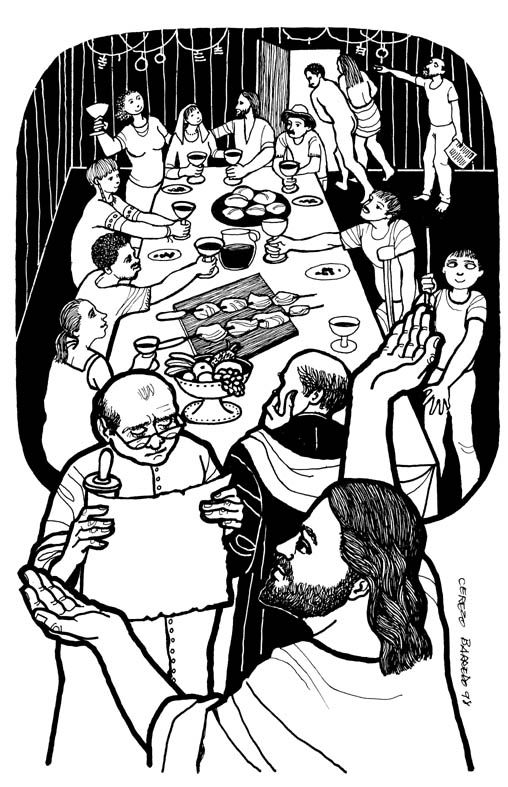
Last Sunday’s gospel has the Parable of the King giving a Wedding Banquet and when the invited guest decline to attend he destroy them and their city and then invites all and sundry but the unfortunate one without a wedding garb is thrown out. I heard at least three sermons on this Gospel from Deans, Canon Chancellors and Precentors from large Cathedrals in the UK that I’ve been watching on a Sunday during this pandemic. They all presented different o=points and meanings to this parable, which fitted in to their own context and situation. However, my mind kept on going back to my mother and how she felt it was unfair on the poor man, fetched from the byways and hedges rows but gets throw out.
Paul J. Nuechterlein, the pastor from Prince of Peace Lutheran Church, in Portage, Minnesota, who runs a website for discussion on the Girardian mimetic theory of interpreting the Scriptures, presented a view I had never thought of before and I’m sure would have pleased my late mother.1
Paul started with an old story of the pastor who was giving a children’s sermon. Each week the children anticipate him making a new point about Jesus. This particular week he began by holding up a stuffed squirrel and asking, “Boys and girls, do you know what this is?” There was silence from the children. So, he asked again. Silence. Finally, one little boy is bold enough to shyly raise his hand and suggested, “Gee, I know I’m supposed to say Jesus, but it sure looks like a squirrel to me.”
Paul thinks that something like that is happening to us in our hearing of the parable from Jesus in last week’s Gospel reading. In his parables, Jesus tends to use kings or lords as symbols for God. So as soon as he begins, “The kingdom of heaven may be compared to a king…,” our immediately thought is. “This king as God.” But Jesus goes on with parable and describes hideous behaviour on the part of this king. Some folks don’t come when he throws a wedding banquet for his son, so he blows them all away – literally. He sends soldiers who kill them all and destroy their city to boot. When the rest of the citizens left in his kingdom hear what this king had done to people who turn him down, small wonder that the king’s servants have success in filling his banquet hall the second time around.
But that’s not all. The parable goes on with one more act of horror. The king comes in inspecting his guests and notices one who didn’t fear the king enough at this point to dress in his best clothes possible, in his wedding garment. This crazy king goes off again and throws the man out into the darkness, bound hand and foot, vulnerable to any creature that comes upon him out there in the dark. Jesus added a near onomatopoeic image about weeping and gnashing of teeth and this portrays the character of this king to good effect.
But where does this leave us. We want to see and hear about this King as God, but we hear instead the picture of a king which doesn’t in anyway fit the picture of the God we see in the Crucified Jesus. In fact, the crucified Jesus looks much more like the guy at the end of the parable: the one who is silent before his accuser, then bound up and thrown out. What happens to that man in the parable is what is about to happen to Jesus. Matthew’s Gospel emphasizes Jesus’ silence before his accusers more than any other Gospel. We started by hearing the king as God, but by the end of the story, as disciples of the crucified Christ, we are, like my mother, more sympathetic to the guy thrown out of the party.
So, is this a case like with the Children’s Sermon of expecting to see Jesus but instead seeing a squirrel? Is it a case, in other words, of expecting to see God when we hear “king” but Jesus instead giving us something very different? The Rev Paul Nuechterlein think that it is, and believes that this is the only way to take seriously all the terrible details about how this king behaves. Sometimes a king is simply a king. Thinking about it, in our human world of politics and authority, this is the king we expect to find because all human reigns are based on the authority of violence. Even at “peaceful times,” the “peace” is maintained through the threat of an army or police force. We can see the king in this parable as the tyrant he is, a king who rules with the worst kind of brutality and terrorism.
The trouble is Jesus introduced this parable comparing what follows to the “kingdom of heaven.” If Jesus is telling a parable about the way in which our earthly, violence-based authority is on display, then where do we see the kingdom of heaven? The Kingdom of heaven looks like what this king does to the man who stands silently before him at the end of the parable. In short, it looks like what happened to Jesus when he stood silently in the face of his accusers and let them throw him out into the darkness of death.
The Rev Paul does use another verse from Matthew’s Gospel to prove what he is saying is correct. Jesus says plainly – without imagery or parable: “The kingdom of heaven has suffered violence, and the violent take it by force.” (Matt 11:12). Our human, earthly kingdoms operate by the threat or use of force; they dish out the violence. But Jesus here is telling us straight out, that the kingdom of heaven is about suffering the violence instead of dishing it out. It believes steadfastly, in other words, in the power of love and forgiveness as the greatest powers on earth. So, if we keep this clue in mind from chapter 11 of the Gospel, it helps understand these strange parables at the end of the Gospel, which Jesus tells in Jerusalem just as he himself is about to suffer their violence in love and forgiveness. This gospel passage about the violent king and the man not dressed in a wedding garment is about the collision of a typical earthly kingdom and the kingdom of heaven.
But what does this all mean for us? Will we suffer the same fate? Maybe not exactly the same one. But we should probably expect to suffer for standing up to this world’s violent ways. In one of the other readings for last Sunday St. Paul, in Philippians wrote from prison [extemporize]: rejoice in the Lord always follow his example — Euodia and Syntyche should be in the same mind in the Lord.
Where do we see such examples of the kingdom of heaven today? Through those who stand against the evil, violent ways of human kingdoms.
How can we rejoice in the Lord always, like St. Paul? Because each week as we are able, we are invited to a banquet celebration of the victory of God’s kingdom: the cross and resurrection of Jesus Christ….
An abridgement of a sermon by Paul J. Nuechterlein, delivered at Prince of Peace Lutheran, Portage, MI, October 12, 2008.
