
Introduction
Over the past three years I have written a blog about a carol that attracted me in that year’s preparation for Christmas. Two years ago, it was ‘What sweeter music’ (words by Robert Herrick and music by John Rutter.) Last Christmas it was ‘Tomorrow shall be my dancing day’ words by that great poet ‘Traditional’ and music by John Gardner.
This year I had a bit more time to experience various carols as I was asked to do a parish faith-sharing series called ‘Faith and Music’ at St Stephen’s Pinelands and the December meeting was entitled ‘What sweeter music… than a carol.’
Why I chose it…
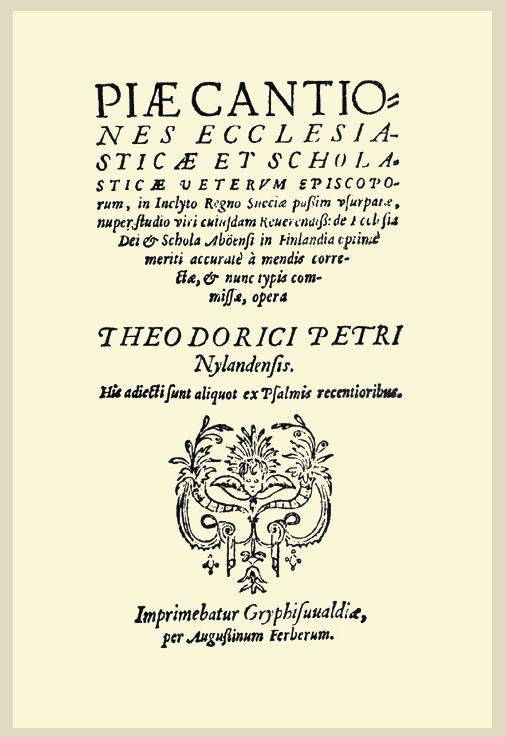
I started watching YouTube videos of Carols and histories of carols to give me a springboard for the presentation. I came across Jeremy Summerly’s various ‘Christmas Lectures’ videos for Gresham College. It appears that he has given an annual lecture on various aspects of carols and music for Christmas for many years now. One of these lectures discussed the 450th anniversary of the publication of Piae Cantiones Ecclesiasticae et Scholasticae Veterum Episcoporum (1582). The title can be basically translated as ‘Pious Church and Scholastic Songs of the Venerable Churchmen’
This publication was from Finland and collected by a Finnish schoolmaster Theodoricus Petri Rutha of Nyland, who taught at the Cathedral school at Turku, Finland. It contained seventy-two songs mostly with just a melody line. It has become a source of many carols and hymns with modern composers arranging the harmonies for us to use today in our worship. In our Hymns Ancient and Modern New Standard we find two hymn tunes sourced from this publication. The tunes are for the hymn ‘Of the Father’s love begotten…’ and secondly, a tune called Personent Hodie used for modern words ‘Long ago, prophets knew…’, an Advent Hymn.
Among the carols are ‘Up! Good Christian folk and listen’ with the words by G. R. Woodward but the melody adapted from Piae Cantiones, and ‘Good King Wenceslas’ with words by J. M. Neale and the music was that for a Spring Carol also found in Piae Cantiones.
It is amazing how one book of tunes from an obscure town of Turku in Finland and collected by a schoolmaster has played such an important role in English hymns and carols. One of the tunes written out in harmony but only for the chorus (not the verse) of the carol I’ve decided to make ‘My Carol for the Year 2025’ mainly because researching it for my Faith and Music presentation at St Stephen’s Pinelands early in December has opened so many doors for me on the history of carols.
MY carol for 2024
The name of the carol I’ve chosen is ‘Gaudete’ [Rejoice]. In my introduction to the Faith and Music presentation I was trying to define what a carol was. The Oxford Book of Carols defined Carols as being ‘simple, hilarious, popular and modern’. These terms need a bit more explanation:
Simple – this implies that a carol should be spontaneous and direct in what it says to us. This often leads to them rambling on like folk-ballads tended to do.
Hilarious – this is a strange use of the word but an archaic meaning is ‘boisterous and merry’. This also points to the word ‘carol’ being derived from the Latin and Old French word meaning ‘to dance’. This is where ‘Gaudete’ comes in for me. With its syncopation one cannot but help feeling the need to dance when it is sung in a vigorous way (see below for examples).
Popular – this means that carols were sung by all people, not just the choir and the clergy. Most often carols were sung by the common people going from door-to-door singing carols in the wassailing tradition, usually ending up in the local pub.
Modern – With Piae Cantiones being published in 1582, this seems to be a contradiction but The Oxford Book of Carols (TOB), using rather gender-specific language, typical of its era, TOB was first published 1928. It says that carols are ‘always modern, expressing the manner in which ordinary man at his best understands the idea of his age, and bringing traditional conservative religion up to date.’
Does ‘Gaudete‘ fulfil the requirements of being ‘simple, hilarious, popular and modern’? I think it does – if one performs it in a suitable way. Here we need to look at the words and the music separately.
The words
| Latin Gaudete, gaudete! Christus est natus Ex Maria virgine, gaudete! Tempus adest gratiæ Hoc quod optabamus, Carmina lætitiæ Devote reddamus. Gaudete, gaudete! Christus est natus Ex Maria virgine, gaudete! Deus homo factus est Natura mirante, Mundus renovatus est A Christo regnante. Gaudete, gaudete! Christus est natus Ex Maria virgine, gaudete! Ezechielis porta Clausa pertransitur, Unde lux est orta Salus invenitur. Gaudete, gaudete! Christus est natus Ex Maria virgine, gaudete! Ergo nostra contio Psallat iam in lustro; Benedicat Domino: Salus Regi nostro. Gaudete, gaudete! Christus est natus Ex Maria virgine, gaudete! | English Rejoice, rejoice! Christ is born Of the Virgin Mary – Rejoice! The time of grace has come— What we have wished for; Songs of joy Let us give back faithfully. Rejoice, rejoice! Christ is born Of the Virgin Mary – Rejoice! God has become man, With nature marvelling, The world has been renewed By the reigning Christ. Rejoice, rejoice! Christ is born Of the Virgin Mary – Rejoice! The closed gate of Ezekiel Is passed through, Whence the light is risen; Salvation has been found. Rejoice, rejoice! Christ is born Of the Virgin Mary – Rejoice! Therefore, let our assembly Now sing in brightness Let it bless the Lord: Salvation to our King. Rejoice, rejoice! Christ is born Of the Virgin Mary – Rejoice! |
This carol is in Latin and not macaronic, where Latin phrases are introduced into a carol in the vernacular language, as for example, ‘In dulci jubilio, Let us our homage show.’ The Latin phrases, however, are all very well-known likely to be understood easily even by the uneducated person having heard them regularly in the liturgy. Thus, it is simple and popular and the music (see below) makes it hilarious and modern.
The Music
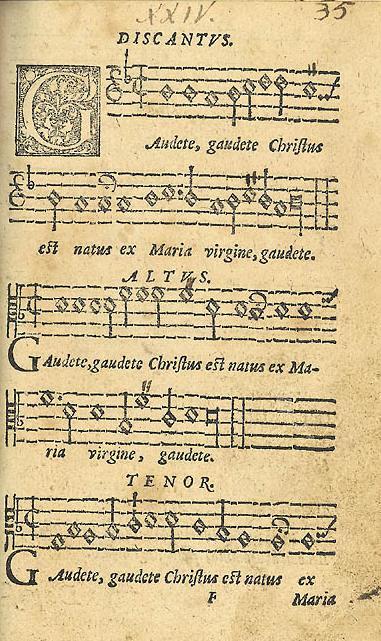
As far as the music goes, I’ve said already that the Piae Cantiones had 72 melodies and very few written with harmonies. Gaudete was one of the few that did. (See picture of score, showing the score with separate parts.) Unfortunately, there is no music given in Piae Cantiones for the verses. The YouTube channel, Early Music Sources by Elam Rotem gives a very good and interesting exploration of the early sources for the chorus as well giving examples of verses used by performers. Use this link https://www.youtube.com/watch?v=Aab7TvfDEKE if you want to see where the tune first arose. Basically, a choir planning to sing today would have to find a suitable version to express the joyfulness of this carol.
I was looking for a version to play for the Faith and Music group.
Version 1: In my CD collection I had a CD I bought at Portsmouth Cathedral with their choir under Dr David Price. Their version of Gaudete was arranged by Luke Fitzgerald who brings in percussion and the organ to express the celebratory nature of the carol. This is close to what I think fulfils the definition of simplicity, hilarity, popularity and being modern.
From CD Verbum Caro Factum Est Choir of Portsmouth Cathedral Director David Price (Herald CD HAVPCD407 2018)
Version 2: However, the one I chose to play to the group was a version by the British folk-rock group Steeleye Span from the 1970s and 80s. It became very popular reaching the Top40 charts – one of the only two Steeleye Span had- the other was ‘All around my hat’. This version of Gaudete has simple harmonies and the singing by the soloist, Maddy Prior and the rest of the group, has a ‘roughness’ and ‘boldness’ giving a ‘in-your-face’ feel to it. The words are also pronounced in a ‘non-liturgical Latin’ or ‘Italianated Latin’ way making it sound more ‘popular’ – of the people, rather than ‘of the choir and educated clergy.’
Taken from one of many online Youtube videos Steeleye Span – live performance.
Which one do you like most? Which version is truly a carol? Feel free to message me in the comments.
While searching I came across a parody version entitled Crudité rather than Gaudete and if you listen carefully to the words, pre-dinner snacks are more to the fore than rejoicing over the birth of Jesus! This version perhaps uses the definition of ‘hilarious’ in its modern rather than archaic way!
Found on YouTube. Song by Blanche Rowen and Mike Gulston