



Sermon: 16 Oct 2022

Gospel Reading: Luke 18:1-8

“Knock-knock” “Whose there” ….

How many ESKOM executives does it take to change a light bulb? ….

An Englishman, an Irishman and a Scotsman go into a bar together

I’m sure you all recognise those phrases as the start of jokes.  But these sorts of jokes are not realistic, are they?  I mean, when someone knocks at our door, we don’t shout out, “Whose there?”, we go and open the door and see whose there.  Of course, regardless of what the joke says, it only takes one person to change a light bulb.  And would an Englishmen, Scotsman and Irishman really go into bars together?  Jokes are a bit like parables.  They are stories that are not meant to be completely realistic.  They are stories which help to get a message across.

Many of these starter line to jokes or catchlines are now very old fashioned and not used by stand-up comics these days.  I wonder if there were any catchlines to jokes in Jesus’s day?  Perhaps they started, ‘In a certain city there was a judge…’   Just like Jesus’ parable does this morning. So, am I saying that Jesus is telling a joke?  Well, one commentator I read said: “Enjoy the humour of the story and the colourful nature of the characters.” So maybe he is.  But isn’t this the nature of all of Jesus’ parables?  We must enjoy the story that Jesus tells, the same as we enjoy a joke and, as with all parables, we must not take them too literally.  They are told to us to teach us a deeper meaning for our lives and they tell us more about our faith. 

This morning gospel parable is one of Jesus’ most complex.  A widow comes to the judge for a legal decision against her opponent. She is a widow, and like all widows in Jesus’s time she would have been dependent on a son or possibly a brother for all her needs.  It appears that she owns some property — but someone else is laying claim to that property.  We are not told whether her claim or the other persons claim to the property was legal or right.  We only know that it is disputed by the widow and her unnamed opponent.  But the parable doesn’t require us to know the facts of the legal case.  We only need to know that she is widowed and that she has property to which someone else — we don’t know who — is laying claim.  And so she goes to the judge again and again to get a decision on the case in her favour.  The judge, however, doesn’t care one way or the other about this pestering widow.  At first, he puts up with her, but the woman simply will not stop.  She’s not important to the judge, but the trouble is, she won’t go away. She is annoying at first, but then simply a pain. She’s always there.  Our translation is polite when it says the woman keeps “bothering” the unjust judge.  In the original Greek, however, the word translated here as “bothering” literally means to give somebody a black eye.  Can you imagine a elderly widow giving a judge a black eye?  Well, finally the exacerbated judge thinks to himself that though he fears neither God nor does he respect anyone, this woman is so troublesome that the only way to get rid of her is to give her what she wants. Otherwise, she’ll just wear him out.  And so the judge resolves the case in her favour. Case solved.  Woman gone.  End of story!  Or is it?

You can see that this story is a bit like a joke – it is not realistic – I mean, a woman giving a judge a black eye?  A judge finding in the woman’s favour merely to get her to stop bothering him.  I mean, what about the law?  What about Justice?  These questions make us ask, ‘Why did Jesus tell this parable?  What did Jesus want to teach us from this parable?’

Well, he actually tells us at the begin of the reading. “Then Jesus told them a parable about their need to pray always and not to lose heart.” Need to pray always and not to lose heart.  Two things there… ‘need to pray always’ that is to be persistent in our praying to God.  And secondly, ‘not to lose heart’, in other words to remain sure, faithful, that God will answer our persistent prayers.  We could say that the message of the parable is, “If persistence can pay off with even a lousy corrupt human judge, how much more effective will persistence be when we pray to a perfectly just and loving God!?”  But notice, Jesus doesn’t quite say that at the end of the reading, does he?  Instead, he says “Listen to what the unjust judge says.”

But what are we supposed to learn from what the judge said, besides his sheer frustration, and it is self-centred frustration at the woman?  Is Jesus telling us that we are to make God frustrated by our persisted prayers?  Are we to imagine that even God worries about getting a black eye from us?  The judge had ‘no fear of God and no respect for anyone.’  Do we think that God is scared of losing his reputation and so will give in to us because of that? Surely not!

And what about when Jesus, speaking of God, asks “Will God delay long in helping those who are persistent in prayer?”  This question from Jesus doesn’t really need an answer from us, does it?  Because we know that God will answer our prayers.  That is our faith, that is what we believe.  But if that is the case, why doesn’t Jesus just say that flat out? That God will never delay in helping us when we pray to him.  But he uses the words “delay long” and that makes it sound as though God does sometimes delay a short time in answering our prayers.   Have you found that this to be the case?

But this Gospel passage makes it clear that in the end it’s not about whether, or to what extent or in what way, God will bring justice to the earth.  It’s not about whether there are times when for some mysterious reason God has to delay answering our prayers.  There are countless unknown variables in God’s ways.  What’s the famous say?… ‘Our ways are not God’s ways.’ We cannot see what God can see, so there are prayers that appear to us to go unanswered.  However, they are not unheeded, but unanswered in the sense that we are not receiving what we want or what we think is the best for us.  That kind of disappointment all too often leads us to begin wondering what God is up to, what is on God’s mind, what kind of a God is he?  Unfortunately, this can also lead to a loss of faith in God.

However, notice that in this parable Jesus turns the tables on us and puts the focus back on our faith.  We have to assume the best about our God’s goodness, our God’s love, our God’s justice, and our God’s mercy.  By faith we hang on to our belief, whether our prayers are answered at once or not.  What we have to worry about is not about the character of God but more about the strength and the persistence of our faith.  God may well be, as us Christians say, the most generous source of grace and light in the universe.  But if people stop praying to God, how can they ever show the might and wisdom of God and God’s hidden kingdom to the world out there?  How can those who will not pray, access and tap into the power and love of God?  As Jesus said at the end of the parable: “And yet, when the Son of Man comes, will he find faith on earth?”  Do you have that sort of persistent faith?

Oh yes… How many ESKOM executives does it take to change a light bulb?  Three one to hold the light bulb, one to turn the ladder and one to go and start up the generator because loadshedding has started.

Have faith my friends!
Sermon: 9 Oct 2022

On Sunday 9 Oct and 16 Oct 2022 the Rector of St Clare’s, Ocean View, Fr Ulrich Groenewald asked me to do the 8am Eucharists services. Here is the sermon I preached on Sunday 9 Oct 2022.

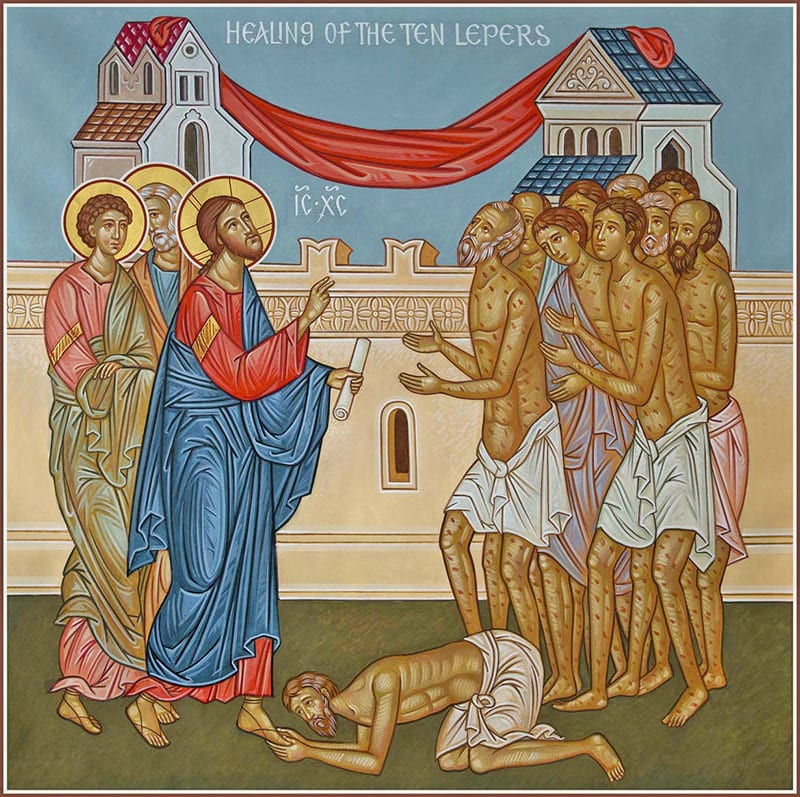
Jesus Healing the ten Lepers. Luke 17:11-19

In today’s Old Testament and Gospel readings we hear about leprosy being healed.  What is this leprosy we hear about in these readings?  Leprosy is a chronic infectious disease caused by a bacillus, Mycobacterium leprae. It mainly affects the skin, the peripheral nerves, mucosa of the upper respiratory tract, and the eyes.  It begins with skin lesions affecting the nerves so the person has no feeling in that area.  If left untreated, leprosy can cause progressive and permanent damage to the skin, nerves, limbs, and eyes.  Those living with untreated leprosy suffer from paralysis and crippling of hands and feet, with the shortening of toes and fingers due to re-absorption as well as nose disfiguration. 

Now, don’t for a moment think that leprosy is something from the past, only found in the pages of the Bible. Perhaps you do not know of anyone with leprosy today, but here in Cape Town I know of at least two sites where leprosy was treated in the 1800s and 1900s.  Robben Island, before it became a gaol for political prisoners, was both a psychiatric hospital as well as a hospital for lepers.  It was here that the Anglican monastic order, the Society of St John the Divine commonly known as SSJD or the Cowley Father’s ministered.  One of these father’s Fr Congreve, wrote in his biography about how he spent time on Robben Island and received communion in the Church of the Good Shepherd there.  He knelt down at the altar rail to receive, right next to person with advanced leprosy and Fr Congreve felt moved that as he lifted his hands to receive the Body of Jesus in the form of a communion wafer, the leper kneeling next to him lifted his damaged hands with shorten fingers to receive that same body of Christ.  ‘We who are many are one body for we all partake of the one bread.’

Some of you might have been to the Retreat Centre, St Raphael’s in Faure.  In the early 20th Century St Raphael was isolated from the city of Cape Town which now encircles it with suburbs, but in the early days the Anglican Church ran St Raphael’s as a leper hospital.  In the small chapel at St Raphael’s, you will see on the altar a picture of a leper saying to Jesus “Lord, if you are willing, you can make me clean.” This is from Mark’s Gospel and Mark tells us that Jesus reached out his hand and touched the man and said: “I am willing.”  When I was at St Raphael’s on my ordination retreat 26 years ago, I was greatly moved by these two statements.  “Lord, if you are willing, you can make me clean.” Jesus Christ reached out his hand and touched him. “I am willing,”   Isn’t it wonderful to have Jesus say to us… I am willing?

In our Gospel reading today there is not one but ten lepers that are healed.  They have gathered as a group outside a town.  They had to do that because the people of the town knew that leprosy was infectious and so they didn’t want those with leprosy, who they saw as being unclean, in their neighbourhood.  But these lepers had to live somehow, so as a group they stayed just outside the town to beg from those coming and going to and from the town.  On this day Jesus and his band of followers came that way and so they call out to him ‘Jesus, Master, have mercy on us!’.  When he saw them, he told them to go and show themselves to the priests.  This was because the Jewish people lived in what could be called a theocracy.  God was their ruler.  Because they could not see God, it had to be God’s intermediaries, the priest, who made decision on whether the lepers were clean and could re-enter society, go back and live in their town again. 

Now notice there was one among them one who was not a Jew.  He was a Samaritan.  Jews despised and even hated Samaritans.  Those other nine lepers, when they were rejected so was the non-Jew among them, the Samaritan.  As they had all been rejected, they were willing to have him in their group.  But now they were healed and hurrying to the priests to get the all clear.  That Samaritan man realised he was no longer acceptable to them.  He turns, not to the priest to get the all clear, but to the man who had healed him, Jesus Christ. Notice what Jesus said:  ‘Were not ten made clean? But the other nine, where are they? 18Was none of them found to return and give praise to God except this foreigner?’ Then he said ‘Get up and go on your way; your faith has made you well.’  What faith?  That Samaritan didn’t believe in the same God as the other nine Jews who were healed but that didn’t make any difference to Jesus.  ‘Get up and go on your way; your faith has made you well.’ 

What can we learn from the Gospel reading?  Is it merely that we have to say thank you?  I have a 3y old grandchild called Elias and when he asks for something I keep on saying to him, ‘Say please?’ and when I’ve given it to him, I ask him: ‘Do I hear a thank you?’  Please and thank you is what my mother drilled into me when I was young as I’m sure your mothers did too.  But does this story of healing carry a deeper teaching for us than just saying thank you?

I think it does.  You know we all have people with leprosy in our family, in our community and within our nations.  No, not the disease caused by that bacteria, but rather the way we treat others as if they had leprosy.  We chase them out of family, our community, our nation.  And if we can’t chase them away from us, we treat them as if they no longer exist.  Perhaps someone in your family who fell pregnant while still at school, or someone who is gay, basically anyone who is radically different from you.  You reject them and treat them as if they had leprosy.  And in the Ocean View Community, what about the gangsters and the drug-dealers?  In our nation, what about the foreigners?  Let each of us think for a moment of someone, some group we have treated as if they have leprosy………

How did Jesus respond to those with leprosy?  “‘Go and show yourselves to the priests.’ And as they went, they were made clean.”  What can you do to help people you reject to be made figuratively clean?  That is something between you and God but God has given you Jesus as the example.  What does he do?  Can you do the same?

I want to end by giving a personal story, a sort of testimony.  When I was rector of St Andrew’s in Steenberg I was on my way up Military Road to go to the Blue Route.  The railway crossing booms at Steenberg Station were down so I decided to sneak past the waiting traffic and make my way along the road that runs parallel to the Railway line and cross at White Road.  Unfortunately, as I tried to sneak past, I slightly scratched a bakkie in front of me which had a pile a young men in low-slung jeans and hoodies sitting in the back.  One leapt off and started cursing me in some choice language.  Realising I was at fault I nervously got out the car and the bakkie driver did the same.  He was tall, thickset man with a shaved head and to me had the typical look of a gang-leader.  He indicated to me the scratch on the bakkie, which I could barely see.  My car was fine but he said that I would have to pay R150 for his car to be repaired.  It was a small amount compared to most panel-beating quotes so I thought, ‘Let’s just pay this man and get it over with.’  Basically, I was treating him like those lepers outside the town we heard about in the gospel – I was just throwing money at him to get him out of my hair.  I said I didn’t have any cash on me then but if he came to my house in Bothma Street at 5pm I’d give it to him.  At first, he didn’t believe that any white people lived in Bothma Street but I told him I did because I was the Anglican priest at St Andrews.  So he agree to come at five.

At five the front door bell went and there he was.  I thought, ‘I’m not going to invite you in because you might check out my possessions and decide to come and burgle the house later’, so we chatted on the front door step. – See I’m still treating him as a leper.  After I had given him the money, he started talking about himself and his girlfriend and their son.  He would have liked to have his son baptised so that the son would have a better chance in life than he did.  I said to him that if he came to church on Sunday, I would enrol him in the Baptism Preparation classes and we could then talk about him and his girlfriend getting married.   Our conversation was taking so long my wife kept looking through the glass pane on the side of the door to make sure that I hadn’t been kidnapped or stabbed.  But I was quite safe talking to this gangster. 

I would love to tell you that the following Sunday he was in Church.  Unfortunately, he wasn’t but maybe because I was willing to listen to his story and encourage him, he felt less rejected, less like a leper.  Perhaps he came to church after I had moved on to my next parish and perhaps the priest who succeeded me, baptised his son and married him and his girlfriend.  And perhaps he then heard Jesus say: ‘Get up and go on your way; your faith has made you well.’

You, too, can make a difference.  To know how and to do what, will depend on your relationship with Jesus.  You must listen to what he is saying to you, through his word and through your prayers.