
My Favourite Carol 2023 Version:

Tomorrow shall be my
dancing day.

Each year as Christmas comes round and as choir members start practicing carols, one carol seems to stand out and have a particular effect on me, leading to the desire to explore the words (and music) in more detail.

A few years ago it was John Rutter’s What sweeter music, the words of which were by Robert Herrick (see https://dappergeni.co.za/wp/2021/12/17/christmas-day-reflection-what-sweeter-music-than-a-carol/ ). Last year it was ‘That Chord’ in the organ part of the last verse of O come all ye faithful by David Willcocks. (see  https://dappergeni.co.za/wp/2022/12/ )

This year it has become the exciting and very rhythmical setting of Tomorrow shall be my dancing day by John Gardner.

I think I need to look at this carol both from a musical and a text point of view.

Text
Gardener’s setting, like most others sung at Carol Services only uses the first four verses of this carol by an anonymous author.

1. Tomorrow shall be my dancing day;
I would my true love did so chance
To see the legend of my play,
To call my true love to my dance;
        Chorus
        Sing, oh! my love, oh! my love, my love, my love,
       This have I done for my true love.

2. Then was I born of a virgin pure,
Of her I took fleshly substance
Thus was I knit to man’s nature
To call my true love to my dance. Chorus

3. In a manger laid, and wrapped I was
So very poor, this was my chance
Betwixt an ox and a silly poor ass
To call my true love to my dance. Chorus

4. Then afterwards baptized I was;
The Holy Ghost on me did glance,
My Father’s voice heard from above,
To call my true love to my dance. Chorus

There are, in fact, eleven verses which describe the whole of Jesus life dealing with his temptation in the wilderness (v5), his teaching and miracles (v6), his betrayal by Judas (v7), his trial (v8), his crucifixion (v9), resurrection (v10) and ascension (v11), concluding with the whole purpose of the incarnation: … now I dwell in sure substance/ On the right hand of God, that man/ May come unto the general dance.

Perhaps I need to place this carol into an historical context. Although much older, it appeared in William Sandys Christmas Carols Ancient and Modern published in London by Richard Beckley in 1833. On the internet and on CD liners and introduction to Carol Books there has been much discussion about this carol. But first we need to understand more clearly what a carol is.

One site defined the following: CAROL (0ld French carole), a hymn of praise, especially such as is sung at Christmas in the open air. The origin of the word is obscure. Some suggest that the word is derived from chorus. Others link it with corolla, a garland, circle or coronet, in the earliest sense of the word being apparently a ring or circle, a ring dance. So perhaps we are getting close to Tomorrow shall be my dancing day…

Interestingly, Stonehenge, often called the Giants Dance, was also frequently known as the Carol; thus Harding, Chron. lxx. x.,
Within (the) Giauntes Carole, that so they hight,
The (Stone hengles) that nowe so named been.

The crib set up in the churches at Christmas was the centre of a dance, and some of the most famous of Latin Christmas hymns were written to dance tunes. These songs were called Wiegenlieder in German, noels in French, and carols in English. Strictly speaking, therefore, the word should be applied to lyrics written to dance measures; in common acceptation it is applied to the songs written for the Christmas festival.

Another internet source suggests that according to Christmas Carol legend, all old carols that were written in 3/4 time were written as Creche dances. As these carols were sung, people would dance around the creche or the manger. One of the most famous Creche songs is “Away in a Manger”.
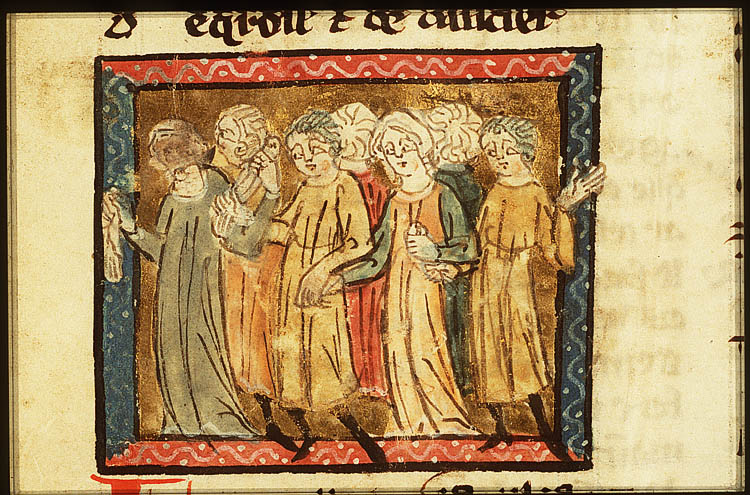

Thus, the idea is that Tomorrow shall be my dancing day is a carol that one can dance to. “Dancing Day” in the text is a reference to the dance around the creche, or dancing on the birthday of Christ. Notice that the speaker/singer of the text is Christ. There is a suggestion that line “To see the legend of my play,” could be a reference to a mystery play and just like the Coventry Carol, this could have been derived from a mystery play. The actor playing Christ singing the verses while the audience would join in with the chorus. Sing, oh! my love, oh! my love, my love, my love, /This have I done for my true love. This creates a delightful image of Christ viewing humankind as his ‘true love’ for whom he was willing to come to earth and go through what the next ten verses describe so well.

Each line of verse one needs a brief explanation:
Tomorrow shall be my dancing day; Sung at Christmas so Christ would start dancing/ be born the next day or perhap speaking about the end of time?
I would my true love did so chance  ‘My true love’ is humankind or perhaps the church – depending on one ecclesiology.
To see the legend of my play, Legend could be story and play could be life or a hint at being part of a mystery play.
To call my true love to my dance; Christ life was to call us – humankind’ to join him in the ‘dance’

The other three verses are more directly descriptive, even if the language is a bit stilted in old-fashioned English. I have already mentioned the last line: “that man may come unto the general dance.” and how this wonderfully summarises the incarnation.
Music
I said above that carol tunes that were in 3/4 time were for dancing. The original ‘Traditional’ tune as it appears in Sandy’s Carols Ancient and Modern is in 3/4 time but in a fairly legato style. John Gardner (1917 – 2011) has written a completely different tune from the original. It has a drum and cymbal accompaniment in the opening and in between the verses with staccato chords on the organ. The verses and choruses are sung unaccompanied. The staccato and dance rhythms make it a very exciting carol to hear.

Here is the carol sung by the Portsmouth Cathedral Choir under the direction of Dr David Price. It is from the CD, Verbum Caro Factum Est: Advent and Christmas from Portsmouth from Herald HAVPCD 407.

Tomorrow shall be my dancing day by John Gardner.

Why did I like this Carol?

The use of the image of dance, of love and the idea of Jesus addressing us directly relating his life (‘dance’) to us and asking us to join in the dance, is a wonderful way of evangelising without bible-bashing and that last line of verse eleven hoping that ‘Man may come under the general dance’ — Thus ‘the general dance’ is revealed to be not only our earthly life with Christ but also the heavenly wedding banquet—as well the literal dance that may have accompanied the finale of the mystery play. The whole concept of the image of dance in religion is the next thing I need to explore!

Musically, its rhythm is what attracted me to this tune. It is vibrant and exciting and certainly makes me, not so much want to dance, but to join in the drum beats by stamping or beating time on the pew in front!

The complete text.
1. Tomorrow shall be my dancing day;
I would my true love did so chance
To see the legend of my play,
To call my true love to my dance;
        Chorus
        Sing, oh! my love, oh! my love, my love, my love,
        This have I done for my true love

2. Then was I born of a virgin pure,
Of her I took fleshly substance
Thus was I knit to man’s nature
To call my true love to my dance. Chorus

3. In a manger laid, and wrapped I was
So very poor, this was my chance
Betwixt an ox and a silly poor ass
To call my true love to my dance. Chorus

4. Then afterwards baptized I was;
The Holy Ghost on me did glance,
My Father’s voice heard from above,
To call my true love to my dance. Chorus

5. Into the desert I was led,
Where I fasted without substance;
The Devil bade me make stones my bread,
To have me break my true love’s dance. Chorus

6. The Jews on me they made great suit,
And with me made great variance,
Because they loved darkness rather than light,
To call my true love to my dance. Chorus

7. For thirty pence Judas me sold,
His covetousness for to advance:
Mark whom I kiss, the same do hold!
The same is he shall lead the dance. Chorus

8. Before Pilate the Jews me brought,
Where Barabbas had deliverance;
They scourged me and set me at nought,
Judged me to die to lead the dance. Chorus

9. Then on the cross hanged I was,
Where a spear my heart did glance;
There issued forth both water and blood,
To call my true love to my dance. Chorus

10. Then down to hell I took my way
For my true love’s deliverance,
And rose again on the third day,
Up to my true love and the dance. Chorus

11. Then up to heaven I did ascend,
Where now I dwell in sure substance
On the right hand of God, that man
May come unto the general dance. Chorus

Sources used:
https://en.wikipedia.org/wiki/Tomorrow_Shall_Be_My_Dancing_Day
http://www.hymnsandcarolsofchristmas.com/Hymns_and_Carols/tomorrow_shall_be_my_dancing_day.htm 
And numerous other bloggers who wrote about this carol
George Herbert: Christmas and ‘The Chord.’

Presently Karen is a member of the Cathedral Evensong Choir as well as the Cathedral Chamber Choir. This means that this Christmas season we have had the Carol Service at 5pm on Christmas Eve and the Orchestral Mass on Christmas Day morning at 10am. As with all choirs there is a last-minute warm-up and rehearsal. We arrive at the Cathedral an hour or more before the service and I am left in the car while she goes to rehearse

This means that I have an opportunity to read while waiting. As the service times approaches, I make my way into the Cathedral. Because of the large crowds at Christmas, I went in at least half-an-hour before the service. To read my ‘whodunnit’ crime thriller in the car park is one thing but to read it in the Cathedral seems inappropriate. So I took along with me two poetry books by well know spiritual poets. 

On Christmas Eve I read some of R. S. Thomas’s poems.  Once again, it was his poem In Church which touched me. I spoke about it before https://dappergeni.co.za/wp/2021/03/18/r-s-thomas-the-east-end-cross/ when I discussed the cross at the east end of St Margaret’s, Fish Hoek.

The next day I took a book edited by Philip Sheldrake, discussing George Herbert poetry. As it was Christmas Day I though it best to look up ‘Christmas’ in the index and found this poem:
The shepherds sing; and shall I silent be?
      My God, no hymn for Thee?
My soul’s a shepherd too; a flock it feeds
      Of thoughts, and words, and deeds.
The pasture is Thy word: the streams, Thy grace
      Enriching all the place.
Shepherd and flock shall sing, and all my powers
      Out sing the daylight hours.
Then will we chide the sun for letting night
      Take up his place and right:
We sing one common Lord; wherefore he should
      Himself the candle hold.
I will go searching, till I find a sun
      Shall stay, till we have done;
A willing shiner, that shall shine as gladly,
      As frost-nipped suns look sadly.
Then will we sing, and shine all our own day,
     And one another pay:
His beams shall cheer my breast, and both so twine,
Till ev’n His beams sing, and my music shine.

Herbert uses a typical conceit of his period as he compares his soul to the shepherds ‘watching their flocks by night.’ His soul shepherds his thoughts, words, and deeds.  His sheep are feed on God’s word and watered by God’s grace. Filled with this heavenly food and drink, both sheep and shepherd sing, out singing the daylight. Their musical theme is ‘one common Lord.’  Just as the winter sun looks dull and sad so Herbert’s singing of the light will outshine the very sun and God the Son’s light shall ‘twine’ with his light, his soul making God’s beam to sing and God’s light making Herbert’s music shine.

Having read that, I sat quietly in the Cathedral then had the privilege of hearing the wonderful Mozart “Spatzen” Mass in C (K220) sung in a liturgical setting.  And, of course, the hymn/carol ‘O Come all ye faithful’ with the wonderful CHORD in the last verse ‘Word of the Father, now in flesh appearing’ which cheered my breast and my music shine.

Footnote:
“The Chord” is an unexpected change of harmony in the organ accompaniment in the last verse of “O Come, All Ye Faithful,” corresponding to the line “Word of the Father.” In the language of music theorists, The Chord is a B half-diminished seventh.  Read more about it and Sir David Willcocks contribution to choral music at:

Poems besides my own. Number: 1 Dictator – Ruthven Todd

Poems can be an expression of faith (e.g. R. S. Thomas) or political attitudes (e.g. so many of the 1930 poets such as W. H. Auden and Ruthven Todd – see below) as well as touching many other emotions.  I remember at school having to learn a certain number of lines of poetry off by heart.  I had just come across my mother’s text book from Rhodes University (1931-34) Twentieth Century Poetry: an Anthology chosen by Harold Munro.  Needless to say, there were copious poems by the poets of the Great War and so in the style of the late 1960s epithet “Make love, not War”, I choose to learn Wilfred Owens’ Dulce et decorum est for my English Oral.  Oh! What a rebel I was!

A few years ago, while helping the late Pat Ellis at one of her Charity Book Sales for Cathedral funds held in large shopping malls, I came across a Penguin Modern Classic, Poetry of the Thirties introduced and edited by Robin Skelton.  It cost me all of R12 and those who remember Pat will know that she insisted on receiving the full amount!

Among the well-known poets such as Auden, Betjeman, Dylan Thomas, C. Day Lewis et al there were quite a few poets I had never heard of including Ruthven Todd.  One of his poems attracted my attention.  It was entitled “Dictator” and written in 1938 I presumed it was speaking about Franco of Spain.  So as an “anti-fascist rebel” (see above), I started studying it.

I have often bought poetry books and read them and thought, “That’s nice,” and left it at that.  I realised I needed to spend time with a poem, not just find a few good metaphors and move on.  I remember my UNISA English lecturer going through a poem with us when I was doing English II in my BA-degree. We responded with amazement that he could see so much more than we could in the poem.  He re-assured us that it was not because he was brilliant but simply that he had read the poem many times, looking for and finding the important lines.  He also read what others had said about it and then put it all into his own words.  So that is what I have decided to do with “Dictator” by Ruthven Todd.  Most of these ideas are my own but with a bit of extra help from google.  It is not meant to be a definitive exposition of the poem but rather a personal exercise in reading and trying to understand more of the poem than a simple surface reading of it.

Dictator               by Ruthven Todd (1938)
From a strange land among the hills, the tall man
Came; who was a cobbler and a rebel at the start
Till he saw power ahead and keenly fought
To seize it; crushed out his comrades then.
His brittle eyes could well outstare the eagle
And the young followed him with cheers and praise
Until, at last, all that they knew – his nights, his days,
His deeds and face were parcel of a fable.

Now in the neat white house that is his home
He rules the flowers and birds just like a king,
And, Napoleon by the sundial, sees his fame
Spread though the garden to the heap of dung;
“All that I do is history,” he loudly cries
Seeing in his shadow his romantic size.

Structure: This poem is in sonnet form being 14 lines long.  However, it is not in iambic pentameter format and its rhyming scheme is ABBA ABBA CDCDEE so it is a neither a true Petrarchan (usually ABBA ABBA CDCDCD) or Shakespearian sonnet (usually ABAB CDCD EFEF GG).  The octet part is Petrarchan while the sextet resembles the Shakespearian form with the rhyming couplet at the end tying up what went before.  There is a distinct break and change of direction between the octet and the sextet.

Message of the Poem: It seems to be telling the reader that politicians in their seeking of power crush those who are both friends and foe.  Young supporters cheer him on and refuse to see his faults and weaknesses; the stories about him become the sole source of who he is.  In the final six lines, a complete change of feeling, where his insignificance (now only ruling “the flowers and the birds”) is shown but he starts believing his own fables “All that I do is history”.  His power is merely the sun’s shadow made to look long and large so that even someone short like Napoleon (or Franco) appears tall.

Some questions on use of words and images which I need to explore more:

  1. Why ‘Strange ‘ land?  Perhaps the poet is contrasting the strangeness of the rural areas (…among the hills) with the urban – where power normally is found
  2. Why ‘Tall’ man? I think the poet is contrast the Dictator’s actual height with the shadow appearing tall in the sextet.  Interestingly, Napoleon (1.68m), Hitler (1.75m) and Franco (1.63m) were all fairly short men.
  3. Why ‘a cobbler’?  Cobblers in fairy stories were usually normally poor but hardworking individuals and also fairy stories were frequently the ‘victim’ of the evil villains.
  4. Why are his eyes ‘brittle’?  Brittle dictionary definition is ‘hard but likely to break’.  Dictatorships are often brittle.  Here the Dictator could outstare the eagle, the symbol of government in many countries at that time.   
  5. Why does the poet use the image of ‘parcel of a fable’?  – Perhaps they were all part of a ‘package deal’ but not real (a fable), or is it perhaps that the truth/reality is wrapped up so the onlooker cannot see what it contains and all they see is “a fable.”
  6. Why ‘neat white house’?  Napoleon’s house in St Helena was white and neat.  White is also a sign of purity.  Notice how the dictator is now in a house and no longer in a palace. 
  7. Why does the poet uses the word ‘Neat’ to describe the house of exile?  It implies that the overthrow of the dictator is ‘done and dusted’ – thus all neatly packaged up.  Neat also indicates efficiency.  The dictator is no longer in control of the nation but merely his exile-home.  Dictators were reputed to get a nation to run efficiently.   We were always told in history classes how Mussolini got the trains to run on time in Italy.
  8. Why does the poet use the word romantic?  The poet use ‘romantic’ to imply that all the dictator can see is his own “idealised view of reality”, which is a dictionary definition of romantic.

If I were to give a simple one sentence meaning of this poem I would say:  Leaders who seize power as dictators are filled with hot-air. They have ideals but do not have awareness of the reality of a situation.

I saw a comment in a blog in 2012 where the blogger, who had supported Obama in 2008, felt that Obama had done nothing of what he had promised to do.  As the Blogger says: “The Idea of Obama is more powerful than the Reality of Obama has ever been.”  So too with dictators the idea is more powerful than the reality.   Or is that, with dictators, ‘threat’ rather than ‘idea’?

As I said above, this might be a completely wrong interpretation of this poem.  If you think so, why don’t you make a comment below.


R. S. Thomas & The East End Cross

I was recently asked if I would like to contribute to a special edition of St Margaret’s Times dealing with memories. I suppose if I thought about it, I have so many little episodes worth recalling. But usually these memories need a cue of some sort to get them going. Without that it is hard to creatively recall some special event. So I submitted this short piece, blending what I had been reading at the time (poems by R. S. Thomas) with an event that this poem reminded me of.

The East End Cross
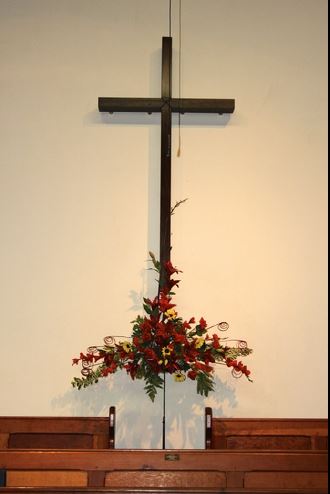
Above the choir stalls on the liturgical east end of St Margaret’s is a large wall-mounted blank cross.  It was placed there during the rectorship of Bishop John Carter and at that time I was a lay-minister and served as a parish councillor and therefore I was involved in the decision to ask for a faculty for the design and the placement of this cross.

I was reminded of this a few weeks ago.  I was listening to the live-streamed service from Christchurch Cathedral, Oxford.  The preacher began her sermon quoting from a poem by the Welsh Anglican priest and poet, R. S. Thomas.  My immediate response was to try and find the poem in my small volume of selected verses by R. S. Thomas.  I couldn’t find that poem but did find one entitled In Church which attracted my attention and gave me a few hours of joy as I analysed its use of metaphors, similes and under-stated theology.  It was the last few lines that ‘shocked’ me.  Thomas, as the narrator speaks of seeking God in the silence of the empty church and he ends:

There is no other sound
In the darkness but the sound of a man
Breathing, testing his faith
On emptiness, nailing his questions
One by one to an untenanted cross.

On the first reading of these lines, I was shocked that a man-of-God, a priest, should believe that his faith was ‘empty’ and that Christ was not there to answer his questions.  But then I remembered that cross on the East wall at St Margaret’s and Bishop John’s comments as we discussed its placement.  Bishop John said that he intentionally asked the architect to design a cross without the body of Christ on it.  In many churches and cathedrals, we see the crosses behind the altar with a corpus on it but Bishop John said that a cross showing the suffering of Jesus on the cross should hang above the pulpit. ‘We preach Christ crucified,’ he said, ‘but celebrate the Risen Christ at the altar and so that cross should be bare.’ This is what makes those last two lines of R. S. Thomas’s poem into a paradox.  When we are feeling down, and who isn’t during lock down when we cannot be In Church the way Thomas speaks about, then the cross might appear to us to be empty or ‘untenanted’ but it is ‘untenanted’ because of Easter, because of the resurrection of Christ who is with us all the time wherever we are.  So be encouraged as you worship, not In Church but perhaps at home, that Christ has risen and Christ will answer your question of faith.

Poetry No. 2: Children’s Toys

From 28 Dec until 2 Jan, Karen and I were joined by our daughter Kate and her husband Alan at Blue Bay Lodge in Saldanha Bay.   Also, there was, of course, Elias our grandchild.  The first afternoon we spent time down at beach, literally ten yards from our chalet. It was lovely to go into what Elias was calling “Wa..”  the warm seawater.  Then, that night, President Ramaphosa had a “family meeting,” as he rather cutely calls his addresses to the nation during this pandemic.  At the “family meeting” he told us that all the beaches in the Western Cape (including Saldanha Bay) were closed.  So, although Elias could point to the sea water ten yards away and say “Wa…” we could not take him down to it.

The resort’s swimming pools were still open but for an eighteen-month-old, it meant someone had to get into the pool with him and if slightly older children came to the pool and splashed about too much, he was not so happy.  That meant we had to entertain him with the toys he had brought from home but also with the numerous toys he made himself from the pots and containers filled with tap-water or “Wa…” being poured from one container to another, being mixed with sand from the beach and making mud pies.  These makeshift toys seemed to be much more fun that expensive toys he got for Christmas.

Elias with some watermelon… note beach bucket and ice cream container in the background… the BEST toys on this holiday!

All this made me think of a time our family was at Holy Redeemer, Sea Point and I wrote this poem:

Urban Street Scene I
I saw a man
Going through our rubbish-bin today.
At the very bottom,
Amongst the potato peels and empty cans,
He found…
A yo-yo.

He took it out and looking at it closely,
Letting his fingers run along the string.
He carefully wound it up,
And then, looking up and down the busy street,
Hoping no one was looking,
He tried it out.

Down it went.
But there it stayed.
Refusing to come up again.

He glared at it,
Then threw it back,
And moved off to the next door’s bin.

The child in us never dies.
The joyful desire to see a yo-yo
Dropping and rising
At the tweek of a finger,
Is as present in that old man
As it is present in me.
I wanted to run out to the pavement
And dance with him around the rubbish bins,
Those magic toadstool in the garden of urban and eternal youth….
But the Adult in me said ‘No!’

23 February 1996.   

Poetry No. 1: Re-discovered

Poetry No 1: Re-discovered

I am busy removing old files from my computer.  Most of them are in a folder carrying the vaguely general title of ‘Church’ with numerous subfolders such as ‘Parish Council’, ‘Liturgy’ and ‘Sermons’.  Do I really need to keep all the sermons I’ve preached since 2010?  (That was the last time my hard drive crashed and I had not backed-up such items as sermons.)  ‘Maybe… You never know, I might be asked to preach on the 27th Sunday after Pentecost and I could simply lift the sermon I preached in 2011 and use that.’  But reading through such ancient old sermons you realise that most sermons are definitely time-bound.  What was happening in 2011 is not the same as what is happening in 2020 or 2021.  I say that as a historian and it is us historians who constantly say that history repeats itself!  

I remember as a server at St Margaret’s, Fish Hoek in the early 1960, I was the only server willing to serve on the third Sunday of the month when retired Bishop Basil Peacey used to be the celebrant and preacher.  I loved serving for him at the Eucharist because he was so High Church Anglo-Catholic.  Genuflecting at what I now know through Ritual Notes1 to be the right places, saying the Last Gospel (genuflecting at the words ‘made flesh and dwelt among us’, of course!), doing the preparation from a printed card which included a confession and the saying the antiphon I will go unto the altar of God : even unto the God of my joy and gladness.  Oh, it was so exciting and colourful and rebellious among the rather staid broad-church congregation of St Margaret’s then!  I must admit that his sermons were long and hard to follow because he spoke in such the strange modulating tone of a very old man.  I wonder how old he was?  He was made a deacon in 1913 and let us say he was 25y old then that would make him born 1888.  In 1966 he would be about 78y!  During the Preparation he was so hard to follow as we servers knelt on either side of him.  Fortunately, we only had to say something after he had beaten his chest at the confession so we could catch up at that point.  One Sunday after the service, as I was clearing away the sacred vessels and setting up the tray for the next Eucharist on Tuesday morning, Bishop Peacey was disrobing and he took his sermon notes and tore them up and threw them into the wastepaper bin.  “This is where most sermons belong” he said smiling at me as he did it.

While talking about Bishop Peacey, I feel should mention two other things.  The first is personal and occurred when I was in Std 8 (now Grade 10).  I was sixteen years old.  He said to me.  ‘Young man, have you ever thought about becoming a priest?’  I was at that time into the Anglo-Catholic novels of authors such as Ernest Raymond (Tell England, My Brother’s Keeper etc.)  and Compton Mackenzie (Altar Steps) and I had thought how wonderful it could be if I could become a priest and celebrate the Communion as Bishop Peacey did, with bells and smells and all the ceremony and the choir singing the setting by John Merbecke.  I feel that I had reached heaven!  So, I answered, ‘Yes’.  ‘How is your school work,’ the Bishop asked me.  I told him my not-so-good marks.  He responded, ‘If you want to become a priest you will have to work much harder!’  I cannot say that his comment put me off and it certainly wasn’t what cause delay of any further exploration of my vocation for some twenty-four years, but that is another story.  I greatly admired Bishop Peacey and it was only later while doing Church History through university in the 1990s that I read Alan Paton’s book on Archbishop Geoffrey Clayton2 which speaks of Bishop Peacey’s strong pro-Apartheid views.  R. R. Langham-Carter, in his booklet on the history of the Parish of Christ Church, Constantia3 speaks of Bishop Peacey being rector there from 1941.  His wife was pro-German and he would not allow prayers to be said for those away serving in the Allied forces.  He also believed that the Constantia parish was a ‘Coloured’ parish and he asked the white parishioners to go elsewhere, though not all followed his request.  By the time I knew Bishop Peacey, some 25 years later, I saw none of this nor knew about it until my reading came across it, well after he had died.

I have drifted off the reason for writing this blog-essay.  So back to me clearing my computer hard drive.  As I was wiping off unwanted files and folders from my hard drive I came across a folder called ‘Poems’.  I re-read the poems I wrote in the 1990s, especially those I wrote while at the College of Transfiguration and the year immediately after it.  It is strange to re-read about how one felt twenty-five years previous.  I kept on thinking: “Did I write that! It’s too good! Wow!”  or “It’s too bad!  Let me destroy it!”  Most of these poems were captured in my Spiritual Journal and then typed out on my PC.  But why did this poetry writing stop in 1996?

I was thinking about this the other night when I woke up in the middle of the night.  I came up with a reason but I think there are a multitude of reasons and perhaps this is the simplest and least threatening to me.  My life as a Medical Laboratory Technologist had become routine.  Oh, yes, exciting things were happening – birth of Nick and Kate being the most important but then my decision to allow myself to hear what God was saying to me about my vocation to serve God as a priest and then the church’s acceptance of that call, put me into a transitional zone, a liminal space.  Into this space I started writing poems that expressed my feeling and emotions at that time, responding to things that were happening around me.  The first batch of poems disappeared in some hard-drive crash or other but once at College where my time was no longer routine like going to the laboratory to work and coming home again, but rather ordered in a very monastic-type of way, allowing me time to think and write, which I had to do as I was doing BTh(hons) at Rhodes University and had to produce an essay a week.  This liminal space within continued into my deacon year and up to my ordination as a priest.  Then my poetry writing ceased.  I think what happened is that I was now back into a regular routine of sermon-writing, visiting, chairing parish meetings etc. I was comfortable with it and so the discomfort of my liminal space disappeared.

Going through later spiritual journals I find plenty of recorded quotation that moved me, plenty of entries at the start of a retreat saying it would be great if I could be inspired to write a poem again.  But very few if any poems appear.

Now, at this time, the routine of running a parish has been removed from me and so I’m sitting down and writing again.  Not sermons, nor poetry, but essay-type scripts expressing my feelings and emotions in prose rather than poetry.  The academic writing of my Master’s thesis (completed in 1997) and the editorship of the Cape Town Family History Society’s Newsletter (since 2010) has perhaps resulted in me approaching writing in a more ‘academic’ way, ensuring that all quotes and references are duly foot-noted.  Not conducive to the writing of verse!

I said above that as I looked at some of my poems I thought, ‘This is much too good for me to have written, surely it is a quote from someone else.”  I’m not saying the poems are brilliant but maybe someone else might be moved by them so I’m going to place on this blog every so often a poem from my collection which I think you, the reader, might enjoy.  I will title these blog entries as “Poem No. xx”  and beside giving the verse I might need to set the context in which it was written and I’ll place in the blog entry too. 

Let me give you a taster. 
These lines were written during a Saturday Quiet Day, during the time we were sent away to meditate

In the College Garden on a Quiet Day
The sound drifts up from the valley below,
The rustle of trees, doors being opened and closed,
The ‘sprong’ of well-struck tennis-balls,
The laughter of sportsmen preparing for their match,
And above, through and gently over these….
The sound of a meandering flute being practised
somewhere in the stillness below.

[4 June 1994]

I remembered this poem some twenty years later when I joined a group of Cape Town Clergy to lecture at COTT for a week.

Then and Now
Twenty years ago,
on a Saturday afternoon,
the sound of a flautist practising
came drifting up towards the college.
It was a quiet day,
and I was wandering in the garden.
The sound touched my inner being,
forcing me to capture the moment in verse.

Tonight, staying in nearby staff accommodation
I hear the sound of marimbas practising.
It drifts up a block and a half
yet takes me back twenty years.

By tomorrow I’ll be home,
but those around me will still be here
in their same positions in the Chapel.
Silent in meditation.
It is just like it was twenty years ago,
all that has changed are the faces.

[2014.  Grahamstown]

  1. E. C. R. Lamburn. Ritual Notes (London: W Knott & Son Limited, 1964 []
  2. Alan Paton, Apartheid and the Archbishop: the life and times of Geoffrey Clayton.  (Cape Town: David Philip, 1983) []
  3. R. R. Langham Carter, Among the vineyards: the story of Christ Church, Constantia (Constantia: Christ Church Parish, no date) []