Poetry No. 1: Re-discovered

Poetry No 1: Re-discovered

I am busy removing old files from my computer.  Most of them are in a folder carrying the vaguely general title of ‘Church’ with numerous subfolders such as ‘Parish Council’, ‘Liturgy’ and ‘Sermons’.  Do I really need to keep all the sermons I’ve preached since 2010?  (That was the last time my hard drive crashed and I had not backed-up such items as sermons.)  ‘Maybe… You never know, I might be asked to preach on the 27th Sunday after Pentecost and I could simply lift the sermon I preached in 2011 and use that.’  But reading through such ancient old sermons you realise that most sermons are definitely time-bound.  What was happening in 2011 is not the same as what is happening in 2020 or 2021.  I say that as a historian and it is us historians who constantly say that history repeats itself!  

I remember as a server at St Margaret’s, Fish Hoek in the early 1960, I was the only server willing to serve on the third Sunday of the month when retired Bishop Basil Peacey used to be the celebrant and preacher.  I loved serving for him at the Eucharist because he was so High Church Anglo-Catholic.  Genuflecting at what I now know through Ritual Notes1 to be the right places, saying the Last Gospel (genuflecting at the words ‘made flesh and dwelt among us’, of course!), doing the preparation from a printed card which included a confession and the saying the antiphon I will go unto the altar of God : even unto the God of my joy and gladness.  Oh, it was so exciting and colourful and rebellious among the rather staid broad-church congregation of St Margaret’s then!  I must admit that his sermons were long and hard to follow because he spoke in such the strange modulating tone of a very old man.  I wonder how old he was?  He was made a deacon in 1913 and let us say he was 25y old then that would make him born 1888.  In 1966 he would be about 78y!  During the Preparation he was so hard to follow as we servers knelt on either side of him.  Fortunately, we only had to say something after he had beaten his chest at the confession so we could catch up at that point.  One Sunday after the service, as I was clearing away the sacred vessels and setting up the tray for the next Eucharist on Tuesday morning, Bishop Peacey was disrobing and he took his sermon notes and tore them up and threw them into the wastepaper bin.  “This is where most sermons belong” he said smiling at me as he did it.

While talking about Bishop Peacey, I feel should mention two other things.  The first is personal and occurred when I was in Std 8 (now Grade 10).  I was sixteen years old.  He said to me.  ‘Young man, have you ever thought about becoming a priest?’  I was at that time into the Anglo-Catholic novels of authors such as Ernest Raymond (Tell England, My Brother’s Keeper etc.)  and Compton Mackenzie (Altar Steps) and I had thought how wonderful it could be if I could become a priest and celebrate the Communion as Bishop Peacey did, with bells and smells and all the ceremony and the choir singing the setting by John Merbecke.  I feel that I had reached heaven!  So, I answered, ‘Yes’.  ‘How is your school work,’ the Bishop asked me.  I told him my not-so-good marks.  He responded, ‘If you want to become a priest you will have to work much harder!’  I cannot say that his comment put me off and it certainly wasn’t what cause delay of any further exploration of my vocation for some twenty-four years, but that is another story.  I greatly admired Bishop Peacey and it was only later while doing Church History through university in the 1990s that I read Alan Paton’s book on Archbishop Geoffrey Clayton2 which speaks of Bishop Peacey’s strong pro-Apartheid views.  R. R. Langham-Carter, in his booklet on the history of the Parish of Christ Church, Constantia3 speaks of Bishop Peacey being rector there from 1941.  His wife was pro-German and he would not allow prayers to be said for those away serving in the Allied forces.  He also believed that the Constantia parish was a ‘Coloured’ parish and he asked the white parishioners to go elsewhere, though not all followed his request.  By the time I knew Bishop Peacey, some 25 years later, I saw none of this nor knew about it until my reading came across it, well after he had died.

I have drifted off the reason for writing this blog-essay.  So back to me clearing my computer hard drive.  As I was wiping off unwanted files and folders from my hard drive I came across a folder called ‘Poems’.  I re-read the poems I wrote in the 1990s, especially those I wrote while at the College of Transfiguration and the year immediately after it.  It is strange to re-read about how one felt twenty-five years previous.  I kept on thinking: “Did I write that! It’s too good! Wow!”  or “It’s too bad!  Let me destroy it!”  Most of these poems were captured in my Spiritual Journal and then typed out on my PC.  But why did this poetry writing stop in 1996?

I was thinking about this the other night when I woke up in the middle of the night.  I came up with a reason but I think there are a multitude of reasons and perhaps this is the simplest and least threatening to me.  My life as a Medical Laboratory Technologist had become routine.  Oh, yes, exciting things were happening – birth of Nick and Kate being the most important but then my decision to allow myself to hear what God was saying to me about my vocation to serve God as a priest and then the church’s acceptance of that call, put me into a transitional zone, a liminal space.  Into this space I started writing poems that expressed my feeling and emotions at that time, responding to things that were happening around me.  The first batch of poems disappeared in some hard-drive crash or other but once at College where my time was no longer routine like going to the laboratory to work and coming home again, but rather ordered in a very monastic-type of way, allowing me time to think and write, which I had to do as I was doing BTh(hons) at Rhodes University and had to produce an essay a week.  This liminal space within continued into my deacon year and up to my ordination as a priest.  Then my poetry writing ceased.  I think what happened is that I was now back into a regular routine of sermon-writing, visiting, chairing parish meetings etc. I was comfortable with it and so the discomfort of my liminal space disappeared.

Going through later spiritual journals I find plenty of recorded quotation that moved me, plenty of entries at the start of a retreat saying it would be great if I could be inspired to write a poem again.  But very few if any poems appear.

Now, at this time, the routine of running a parish has been removed from me and so I’m sitting down and writing again.  Not sermons, nor poetry, but essay-type scripts expressing my feelings and emotions in prose rather than poetry.  The academic writing of my Master’s thesis (completed in 1997) and the editorship of the Cape Town Family History Society’s Newsletter (since 2010) has perhaps resulted in me approaching writing in a more ‘academic’ way, ensuring that all quotes and references are duly foot-noted.  Not conducive to the writing of verse!

I said above that as I looked at some of my poems I thought, ‘This is much too good for me to have written, surely it is a quote from someone else.”  I’m not saying the poems are brilliant but maybe someone else might be moved by them so I’m going to place on this blog every so often a poem from my collection which I think you, the reader, might enjoy.  I will title these blog entries as “Poem No. xx”  and beside giving the verse I might need to set the context in which it was written and I’ll place in the blog entry too. 

Let me give you a taster. 
These lines were written during a Saturday Quiet Day, during the time we were sent away to meditate

In the College Garden on a Quiet Day
The sound drifts up from the valley below,
The rustle of trees, doors being opened and closed,
The ‘sprong’ of well-struck tennis-balls,
The laughter of sportsmen preparing for their match,
And above, through and gently over these….
The sound of a meandering flute being practised
somewhere in the stillness below.

[4 June 1994]

I remembered this poem some twenty years later when I joined a group of Cape Town Clergy to lecture at COTT for a week.

Then and Now
Twenty years ago,
on a Saturday afternoon,
the sound of a flautist practising
came drifting up towards the college.
It was a quiet day,
and I was wandering in the garden.
The sound touched my inner being,
forcing me to capture the moment in verse.

Tonight, staying in nearby staff accommodation
I hear the sound of marimbas practising.
It drifts up a block and a half
yet takes me back twenty years.

By tomorrow I’ll be home,
but those around me will still be here
in their same positions in the Chapel.
Silent in meditation.
It is just like it was twenty years ago,
all that has changed are the faces.

[2014.  Grahamstown]

  1. E. C. R. Lamburn. Ritual Notes (London: W Knott & Son Limited, 1964 []
  2. Alan Paton, Apartheid and the Archbishop: the life and times of Geoffrey Clayton.  (Cape Town: David Philip, 1983) []
  3. R. R. Langham Carter, Among the vineyards: the story of Christ Church, Constantia (Constantia: Christ Church Parish, no date) []

St Paul’s Rondebosch Response to Spanish Flu

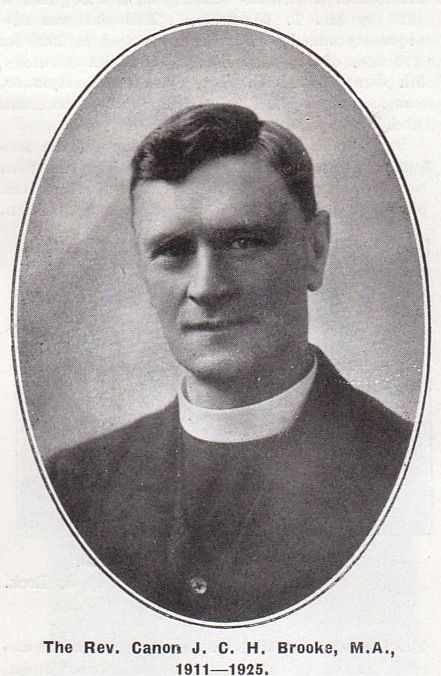
The Rev. John Brook

The following extracts come from S. Paul’s Record, November 1918 Edition.

The Rector’s Letter
My Dear Friends and Parishioners,
Only one has occupied our minds during the past month, and that is epidemic of “Spanish Influenza.” Unseen, but swift as the wind, it swept over the whole country, and has left behind it such a legacy of sorrow that this beautiful month of Spring will always be remembered as the Black October of 1918. Everything had to give way before it. The arrangement of “Our Day”, so splendidly organised and copiously advertised, went to pieces. Business was brought almost to a standstill. Every home was affected by it. In most cases the servants were the first to be taken ill, and either went home or had to be nursed by their employers, while the housework had to be done by members of the family, who soon fell victims themselves to this treacherous sickness. The ordinary work of the parish ceased, and all the energies of those who were well and could be spared from their homes were devoted to the work of tending the sick, feeding the hungry, trying to save the dying. or helping the bereaved to bury their dead.

I am deeply grateful to all those who worked so splendidly in Rondebosch and on the Flats, and helped to save many lives by providing them with proper nourishment and giving them valuable advice and attention. At a time when it was possible for the clergy to visit only the most urgent cases, it was a very great relief to them to know that the bodily needs of all the poorer people were being attended to daily, either at the various depots or at the house of the sick. As you will see from the list of burials at the end of this issue, the mortality in this parish has been terrible, especially among the poorer parishioners. At Black River no less than five of one family died in a week. One of our old coloured parishioners of Rondebosch, Alfred Adams lost two sons, a daughter, and a son-in-law, one of the sons and the daughter being married and leaving behind several young children. The verger at S. Paul’s lost a son of 15, and the verger of S. Thomas’s a daughter of 20. One of the saddest deaths was that of choir boy of S. Paul’s, Jack Andrews, at the age of ten years. On behalf of the parish I wish to convey to the bereaved parents, in each of the above cases, our heart-felt sympathy. It is difficult express adequately our sympathy for Mr and Mrs Roper in their great sorrow. Their eldest daughter seemed to be going on well, when collapse came suddenly, and in a few hours she was called to her eternal rest. The shock to her family was accentuated, too, by the fact that she died at a time when help was unobtainable from those who ordinarily arrange the details of a burial. May God in His infinite mercy help and comfort her sorrowing family and those thousands who have been plunged into mourning by this terrible visitation.

I am sorry to have to refer to finance in this letter, but I am afraid that I must do so, as the parish has been reduced to a very serious position by the epidemic. During October the Church collections have been about a quarter of the average for a month, for the Sunday congregations were the smallest on record. The Mission Schools have been closed, and so no school fees have come in. And as the parents pay by the week, and only then if their children have been to school that week, the school fees that ought to come in during October are irretrievably lost. But the teachers’ salaries must, of course, be paid in full, as usual. And the income for the General Purposes Fund during October will be very small, as many of the collectors and subscribers have been ill, and home expenses have been heavy. The consequence is that in order to pay stipends, salaries, and other current expenses, the Churchwardens have been compelled to overdraw to the extent of £75. We must somehow make this amount good before the end of the year, as well as pay the next two months’ expenses. I would therefore make an earnest appeal to all who were absent from Church during October to bring with them, next time they are able to attend the House of God, the offerings that they would have made each Sunday if they had been in church. And I would suggest that all who have been spared an attack of this treacherous sickness, and those who have safely recovered their health, should endeavour to make a worthy thanksgiving to Almighty God for His “late mercies vouchsafed unto them.”

I am your faithful friend and Rector

J.C.H. Brooke
—————————-
Notes on the Epidemic

As soon as it was realised that a large number of the poorer parishioners were ill with “Spanish Influenza”, Mrs Currey, of “Welgelegen” very kindly sent a large quantity of milk daily to the Rectory for distribution. The demand soon began to exceed the supply, even though the latter was supplemented from another source. Just in time the public depot at the Town Hall was opened and put in working order with wonderful promptitude and the milk from “Welgelegen” was sent elsewhere to those who needed it. Mrs Cripps and her band of helpers lost no time in making Rondebosch Town Hall a centre of relief and a blessing to the neighbourhood. Medicines, soup, and milk for the sick, and food for the families thrown out of employment or rendered destitute and helpless by sickness, were served daily to very large number of applicants, The suburb was divided into districts, and all the houses of the poor were visited daily by ladies, who brought nourishment and medicine to those who were unable to send for them, and who gave valuable help and advice to the sick and those of their friends who were nursing them. Scarcely any poor were able to secure the services of a doctor, though, when the seriousness of the situation was realised, Dr Parson and Dr Galpin, who years ago retired from practice, kindly turned out and attended all whom they had time to see. Even so, in the first ten days of the epidemic many poor people died without comfort of seeing a doctor. At first the City Corporation provided for only one Relief Depot in this parish, at the Town Hall, and so some of the ladies of the parish, Mrs Cronwright, Mrs Peters, and Mrs Nimmo Brown, with the help of other parishioners, opened a depot for Black River at the Klipfontein Hall (formerly a slaughter-house, now kindly lent to us by the Imperial Cold Storage Co. for parish purposes). Almost as soon as it was opened, the City Hall authorities made themselves responsible for all the expenses incurred in connection with its maintenance .

Meanwhile the state of things at Milner (i.e. West London) was most serious, and Mr Floyd made urgent representations to the authorities. As soon, therefore, as Mr Sawkins had completed his arrangements for the Rondebosch Town Hall, he paid a visit to Milner with Mr Floyd. The Wesleyan Church building, being central and near the hard road, was chosen as the most suitable place for a depot, and the Wesleyan authorities very kindly at once agreed to lend it, and gave every facility to the workers. Miss Hall, Miss Parson, and Miss Syfret, soon established a soup kitchen there, with medicines, etc., for all applicants. Mr Floyd was given authority by the City Corporation to issue bread, meat, and other necessaries to those who were in urgent need. Both at the Black River and Milner, and later at Welcome Estate, he organised a committee of coloured men and women to visit from house to house in their district. He selected the most respected and reliable persons for this purpose, those who knew the coloured people and could best judge their needs.

From further down the Flats came reports of sickness, helplessness, and destitution, and on the second Sunday in October Mr Floyd was able to establish another depot at Welcome Estate some five or six miles from Rondebosch Town Hall. The Black River Depot being in full running order, Mrs Peters and Mrs Nimmo Brown were able to leave it in Mrs Cronwright’s hand, and they transferred their energies to organizing and carrying on the Welcome Estate Depot. In this they were devotedly assisted by Mr Nimmo Brown. This served the people at Rylands Estate and for miles around, food, etc., being carried on foot or by the motor-car to people as far as ten miles down the Cape Flats.

This work could not have been carried on if Mr Hartford of “Elwyngor”, Silwood Road, had not been so thoughtful and kind as to place his motor-car entirely at the disposal of the workers. Every day they were taken to their depot and brought back by car, and incidentally Mr Hartford’s car relieved the Rector and Mr Floyd of some their longer bicycle rides to Maitland Cemeteries and down the Flats. The Rector is also very grateful to Mr L. Spilhaus for taking him on a round of visits one night after a long and tiring day on his bicycle.

When anyone in this parish dies without having been attended by a doctor in his last days the body has to be removed to Wynberg for a post-mortem examination by the District Surgeon. By October 7th this rule has been suspended, as more than half of them who were dying of pneumonia had not been able to see a doctor’s attention. Mr Floyd was appointed a Registrar of Deaths in those districts, and from early in the morning his house and the Rectory were besieged by those wanting burial orders, coffins and graves. From October 7th it was especially impossible for the poorer people to get a coffin from undertakers and even some of those who are well-to-do found themselves in the same dreadful situation. The City Corporation realised the position of this just in time, and placed large orders with firms who employed carpenters. The Rector made representations to our local City Councillor, Mr Sawkins, who immediately got a dozen coffins from the City Hall, and saw that a sufficient supply was sent daily to the Rondebosch Town Hall and the Relief Depot at West London. These are gruesome details, but they help one to realise what an extraordinary time we have been passing through.

The Cemetery at Black River was originally secured for the Church people of that Mission Station, and by them it was fenced in and put in order. Since then, as the Flat became populated, it was thrown open to Church people in our other mission stations at Milner and Rylands Estate. This epidemic, however, produced a sudden congestion at the Maitland Cemetery Office in Capetown. It was besieged to such an extent that sometimes it took hours for the bereaved to get into the office and purchase a grave. And even then, when the funeral at last arrived at Maitland No.3 (the cemetery of the poor), there was more congestion and a long delay before anyone could be found to point out which was the right grave. Accordingly the Rector and Mr Floyd decided to suspend the rule limiting the right of burial in Black Cemetery to Church people who lived on the Flats, and it was thrown open to people of all denomination in the parish. Several additional gravediggers were engaged with orders to dig graves all day long. At 5 o’clock each day the funerals began, when Mr Floyd had finished his work at the Depots. When possible after his return from Maitland, the Rector went to assist him at Black River Cemetery.

Over 150 burials took place there in three weeks where the monthly average is about six or seven. This little cemetery has been rapidly filling up, and we shall have to endeavour to enlarge it by securing some of the adjacent vacant ground. A glance at the list of burials at the end of this issue will show that it makes an interesting, if terribly sad “barometer” of the epidemic.