Christmas Day Reflection: What Sweeter music… than a carol…

I recently became a follower on twitter of a person who goes by the name of “In quires and places where they meme“.  For older readers who don’t know what a meme is Wikipedia will tell you it is an image, video, piece of text, etc., which is typically humorous in nature, and is copied and spread rapidly by internet users, often with slight variations.  Hence the writer’s name is not “In quire and places where they sing” but …where they meme.

In quires and places where they meme has been having a thread of tweets entitled ‘Harkageddon’.  Its object is to go as long as possible without hearing or singing “Hark! The herald Angels sing”.  The game ends, the tweet assures us at midnight on 24 December.  The last Christmas that I celebrated as a parish priest was in 2019 at St Francis in Simon’s Town.  I asked them whether they found Christmas Carols a blessing or a curse?  I proudly told them after the 9:30 service on Christmas morning I would have sung Hark the herald Angel sing five times.  It has a high tessitura because it is proclaiming an exciting event and by the end of the third verses my throat is all tensed up and I’m wondering if I will ever speak again!  So, I was quick to sign up for Harkageddon!

Carols are not all loud proclamations. Unfortunately, in 2021 we all have to be home by midnight in SA, so Midnight Mass is started at 9pm!  But usually among the carols sung at midnight are some softer quiet ones expressing the wonderful fact that God is born as a vulnerable human baby here on earth, in Bethlehem.  And is asleep in a manger, no crib for a bed.   When Jesus ascended to heaven, when he returned to the Father it was in bodily form apparently on a cloud, but when he came, he came, as the early anonymous carol says…

He came all so still
Where His mother was,
As dew in April
That falleth on the grass.

He came all so still
Where His mother lay,
As dew in April
That falleth on the spray.

He came all so still
To His mother’s bower,
As dew in April
That falleth on the flower.

Mother and maiden
Was never none but she!
Well might such a lady
God’s mother be. 

Carol: I sing of a maiden Music: Patrick Handley Chorister of Ely Cathedral

And that Baby was placed in a manger in Bethlehem, just as the Baby Jesus lies in a manger in our home nativity scenes we have on display.  What we have to realise is that although Christmas commemorates the birth of a baby, as T. S. Eliot says so clearly in The journey of the Magi : ‘There was a Birth, certainly, We had evidence and no doubt.  I had seen birth and death but thought they were different; this Birth was hard and bitter agony for us, like Death, our Death.’ 

I believe that we cannot just celebrate a baby being born at Christmas.  We have to celebrate Jesus’ whole life.  Before Charles Dickens came along and sentimentalised Christmas, early medieval carols did this very thing.

A babe is born I wys,
This world to joy and bliss,
His joy shall never fade and miss,
And Jesus is his name.

On Christmas day at morn,
This little child was born
To save us all that were forlorn,
And Jesus is his name.

On Good Friday so soon
To death He was all done,
Betwixt the time of morn and noon,
And Jesus is his name.

On Easter Day so swythe
He rose from death to life
To make us all both glad and blithe,
And Jesus is His name.

And on Ascension Day
To heaven He took His way,
There to abide for aye and aye,
And Jesus is His name.

A Babe Is Born I Wys (After an English Carol from 15th Century) Music: Edgar Bainton. Choir of King’s College, Cambridge · David Willcocks

I remember many years ago after the Choir had sung carols such as that last one at their Carol Service, my mother said to me; “Why can’t we sing the good old favourite carols and not these peculiar medieval ones.”  Well, we can and we do, at least five times in the week before and maybe even after Christmas Day.   And some of these old favourites have wonderful verses in them that we can and should memorise and use as short prayers every day and not just at Christmas.  Like the last verse of O Little town of Bethlehem
O holy Child of Bethlehem,
   descend to us, we pray;
cast out our sin, and enter in:
   be born in us to-day.
We hear the Christmas angels,
   the great glad tidings tell:
O come to us, abide with us,
our Lord Emmanuel.

Or equally as attractive the last verse of Christina Rosetti’s In the Bleak Midwinter.  In the third line of the first verse, she sounds as if she has run out of ideas: “snow had fallen, snow on snow, snow on snow,” but then in the final verse comes the sublime:
What can I give him, poor as I am?
If I were a shepherd, I would bring a lamb;
if I were a Wise Man, I would do my part;
yet what I can I give him: give my heart.

When I was at Theological College in Grahamstown, I was in the Fort England Module.  Every Saturday we went up to Psychiatric Hospital and took communion to the those mainly in the dementia word.  Every Saturday one patient used to ask, “Can I prayer please?” Of course, we said yes and each week he said:
What can I give him, poor as I am?
If I were a shepherd, I would bring a lamb;
if I were a Wise Man, I would do my part;
yet what I can I give him: give my heart.

Carols?  A Blessing or a curse?  I suppose hearing in shopping malls Boney-M singing repeatedly Mary’s Boy Child at a loud volume will make even the most holy of us curse!  Man will live for evermore because of Christmas Day say the lyrics.  Yes, indeed that is the right theology even if the language is a heavily patriarchal!  The coming of the Baby Jesus, his growing up, his teaching, his death, resurrection and ascension, have turned everything upside down.  We even number our years from the year he was born.

One carol, however, resonates with me and brings a frog to my throat every time I hear it in a Christmas Service. The words were written by Robert Herrick, who perhaps is well-known by his poem To virgins, to make the most of time, with it wonderful opening verse:
Gather ye rose-buds while ye may,
   Old Time is still a-flying;
And this same flower that smiles today
  Tomorrow will be dying.
 

Besides love poems Herrick also wrote what he called Noble Numbers, spiritual poems which were short and easily remembered.  This one was called What sweeter musick. 
What sweeter music can we bring
Than a carol, for to sing
The birth of this our heavenly King? 
… Dark and dull night, fly hence away,
So for Herrick Christi’s birth chases away the northern hemisphere’s dark winter and he goes on
And give the honour to this day,
That sees December turned to May. 
Why does the chilling winter’s morn Smile,
like a field beset with corn?
Or smell like a meadow newly-shorn,
Because …
‘Tis He is born, whose quickening birth
Gives life and lustre, public mirth,
To heaven, and the under-earth

Because Jesus is born Darkness becomes light, December becomes May the frozen ground smells not of snow and mud but of new mown lawn.  Why?  Because God is Born in a stable in Bethlehem.  Now that is something to celebrate, that is something to sing about and as Robert Herrick says “What sweeter music can we bring, Than a carol, for to sing The birth of this our heavenly King?” 

What Sweeter Music. Music: John Rutter (b.1945) Words: Robert Herrick (1592-1647) sung by the Choir of New College Oxford. Edward Higginbottom.

Carols?  A blessing or a curse? – Oh, most definitely a blessing and what sweeter music can we bring than a Carol for to sing the birth of this our heavenly King.

Full text from the carol by John Rutter  
What sweeter music can we bring           
    Than a carol for to sing            
    The birth of this our Heavenly King?    
    Awake the voice! awake the string!
              

               Dark and dull night fly hence away!        
    And give the honour to this day           
    That sees December turn’d to May.
               Why does the chilling winter’s morn       
    Smile like a field beset with corn?            
    Or smell like to a mead new shorn,     
    Thus on a sudden?  Come and see       
    The cause why things thus fragrant be:             
    ’Tis He is born, whose quickening birth              

    Gives life and lustre, public mirth,           
    To heaven and the under-earth.           
 

               We see Him come, and know Him ours, 
    Who with his sunshine and his showers            
    Turns all the patient ground to flowers.            
               The darling of the world is come,                     
    And fit it is we find a room      

    To welcome Him.  The nobler part       
    Of all the house here is the heart,        
    Which we will give Him; and bequeath              
    This holly and this ivy wreath         
    To do Him honour, who’s our King       
    And Lord of all this revelling.  

               What sweeter music can we bring           
    Than a carol for to sing            
    The birth of this our Heavenly King?    
    Awake the voice! awake the string!
     

Robert Herrick (1591-1674)
Music John Rutter (b. 1945)
Fourth Sunday of Advent: Leaping for Change

Gospel Reading

Luke 1:39-45

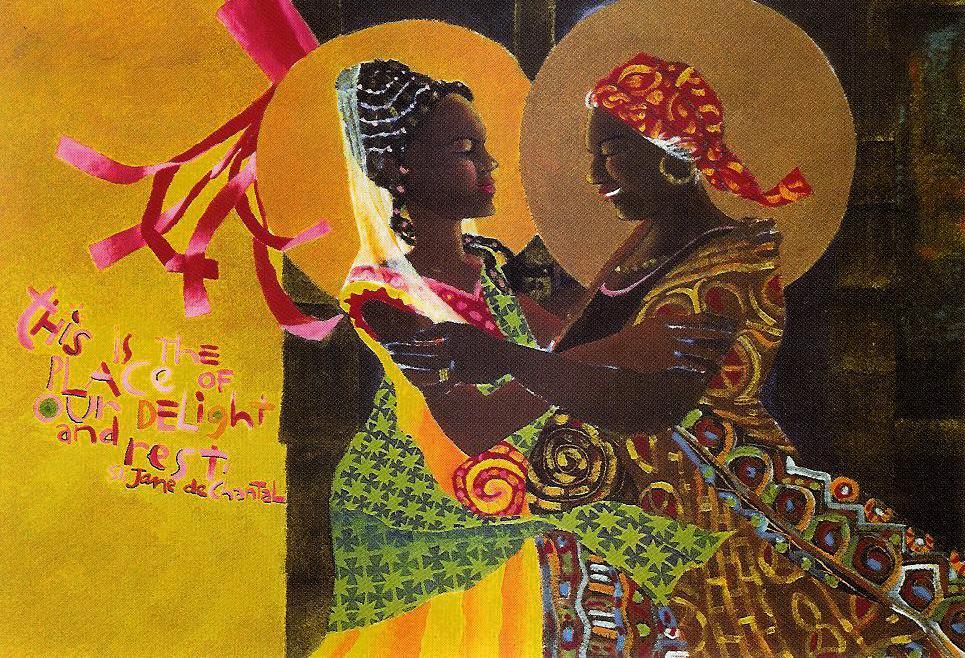
Mickey McGrath Windsock Visitation

39 In those days Mary set out and went with haste to a Judean town in the hill country, 40where she entered the house of Zechariah and greeted Elizabeth. 41When Elizabeth heard Mary’s greeting, the child leapt in her womb. And Elizabeth was filled with the Holy Spirit 42and exclaimed with a loud cry, ‘Blessed are you among women, and blessed is the fruit of your womb. 43And why has this happened to me, that the mother of my Lord comes to me? 44For as soon as I heard the sound of your greeting, the child in my womb leapt for joy. 45And blessed is she who believed that there would be a fulfilment of what was spoken to her by the Lord.’

Acrylic on canvas, 24 x 30″

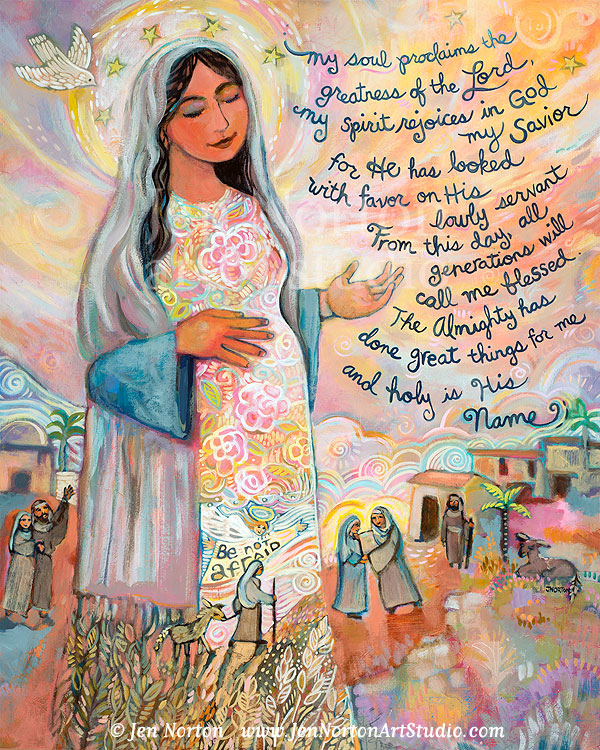
46 And Mary said,
‘My soul magnifies the Lord,
47   and my spirit rejoices in God my Saviour,
48 for he has looked with favour on the lowliness of his servant.
   Surely, from now on all generations will call me blessed;
49 for the Mighty One has done great things for me,
   and holy is his name.
50 His mercy is for those who fear him
   from generation to generation.
51 He has shown strength with his arm;
   he has scattered the proud in the thoughts of their hearts.
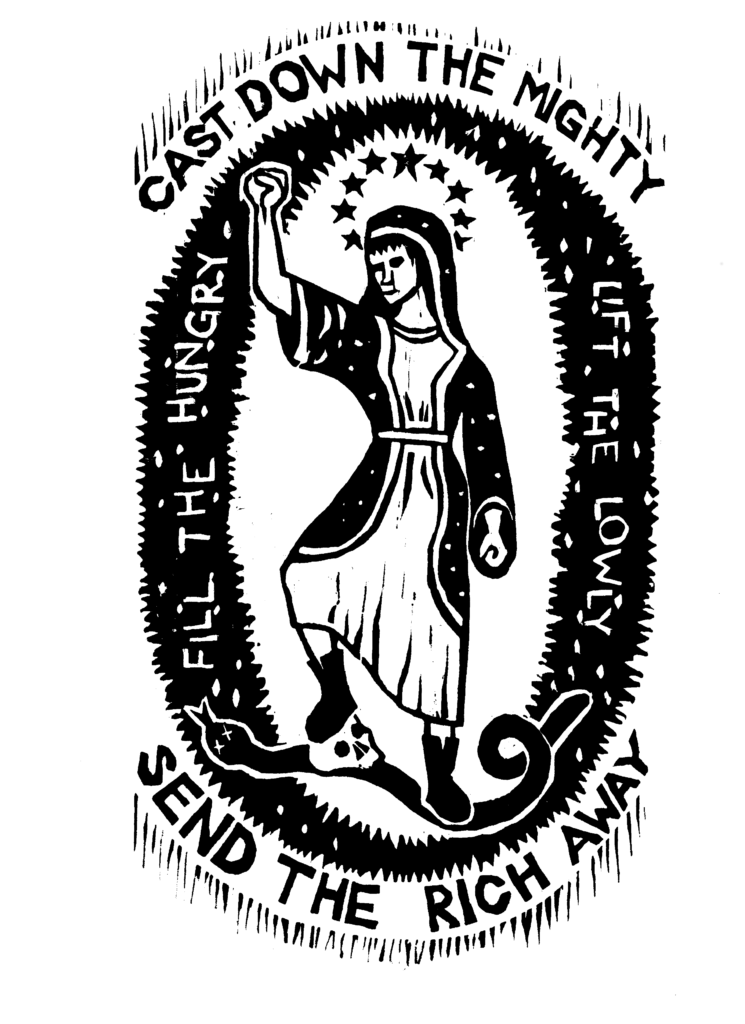
52 He has brought down the powerful from their thrones,
   and lifted up the lowly;
53 he has filled the hungry with good things,
   and sent the rich away empty.
54 He has helped his servant Israel,
   in remembrance of his mercy,
55 according to the promise he made to our ancestors,
   to Abraham and to his descendants for ever.’

Reflection

Astrid Shiloh

Last Wednesday Karen and I became grandparents for the second time with the birth of a baby sister for Elias.  On Sunday we visited the new baby, just named Astrid Shiloh [meaning ‘divine strength’ and ‘peace’].  I was amazed at this tiny (just over three kilogram) bundle, with her perfectly formed little fingers, toes and ears.  Yes, I’m sounding like a soppy old granddad but I am also now realising, a little bit, how Elizabeth must have felt when Mary visited her.

This event has also made me think, how did Luke know about a baby leaping in Elizabeth’s womb?  How did he know what it felt like for her to be able to speak about it as she does in this Sunday’s Gospel reading?  Afterall he was a man, so what did he know about babies in the womb and what did he know about expectant mothers’ emotional feelings when the baby moves – or leaps, if you like – in the womb?  Agreed, Luke was a doctor so maybe he had a better understanding than the other Gospel writers Matthew, Mark or John. 

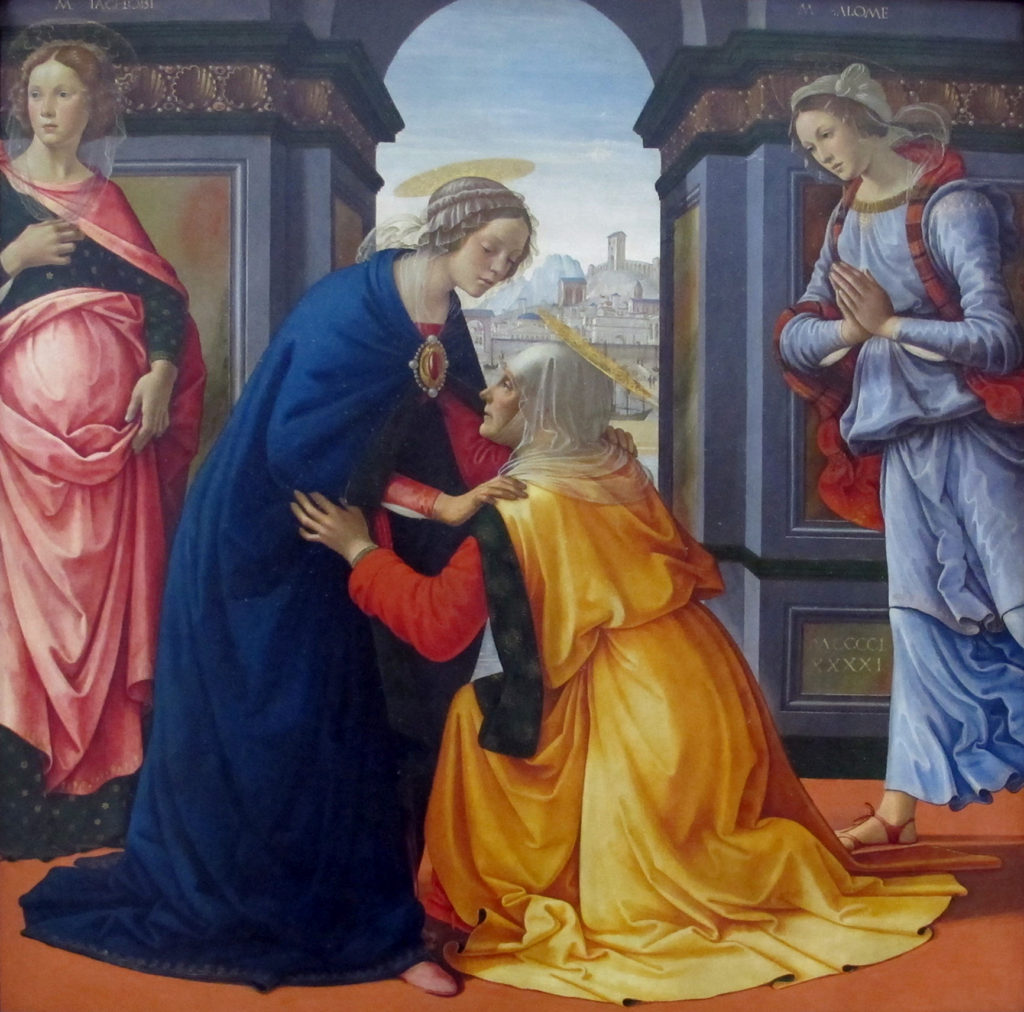
Visitation, by Domenico Ghirlandaio (1491)

I decided to try and find out what the scholars thought about this ‘leap’.  I used the internet to do some research.  Those who know me will know this is my go-to place for information, which I am aware is not always accurate.  The first site I found used this verse of John the Baptist leaping in Elizabeth’s womb to condemn abortion – an area I am going to avoid as it needs a long-considered response and not a quick throw-away few lines, a week or two before Christmas.  Another site’s approach was to get all technical, discussing the actual meanings of the original Greek words used by Luke.  I always find these discussions interesting but often ask at the end of this sort of exegesis, “How has this interesting knowledge changed my life?”  But let’s look at it anyway.1

The Webpage starts by saying ‘The Greek here for “womb” (koilia) actually means “belly” or “stomach.”’  Yes, I was wondering when it was that doctors realised babies were born in the womb and not in a mother’s belly or stomach.  I’m sure it was well after Luke wrote his Gospel.  The website goes on to say that ‘koilia‘ was also the word used in the Greek translation of the Old Testament Book of Genesis where the snake is punished and made to walk on its belly. The website then triumphantly says “snakes don’t have wombs” but begrudgingly admits that “womb” is still a reasonable translation. ‘And certainly, we know that the “child” was in the womb, not some other part of Elizabeth’s anatomy, even if the original text was less clear.’  Yes, but did the writer of the Gospel, Luke, know that?  Is womb a modern word placed in this context to satisfy modern thought?  And does it matter, I wonder?

This website’s author obviously believes we should take the Bible literally and goes on to say the Greek word used here for “child” (brefos) refers to literally an infant, but, just as the shift from “stomach” to “womb,” is acceptable, we too can accept “child” instead what the author thinks should be translated as “foetus.”  Obviously, the website author has no poetry in him (and I suspect it is a ‘him’).  He wants medically accurate translations.  But once again is the author trying to use contemporary medical accuracy to criticise the translation of the anachronistic Greek words used in the NRSV? 

The next subject tackled is the leaping? ‘What was this child or infant or foetus doing?’ the author asks.  In this case the Greek word used is skirtao. We are told that the Greek verb is used elsewhere in the bible but only in only two contexts: figuratively, and dealing with children in the womb (though the author prefers ‘foetuses in the womb’).  In Greek version of the Old Testament, skirtao is used in Genesis 25:22 where Rebekka’s twin children ‘struggled together within her.’ So skirtao used here, is ‘struggle’.  But it is used in more poetic and figurative ways as well – as in the Psalms e.g. Psalm 114 where it is the mountains that ‘skip’; in Malachi 3:20, those who revere God’s name shall ‘leap’ like calves; in Jeremiah, plunderers ‘frisk about’ like a cow; and in Luke 6:23, God’s chosen should rejoice and ‘leap for joy.’  All of these examples use the Greek word skirtao.  Very scientifically the author says that it looks like “leap” is only one possible translation but he would prefer ‘moved in the way that foetuses do’.  Then he does open up to the poetic sense by saying that maybe ‘leaped’ could be seen in the same metaphoric sense of the English phrase, ‘leap for joy’ which indicates joy but not necessarily actual leaping (Hello!).

All of this is super-interesting but have the last thirty-odd lines added anything to my/your spiritual well-being?  Have they brought us closer to God?  Which is something I felt with the birth of our granddaughter, Astrid Shiloh.  As I’ve already said, I seemed to be connected somehow to that tiny bundle of babygrow and living-and-breathing-flesh held in my daughter’s arms.  This bundle also seemed to connect me closer to God.  Seeing both my daughter sitting quietly with Astrid, looking down at this miracle that she had brought forth from her womb and our son-in-law holding tiny Astrid gently in his arms, I realised that family trees were not merely names and dates joined by lines on a piece of paper but real living people. 

In the same way there is in the Gospel reading an energetic harmony that joins John and Jesus from the very beginning.  Bruce Epperly2 says that they were spiritual soul friends, bound by God’s vision, from the very beginning.  Certainly, they were both conceived in a remarkable way and both destined to become world-changers by the message they brought.  Today, we know from our scientific research that foetuses are aware of their environment, and are shaped by the emotional and environmental lives of their parents.  There are CDs especially compiled with the right music to keep the unborn foetus calm and peaceful.  Foetuses can ‘know’ each other by an energetic field and they feel encouraged and uplifted in utero by loving parents and communities. This passage also reminds us to love the children living in our midst.  With the birth of our granddaughter at this time I found this Sunday’s reading more meaningful than in previous years.

At the same time, our granddaughter’s birth has occurred at what we all hope is the last dying surges of the COVID virus.  I mentioned last week the four words of Advent.3  This week’s word is Hell.  For many it might be like hell if they have to say farewell to loved ones without actually being in contact with them, without holding them or hugging them.  There is so much of the World that needs to change and the last part of our Gospel (used in what I think is an inappropriate place in the service to replace the Psalm) is Mary’s Magnificat.  This wonderful song given in Luke’s gospel, provides an image of hope for the vulnerable and oppressed, for those suffering because others refuse to change.  Mary’s hymn speaks of a world turned upside down.  The poor will become affluent and the affluent will lose their fortunes, the powerful will be dethroned and ordinary people will take the reins of power. This is an impossible dream for so many citizens of our own land, as privileged South Africans gain more and more power and wealth.  But it is more than that.  The Magnificat is a dream that tells us that our current situation fails the test of divine affirmation.  Homelessness, unemployment, and economic instability, must provoke an uneasy conscience in us, especially among the powerful, whose wealth is built upon the poverty of others.

Elias and Astrid

Can we dream of a new era for humankind?  Mary could.  The fruitions of her hopes start at Christmas, when someone is born that will mobilize our hopes and hands to change the world that God loves.  May the hope Mary spoke about come to fruition in the lifetime of Elias and Astrid.

Magnificat in B flat by Sir Charles Villiers Stanford (1852-1924) sung by the Choir of Durham Cathedral with Keith Wright, Organist and James Lancelot, Director.

  1. It is found at https://goddidntsaythat.com/2015/09/24/whats-this-leaping-in-luke-141/ []
  2. https://www.patheos.com/blogs/livingaholyadventure/2015/12/the-adventurous-lectionary-fourth-sunday-of-advent-december-20-2015/ []
  3. https://dappergeni.co.za/wp/2021/12/10/advent-3-joy-of-heaven-right-here-right-now/ []

Advent 3 – Joy of Heaven, right here right now.

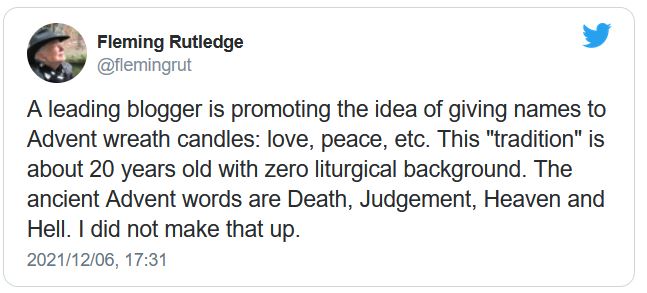
On twitter earlier this week I saw this tweet from Fleming Rutledge.

I must admit that while serving in a parish I promoted the idea of giving names to candles in the Advent Wreath in order to link that candle-lighting to the rest of the service.  Now that I’m out of parish ministry without the need to explain the lighting of Advent Wreath candles to the congregation, I’m tending to agree more with Fleming Rutledge.  In fact, looking back at the previous two Sundays online sermons1,  I see that on Advent 1 I wrote on ‘the Three Comings’ which includes the coming of Christ at the end of time, so it seems to speak about ‘Death’ and how we need to be ready for the coming of Christ to us even before the Final Trumpet is heard.  Last week I wrote about ‘Change’ and how we need to change.  Change is something that judgement brings.  If we just carry on without that change then we will be judged again and again till we do change.

This week the word given by that tweet is ‘Heaven’.  The readings for this Sunday seem to ring out about rejoicing and if (or when/) we get to heaven, we will be rejoicing!  This comes through so clearly in the three readings.2  

The First Reading tells God’s people to shout for joy.  Zephaniah 3:14
14 Sing aloud, O daughter Zion; shout, O Israel!
Rejoice and exult with all your heart, O daughter Jerusalem!

The Second Reading exhorts Christians to rejoice always. In fact, this passage gives the name to this Sunday Gaudete Sunday .3
Philippians 4:4,6 Rejoice in the Lord always; again I will say, Rejoice. … Do not worry about anything, but in everything by prayer and supplication with thanksgiving let your requests be made known to God.

I well remember singing Henry Purcell’s anthem Rejoice in the Lord, always (also known as The Bell Anthem) at St Margaret’s in Fish Hoek with the rector, Canon John Aubrey singing the Bass solo part in the verse and Mr Charles Foot singing the tenor.  I can’t remember who sang the alto part.

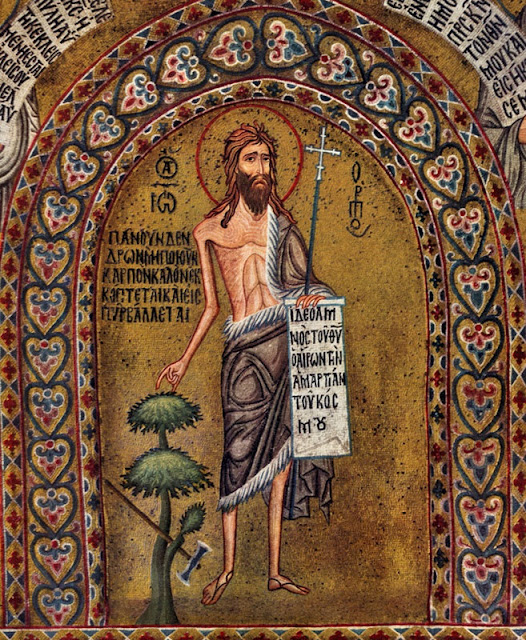
Icon of John the Baptist

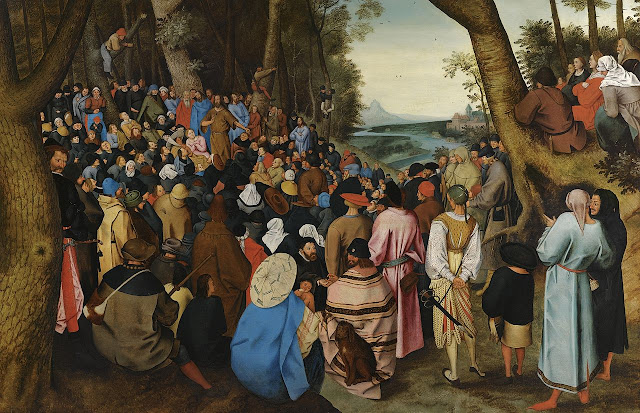
Even the Gospel Reading that has that usual prophet of doom4 John the Baptist preaching, doom but more importantly Good News to the people.  Christ will ‘baptize you with the Holy Spirit, and the Holy Spirit will then dwell in you.  I baptize you with water; but one who is more powerful than I is coming; I am not worthy to untie the thong of his sandals. He will baptize you with the Holy Spirit and fire. 17His winnowing-fork is in his hand, to clear his threshing-floor and to gather the wheat into his granary; but the chaff he will burn with unquenchable fire.’ Luke 3:16-17

John the Baptist preaching to the crowd. Pieter Brueghel the Younger.

We all know the famous question, ‘What do you want to hear first, the Good News or the Bad News?’  When thinking about what is Good News, it helps to have some sense of what the bad news is. 

Notice in the Second Reading that the call to rejoice is followed by an exhortation to have no anxieties. Do not worry about anything v6.  My thinking then, is that the bad news is everything that raises those anxieties. The First Reading spells out some of those anxieties.  There are enemies; there are misfortune—sickness, poverty, unemployment, natural disaster, and all the rest.  It is possible to find some peace about all these things by bringing them to God in prayer and putting your trust in him.  Eleonore Stump says: ‘At any rate, that is the antidote to these anxieties recommended by this reading.’5 

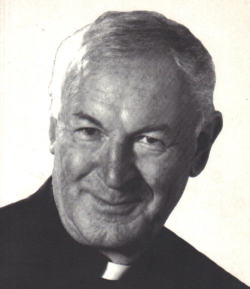
The Very Rev Edward King, Dean of Cape Town for thirty years 1958-1988

Although I agree that this is the antidote, I am not sure how she sees this in the reading.  This reference brought to mind an Advent sermon of the late Dean Ted King that I was reading the other day.  He was exploring how Advent was a time for self-examination and he commented on how we brush off people and events with remarks like, “‘Of course I will pray for you, my dear’ – but we don’t.  ‘You are often in my prayers.’ We say it, but they are not”. 6

But a person can have anxieties that are harder to bring to God. There are the relationships that have broken, the wreckage that is happening in our home, the failures that we are culpable for at work.  Sin can paralyze any effort at joy, in loving relationship with God and others.  Eleonore Stump makes a telling comment, ‘We can put our trust in God; but what happens when we know that God can put no trust in us? What happens to joy, in the face of this thought?  That is the bad news.

But what is so interesting is that this is also where the good news comes in. The First Reading from Zephaniah promises that Godwill rejoice over you.   Why?   The answer is also in the First Reading: God will renew you; and when he does, you will be so lovely that God himself will make songs about you and for you, and God, Gods-self will sing these songs to you.

The Lord, your God, is in your midst,
   a warrior who gives victory;
he will rejoice over you with gladness,
   he will renew you in his love;
he will exult over you with loud singing
18   as on a day of festival.
v17,18

That is amazing good news, isn’t it?  But there’s more, as the TV adverts say about any special offers.  In the Second reading from Philippians, the writer tells us:

7And the peace of God, which surpasses all understanding, will guard your hearts and your minds in Christ Jesus.

But how can it be? 

This is where the good news from John the Baptist comes in.  He tells his hearers that Christ will baptize with the Holy Spirit, and the Holy Spirit will then dwell in us.  Christ is Emmanuel, God with us, and he brings God the Holy Spirit into us.  When God is with us and in us, how can we ???keep from singing for joy?

Certainly, Henry Purcell could not help singing for joy.

This reflection is based on an idea of Eleonore Stump from: https://liturgy.sluhostedsites.org/3AdvC121221/reflections_stump.html


  1. Are they sermon which are never preached? They are an opportunity for me to think more about my faith but I am loathed to call them meditations? ‘Thought-piece’ sounds a bit pretentious so if any of you can think of another name for them do let me know. []
  2. For full versions of the readings go to: https://lectionary.library.vanderbilt.edu/texts.php?id=97 []
  3. Gaudete Sunday is the third Sunday of Advent. The name comes from the Introit for Gaudete Sunday, which is taken from Philippians 4:4,5 Gaudete in Domino semper, or “rejoice in the Lord always.” On Gaudete Sunday, having passed the midpoint of Advent, the Church lightens the mood a little, and the priest may wear rose vestments. https://www.learnreligions.com/what-is-gaudete-sunday-542429 []
  4. Luke 3:7,8 ‘You brood of vipers! Who warned you to flee from the wrath to come? 8Bear fruits worthy of repentance.’ []
  5. https://liturgy.sluhostedsites.org/3AdvC121221/reflections_stump.html []
  6. Edward King. Discovering God: A selection of sermons by Edward King, Cape Town, privately published, 1988, p.40 []

Advent 2: The Need for Change

Lessons: Malachi 3:1-4; Philippians 1:3-11; Luke 3:1-6

Advent is a season of preparation for the coming of the Lord.  Last Sunday I wrote about three Comings – of Jesus at Christmas, of Christ at the end of time and the coming of Jesus the Christ to us on each and every day.  This week I am going to explore how the Lord, who we are expecting, might not be quite like what we have been taught or thought.  To experience this every day coming, we need to be open to changes.

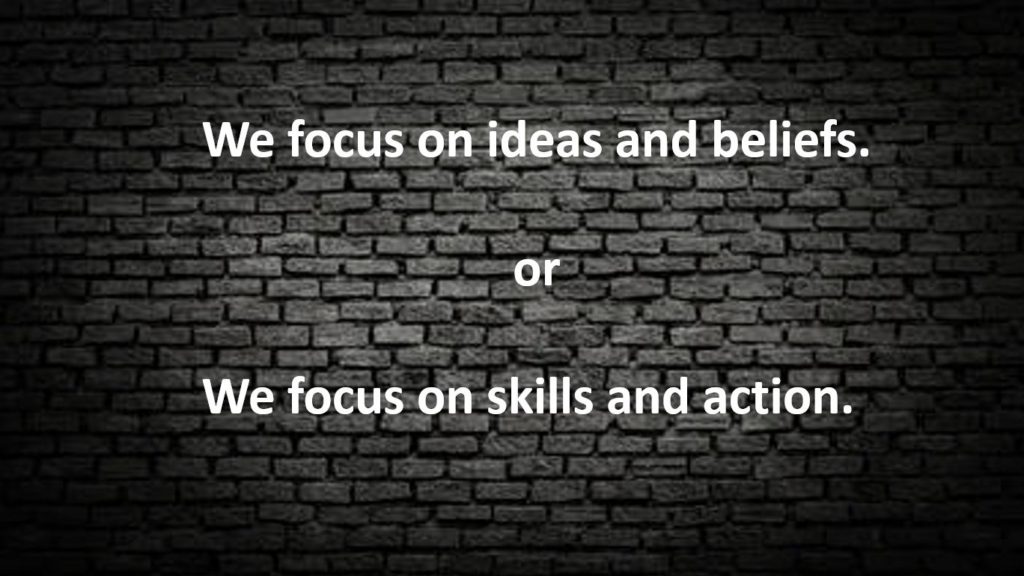
When a parish vacancy occurs in the Anglican Church of Southern Africa, the Bishop asks the parish to provide a Parish Profile so that possible candidates can see what they are letting themselves in for if they should be appointed.  The preparation of this profile is a good exercise for the parish because they have to do a bit of self-examination and reflection.  They have to say what their dreams about the parish are, and say what they think the parish needs to fulfil its God-give task.  I saw on a US Lutheran church site[1] that they had a multiple-choice type questionnaire.  This helps those filling in the form to go into areas they might want to avoid, areas such as theological requirements and pastoral needs in a parish. One of their questions asked about the pastoral attitude of parish and they had to choose between:

We focus on ideas and beliefs.                             We focus on skills and action.

I think in Advent this is a good question for all of us to think about.  In our faith, do we focus on ideas and beliefs?  Are we happy to exclude some people because the Church dogma has taught for centuries that they do not belong… for example, do we condemn people who perhaps are finding it more and more difficult to confidently say the Creed each Sunday?   Or are we more focused on skills and actions which make a difference to our community and wider society?  What do you think the Christian faith is all about? Is it following creeds and dogmas or living lives with actions that make a difference for good?

The Philippians reading for this 2nd Sunday of Advent shows what I think is the right approach.  Paul begins his letter to the Philippians with the basics:

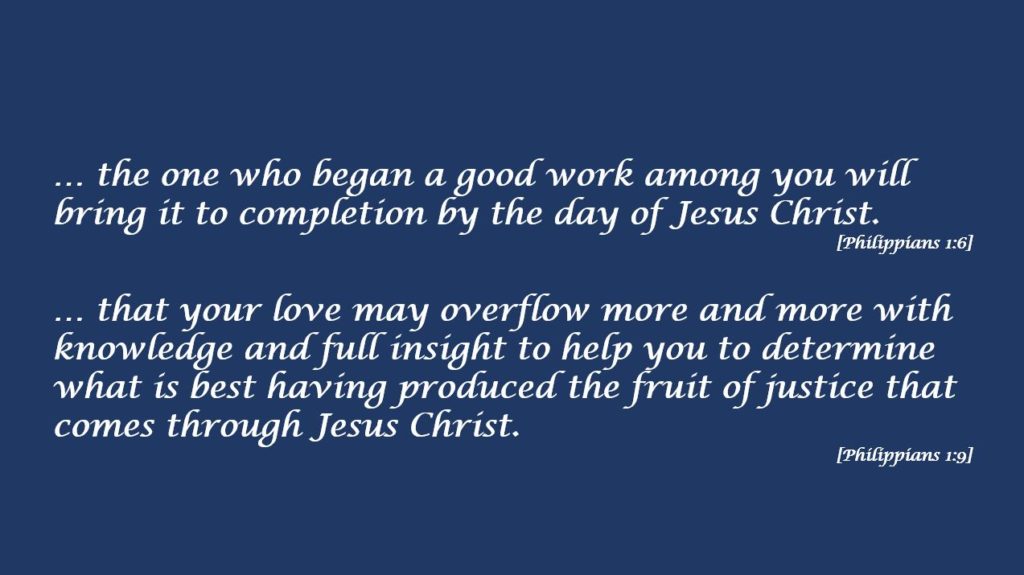
  • the one who began a good work among you will bring it to completion by the day of Jesus Christ. [v6]
  • that your love may overflow more and more with knowledge and full insight to help you to determine what is best having produced the fruit of justice that comes through Jesus Christ. [v9]

What is Paul emphasizing here? Ideas and beliefs, or skills and actions? Ideas and belief certainly are included in “knowledge and full insight,” but these are means to an end, means to action “to determine what is best.”

There are many churches who place an emphasis only on ideas and beliefs.  Members are told to that if they believe a list of things, they will be “saved”, be able to go to heaven when they die.  Biblical studies over the last few centuries have shown that the New Testament paints a different picture: Jesus came to save us from our fallen way of being human — to save us from falling into tribalism, fear, and violence.  These are what prevent us from fulfilling our roles of helping God the Creator to care for one another and for the whole creation.

I’m a Church Historian and I was taught how the Church and the Roman Empire were in partnership and both grew in power and wealth because of this partnership.  Over the past 50 years the concept of this sort of “Christendom” has been coming to an end.  By “Christendom” I mean the partnership between the Church and Empire and by Empire, I mean the governing powers of this world.  The imperial ways of doing things are still alive and well, but they are separating themselves increasingly from the church — except those wings of the church that continue to cling to the old partnership.

A few lines above I wrote that Jesus was saving us from tribalism, fear and violence.  Those last two we all know but what did I mean by tribalism?   I notice that the ANC seems very fearful of tribalism (that is rivalry between Zulu, Xhosa, Sotho Tswana etc) somehow interfering in its policies and membership.  But that is not the tribalism I’m thinking of.  Tribalism I’m thinking of is the ‘group-thinking’ type of tribalism.  The sort that says, “We must all behave and think the same way in order to be safe.”  This kind of tribalism is found in empires of all sorts.  Empire is the epitome of tribalism on a grand scale, defining who’s in and who’s out, who’s friend and who’s enemy, who’s in power and who’s not.

The Good News of Jesus the Messiah is decidedly different.  It is a healing option to Empire, turning upside-down and inside-out Empire’s boundaries.  The best Gospel writer to demonstrate this upside-down-turning is Luke, the Gospel we use in Year C (from Advent 2021 through 2022). Just a few examples prove this:

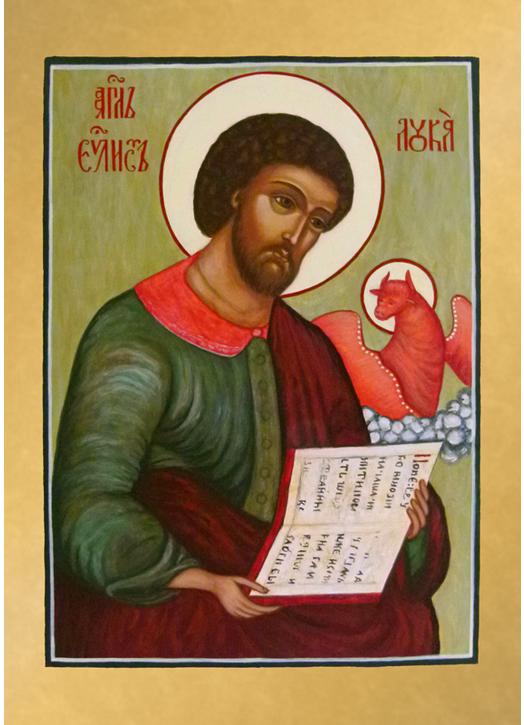
St Luke
  • Luke 1–Mary’s song– “He has brought down the powerful from their thrones, and lifted up the lowly; he has filled the hungry with good things, and sent the rich away empty.”
  • Luke 4–Good news for the poor
  • Luke 6–Blessed are the poor; cursed are the rich
  • Luke 13:30– “Indeed, some are last who will be first, and some are first who will be last.”
  • Luke 15–Heaven rejoices when the lost are found
  • Luke 16–Lazarus dies and lives with the patriarchs; the rich man [Dives] ends up in Hades.
  • Luke 22–The Gentile kings lord over others; Jesus is the Messiah who serves.

Jesus the King brings a different style of politics, politics that are upside-down inside-out from what we see in the nations of the world still today.

If you look at the opening few chapters of Luke you will see that twice he gives us the list of rulers at the time: at the beginning of the Christmas story and at the beginning of Jesus’s ministry in today’s Gospel — “In the fifteenth year of the reign of Emperor Tiberius . . .”.  Are these lists of rulers simply Luke being the historian that he is?  Or are they there to show how Jesus comes to be a totally different king?   One commentator I read points out that imperial pronouncements were called euangelion which the Greek word for Good News and these imperial pronouncements would begin by making sure everyone knew who their rulers were by listing them.  Luke is using the empire’s format of announcing Good News to proclaim a distinctly different Gospel!

If we view Christendom as shared power between Church and State then it is good that it coming to end, but this ending is evolutionary not revolutionary.  This is why the authoritarian options of tribalism can still sound good to many people and it can be uncomfortable to stand in the breach of a great change-point in history.

What does this mean for the church?  It means a re-examination of our faithfulness to Jesus’ Gospel.  As we read scripture each week we do so with different glasses on.  And then we must question some of our basic ideas and beliefs, things like a wrathful, punishing God; concepts of hell and heaven; the idea of the violence of God; the politics of human power in light of the power of a crucified God.  Above all, we examine our practices, our skills and actions. And we must ask: ‘Are they about love?’

One of our most basic practices is our worship.  Does our worship welcome the stranger, or define us over against the stranger?  Are we excluding some, not making them welcome because they don’t belong to ‘our tribe’?

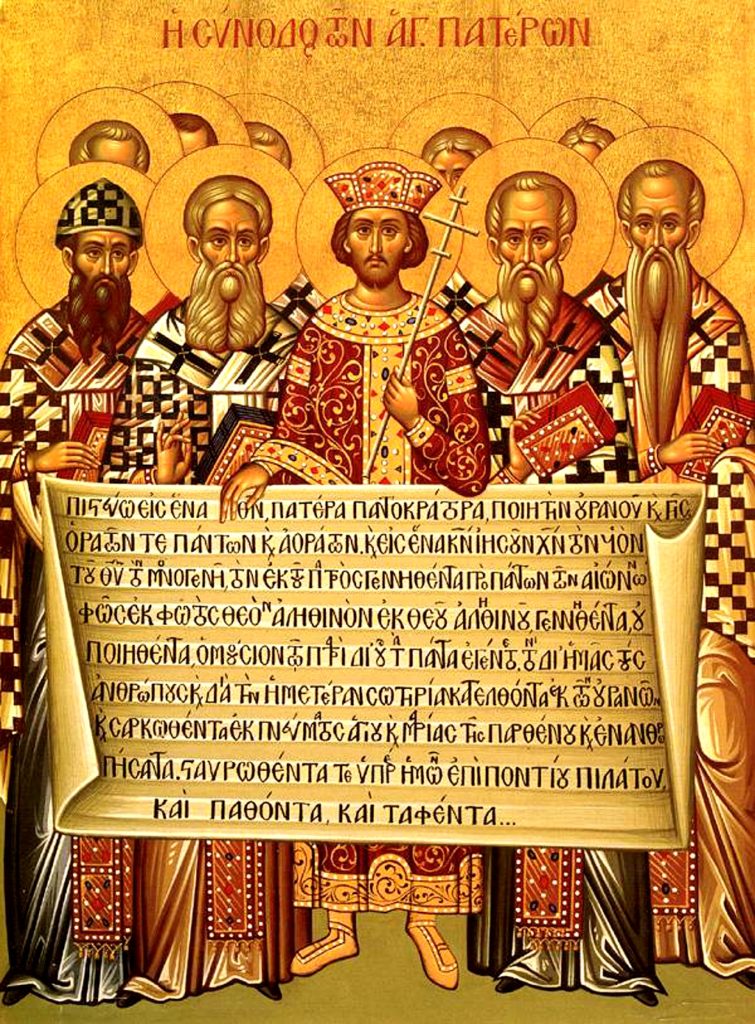
When I came to Simon’s Town Parish, they didn’t regularly use the Nicene Creed, only the Apostles’ or Baptism creed was used.  I left things as they were because as a student of Church Historian, I had learnt that the creeds correctly state some of our basic beliefs, but they also have a history of practice.  The creeds were first started to be used when Christendom – that partnership between church and state – was forming.  Earlier creeds were more fluid and diverse. The story of the Nicene Creed, however, is one of violent Empire-building: the aftermath led to the execution of two bishops and exile of a third. The creeds have been used during Christendom as a way of forcefully maintaining clear boundaries between them and us.

Nicea Icon

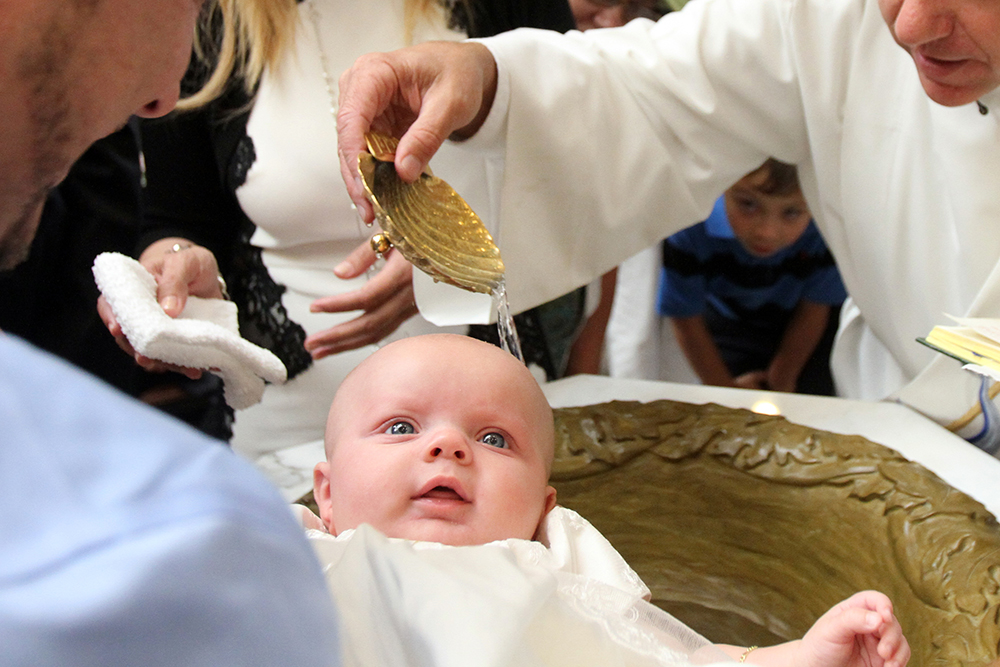
When I was rector of St Paul’s, Rondebosch there was a continual procession of Nigerian parents bringing their children for baptism.  Some parish have very strict rules about who can be baptised and who can’t.  Being a pledge-giver is often the major criterion.  To me baptism is a welcome into God’s worldwide family.  It does not define the Christian family tribalistically over against other religions and cultures. 

Baptism

I remember, too when at Synod and they were debating whether to allow children to be admitted to communion before confirmation.  Someone said that children should not be allowed to receive because they don’t understand its meaning.  The synod president was Archbishop Desmond Tutu who said that he didn’t really understand its meaning either, but he knew he needed to receive it.  Bp Charles Albertyn also responded by saying that when a mother and child came forward to the altar rail, the mother for communion and the child for a blessing, the child, copying mom held up her hands to receive, only to receive a clip across the head from mom who said loudly to her, “No! Bad for you!”  Communion should have no boundaries by denomination or age.

Communion

The bottom line is that we must practice our worship and sacraments in ways that break down the barriers that divide us.  Otherwise, we are practicing religion in ways that maintain the structure of Us and Them; we continue to be carriers of the disease of tribalism instead of agents for healing and love.  It means changing, changing our thinking, changing our actions. 

The Malachi reading this Sunday speaks to us about the “refining fire”[3:2].  As one commentator puts it “A Refining Fire is an impulse, a creative energy given to us by God, in a context of choice: we can choose to do justice out of love, or we can choose to be violent out of pain”[2].  “Refining fire” make me think about T. S. Eliot’s poem Little Gidding[3]

The only hope, or else despair
Lies in the choice of pyre or pyre
To be redeemed from fire by fire.

Thinking of our world, thinking about the church, we often experience despair… but by being ready for the Coming of the Lord means being ready for change.  As we do Advent, we, like John the Baptist, must be the ‘refining fire’ which gives all people hope and redeems us all from the fires of despair.

Some ideas developed from a sermon by Pastor Paul Nuechterlein of the Lutheran Church of the Savior, Kalamazoo, MI.  December 9, 2018  http://girardianlectionary.net/reflections/year-c/advent-2c-sermon-notes-2018/


[1] http://girardianlectionary.net/reflections/year-c/advent-2c-sermon-notes-2018/

[2] Cheryl Kirk-Duggan, Refiner’s Fire quoted in Pastor Paul Nuechterlein’s sermon.

[3] T. S. Eliot, Collected Poems 1909-1962, London, Faber & Faber, 1963, p. 221