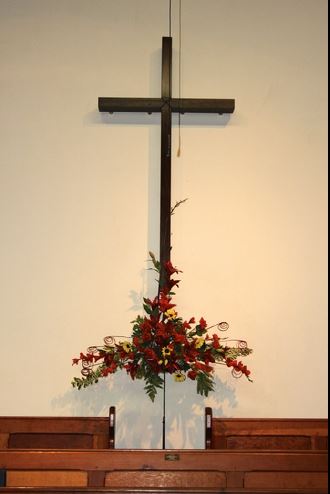
I was recently asked if I would like to contribute to a special edition of St Margaret’s Times dealing with memories. I suppose if I thought about it, I have so many little episodes worth recalling. But usually these memories need a cue of some sort to get them going. Without that it is hard to creatively recall some special event. So I submitted this short piece, blending what I had been reading at the time (poems by R. S. Thomas) with an event that this poem reminded me of.
The East End Cross
Above the choir stalls on the liturgical east end of St Margaret’s is a large wall-mounted blank cross. It was placed there during the rectorship of Bishop John Carter and at that time I was a lay-minister and served as a parish councillor and therefore I was involved in the decision to ask for a faculty for the design and the placement of this cross.
I was reminded of this a few weeks ago. I was listening to the live-streamed service from Christchurch Cathedral, Oxford. The preacher began her sermon quoting from a poem by the Welsh Anglican priest and poet, R. S. Thomas. My immediate response was to try and find the poem in my small volume of selected verses by R. S. Thomas. I couldn’t find that poem but did find one entitled In Church which attracted my attention and gave me a few hours of joy as I analysed its use of metaphors, similes and under-stated theology. It was the last few lines that ‘shocked’ me. Thomas, as the narrator speaks of seeking God in the silence of the empty church and he ends:
There is no other sound
In the darkness but the sound of a man
Breathing, testing his faith
On emptiness, nailing his questions
One by one to an untenanted cross.
On the first reading of these lines, I was shocked that a man-of-God, a priest, should believe that his faith was ‘empty’ and that Christ was not there to answer his questions. But then I remembered that cross on the East wall at St Margaret’s and Bishop John’s comments as we discussed its placement. Bishop John said that he intentionally asked the architect to design a cross without the body of Christ on it. In many churches and cathedrals, we see the crosses behind the altar with a corpus on it but Bishop John said that a cross showing the suffering of Jesus on the cross should hang above the pulpit. ‘We preach Christ crucified,’ he said, ‘but celebrate the Risen Christ at the altar and so that cross should be bare.’ This is what makes those last two lines of R. S. Thomas’s poem into a paradox. When we are feeling down, and who isn’t during lock down when we cannot be In Church the way Thomas speaks about, then the cross might appear to us to be empty or ‘untenanted’ but it is ‘untenanted’ because of Easter, because of the resurrection of Christ who is with us all the time wherever we are. So be encouraged as you worship, not In Church but perhaps at home, that Christ has risen and Christ will answer your question of faith.