St Francis of Assisi, Simon’s Town.
Sunday 1 November 2020
A pdf version for downloading and printing available here
When I was in my 20s, I was in the choir at St Margaret’s, Fish Hoek and one evensong Fr Tim Peacock preached. He told us that if we wanted to explore Scripture we would have to ask ourselves four questions all starting with a WH. WHO wrote the passage, WHY did they write it, WHAT did it mean to the first readers of the passage and finally, WHAT does it mean for us today? I remembered this as I was thinking about this sermon because these four WH type of questions need to be asked as we look at SAINTS and in particular ALL SAINTS. The order of the WH questions change but otherwise they are a good springboard for us this morning. WHAT is a saint? WHO are saints? WHY do we need saints? and WHAT do saints mean to me today?
Let’s begin by asking WHAT IS A SAINT? I think in every All Saints sermon I’ve ever preached I’ve asked this question. I think mainly because we so often have strange ideas about saints. We say “Be a saint and carry this parcel for me” or at funerals “the deceased was an absolute saint as he cared for his wife who had dementia.” We seem to imply that saints have to suffer to earn their title.
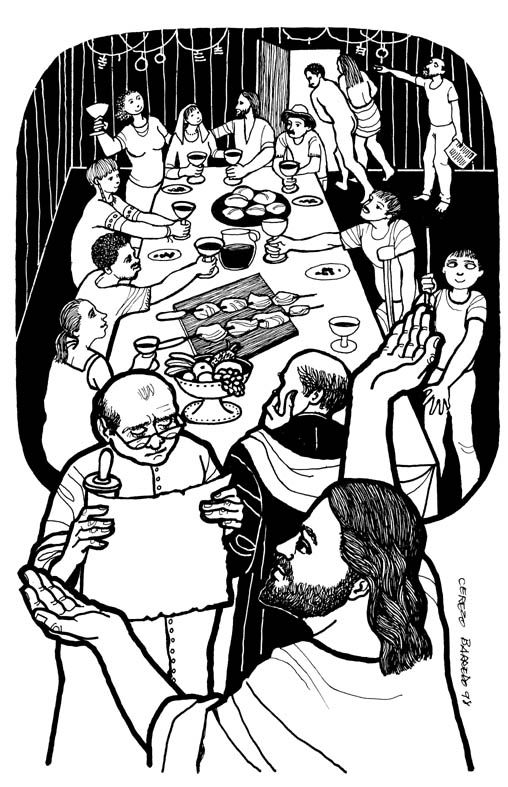
In John Henry Newman’s poem, Dream of Gerontius which was set as an oratorio by Edward Elgar, has the Soul of Gerontius ascending to heaven and as he passes, the Demons call out him. It is interesting that Elgar had the men of the choir singing the Demons part! They call out “What’s a saint? One whose breath doth the air taint”. Now, that is something all of us know about, wearing our face-masks! The demons carry on and say that saints are “Low-born clods of brute earth, they aspire to become gods.” But think about it…isn’t that what all of us are striving to do, to become more like Jesus, who is God? In our Gospel reading Jesus gives us the beatitudes. Eleven verses of encouragement as we strive to become saints. Mahatma Gandhi said of Christ’s Sermon on the Mount of which the beatitudes begin it, that it fills him “with bliss even today. Its sweet verses have even today the power to quench my agony of soul.” Does it quench your Soul? Or do you dismiss it, saying, “Not this passage again!”
Wikipedia says A saint is a person who is recognized as having an exceptional degree of holiness or likeness or closeness to God. So even Wikipedia agrees with those demons! But it also says that the definition of a saint will vary depending on the Christian denomination you belong to. All of the faithful departed in Heaven are considered to be saints, that is why we are having this Festival today, but some are considered worthy of greater honour or emulation. Certainly, for Paul anyone who belongs to the Christian faith, living or departed, can be called a Saint. He writes to the Roman Church: To all God’s beloved in Rome, who are called to be saints: Grace to you and peace from God our Father and the Lord Jesus Christ.
But what about us Anglicans, what does a saint mean to us? For us the title of Saint refers to a person who has been elevated by popular opinion as a pious and holy person, a person worthy of imitating.
But then WHO IS A SAINT? The saints are models of holiness to be imitated, and a ‘cloud of witnesses’ that strengthen and encourage us during our spiritual journey. As Hebrews 12:1 says Therefore, since we are surrounded by so great a cloud of witnesses, let us also lay aside every weight and the sin that clings so closely, and let us run with perseverance the race that is set before us.” If you look at our Church Calendar you will find a lot of Saints who didn’t suffer in anyway, who didn’t go the extra mile to help others, who weren’t martyred. In fact, died in their beds. Many wrote poems or experienced oneness with God in their lives. They will be part of what Bp William Walsham How calls in my favourite hymn, For all the Saints: O Blest communion, fellowship divine or as Bp. Christopher Wordsworth describes them: Patriarch and holy prophet, who prepared the way of Christ, king, apostle, saint, confessor, martyr and evangelist, saintly maiden, godly matron, widows who have watched in prayer, joined in holy concert, singing to the Lord of all, are there.
Are you there? You who are the Saints of Simon’s Town beloved by God? Boet Domisse wrote that little book entitled The Six Saints of Simon’s Town. Agreed, he was referring to the six saints that the local churches are dedicated to, but I believe there is no reason why there should not be hundreds of saints of Simon’s Town.
But WHY COMMEMORATE SAINTS at all? So many of them, we discover, were perhaps not as holy or pious as we originally thought. Another All Saints hymn by James Montgomery says They were mortals too like us, O, when we like them must die, may our souls translated thus triumph, reign, and shine on high.” During Lockdown I have watched streamed services from Portsmouth Cathedral. I choose that Cathedral because my family originally came from there in the 19th Century, my son lives in the Portsmouth Diocese and the Dean, the Very Rev. Anthony Cane was educated at Bishops and UCT before returning to the UK, so I feel a strong connection. In a sermon last month the Dean spoke about walking home from the Cathedral to the Deanery following two visitors to Portsmouth and as they entered the Grand Parade where there was a statue to Lord Horatio Nelson – appropriate for any town with a Royal Navy connection, he heard the one say to the other, “Oh! so it’s not Nelson Mandela then!” The Dean went on to show how Lord Nelson in spite of being a hero and hero-worshipped by the English, was no saint, and I’m sure there are many things in Nelson Mandela’s life that are not really saintly. The Dean indicated that he often, when going to meetings in Church House near the Houses of Parliament in London, had to cross Parliament Square. “There,” he said, “is a statue to Nelson Mandela, and Churchill and Gandhi and Millicent Fawcett, the suffragette and Jan Christian Smuts.” None of these would fit into that hymn which asks, “Who are these like stars appearing… these are they who have contended for their saviour’s honour long…” but there are their statues and we commemorate them just as we do for All Saints today.
So, WHAT DO SAINTS MEAN TO US TODAY? Certainly, they are examples to follow, to imitate and because of their very humanity, we might find it less of a burden to follow their way of living. Three years ago, Fr Richard asked me to help out by becoming your Priest-in-charge for six months. I immediately said yes which I think surprised him a bit because he told me to go home and speak it over with Karen. I said, “No, I want to be able to help in this parish.” Though I must admit I didn’t think it would be for three whole years! But I have really enjoyed being you Priest-in-Charge. I am sure many of you could see my faults and my failings. My failure to be as pastorally-caring as Fr Rodney obviously is, my sermons being too academic and long, my over indulgence with traditional hymns and choir music. “I am no saint,” as the old saying goes and one starts to expect a “but…” There is no but from me!
There is a delightful book I owned, but with downsizing it has disappeared from my bookshelf so I can’t remember the title or the author. It tells of a man called George who felt that his life was empty and worthless and he needed to do something to make it all worthwhile. He decided that he would like to go a quest. His wife thought he had lost his mind but one day while he was preparing to go on his quest, a dragon suddenly appeared and asked in a very bored voice what he was doing. “Going on a quest”, said George. “To do what?” asked the dragon, “I don’t know,” said George, “perhaps to find Truth or the Holy Grail.” The Dragon then asked him, “What’s your name?” “George” said George. “What! Plain George? Not St George?” “I’m not holy enough to be saint!” said George. “No, not Saint George but S-E-N-T, Sent George because you have been sent on a quest.” That was just the opening part of the first chapter of the book, but I think the message for us is clear. Yes, we are all SAINTS because we are SENT, sent by God to make a difference in people’s lives. I was sent to be your priest-in-charge for three years. You are sent to do what God is calling you to do.
Around St Francis Day I found a quote from Francis, as his life was drawing to an end, just as my ministry among you has now drawn to an end. St Francis said: “I have done what is mine to do. May Christ teach you what is yours.” That is quite a challenge to you all. What is your task to do? I found that quote on twitter from a priest who is a tertiary of the Franciscan Order. He added to some words of his own to his tweet and I want to address them to you, as I end my sermon today. “May you know the freedom of what it means to be you, and know that God rejoices in you as you are. You are beautiful!” Amen.
Oh yes, you all know me and my famous saying “Google is your friend!”. I googled and found that the book is called St George and the Dragon and the quest for the Holy Grail by Edward Hays.