Carol of MY year 2024 –

Introduction

Over the past three years I have written a blog about a carol that attracted me in that year’s preparation for Christmas. Two years ago, it was ‘What sweeter music’ (words by Robert Herrick and music by John Rutter.) Last Christmas it was ‘Tomorrow shall be my dancing day’ words by that great poet ‘Traditional’ and music by John Gardner.

This year I had a bit more time to experience various carols as I was asked to do a parish faith-sharing series called ‘Faith and Music’ at St Stephen’s Pinelands and the December meeting was entitled ‘What sweeter music… than a carol.’
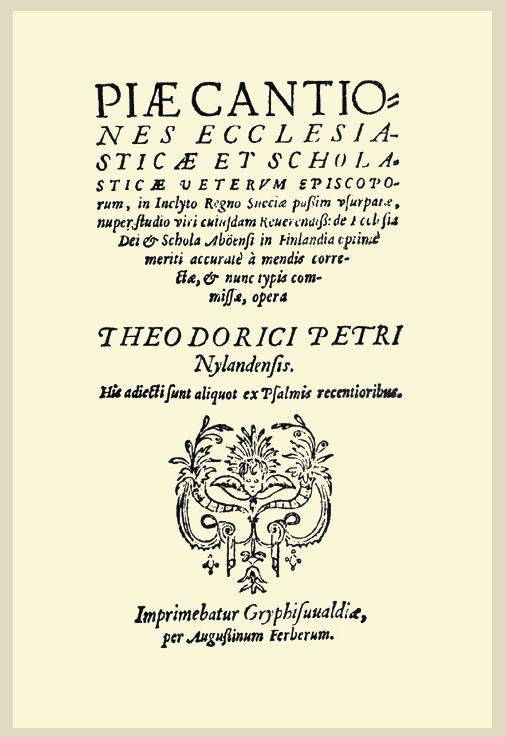
Cover of Piae Cantiones 1582

Why I chose it…

I started watching YouTube videos of Carols and histories of carols to give me a springboard for the presentation. I came across Jeremy Summerly’s various ‘Christmas Lectures’ videos for Gresham College. It appears that he has given an annual lecture on various aspects of carols and music for Christmas for many years now. One of these lectures discussed the 450th anniversary of the publication of Piae Cantiones Ecclesiasticae et Scholasticae Veterum Episcoporum (1582). The title can be basically translated as ‘Pious Church and Scholastic Songs of the Venerable Churchmen’

This publication was from Finland and collected by a Finnish schoolmaster Theodoricus Petri Rutha of Nyland, who taught at the Cathedral school at Turku, Finland. It contained seventy-two songs mostly with just a melody line. It has become a source of many carols and hymns with modern composers arranging the harmonies for us to use today in our worship. In our Hymns Ancient and Modern New Standard we find two hymn tunes sourced from this publication. The tunes are for the hymn ‘Of the Father’s love begotten…’ and secondly, a tune called Personent Hodie used for modern words ‘Long ago, prophets knew…’, an Advent Hymn.

Among the carols are ‘Up!  Good Christian folk and listen’ with the words by G. R. Woodward but the melody adapted from Piae Cantiones, and ‘Good King Wenceslas’ with words by J. M. Neale and the music was that for a Spring Carol also found in Piae Cantiones.

It is amazing how one book of tunes from an obscure town of Turku in Finland and collected by a schoolmaster has played such an important role in English hymns and carols. One of the tunes written out in harmony but only for the chorus (not the verse) of the carol I’ve decided to make ‘My Carol for the Year 2025’ mainly because researching it for my Faith and Music presentation at St Stephen’s Pinelands early in December has opened so many doors for me on the history of carols.

MY carol for 2024

The name of the carol I’ve chosen is ‘Gaudete’ [Rejoice]. In my introduction to the Faith and Music presentation I was trying to define what a carol was. The Oxford Book of Carols defined Carols as being ‘simple, hilarious, popular and modern’. These terms need a bit more explanation:  

Simple – this implies that a carol should be spontaneous and direct in what it says to us. This often leads to them rambling on like folk-ballads tended to do.

Hilarious – this is a strange use of the word but an archaic meaning is ‘boisterous and merry’. This also points to the word ‘carol’ being derived from the Latin and Old French word meaning ‘to dance’. This is where ‘Gaudete’ comes in for me. With its syncopation one cannot but help feeling the need to dance when it is sung in a vigorous way (see below for examples).

Popular – this means that carols were sung by all people, not just the choir and the clergy. Most often carols were sung by the common people going from door-to-door singing carols in the wassailing tradition, usually ending up in the local pub.

Modern – With Piae Cantiones being published in 1582, this seems to be a contradiction but The Oxford Book of Carols (TOB), using rather gender-specific language, typical of its era, TOB was first published 1928. It says that carols are ‘always modern, expressing the manner in which ordinary man at his best understands the idea of his age, and bringing traditional conservative religion up to date.’

Does ‘Gaudete‘ fulfil the requirements of being ‘simple, hilarious, popular and modern’? I think it does – if one performs it in a suitable way. Here we need to look at the words and the music separately.

The words

Latin
Gaudete, gaudete!
Christus est natus
Ex Maria virgine, gaudete!

Tempus adest gratiæ
Hoc quod optabamus,
Carmina lætitiæ
Devote reddamus.
Gaudete, gaudete!
Christus est natus
Ex Maria virgine, gaudete!  

Deus homo factus est
Natura mirante,
Mundus renovatus est
A Christo regnante.
Gaudete, gaudete!
Christus est natus
Ex Maria virgine, gaudete!  

Ezechielis porta
Clausa pertransitur,
Unde lux est orta
Salus invenitur.
Gaudete, gaudete!
Christus est natus
Ex Maria virgine, gaudete!  

Ergo nostra contio
Psallat iam in lustro;
Benedicat Domino:
Salus Regi nostro.
Gaudete, gaudete!
Christus est natus
Ex Maria virgine, gaudete!
English
Rejoice, rejoice!
Christ is born
Of the Virgin Mary – Rejoice!

The time of grace has come—
What we have wished for;
Songs of joy
Let us give back faithfully.
Rejoice, rejoice!
Christ is born
Of the Virgin Mary – Rejoice!  

God has become man,
With nature marvelling,
The world has been renewed
By the reigning Christ.
Rejoice, rejoice!
Christ is born
Of the Virgin Mary – Rejoice!  

The closed gate of Ezekiel
Is passed through,
Whence the light is risen;
Salvation has been found.
Rejoice, rejoice!
Christ is born
Of the Virgin Mary – Rejoice!  

Therefore, let our assembly
Now sing in brightness
Let it bless the Lord:
Salvation to our King.
Rejoice, rejoice!
Christ is born
Of the Virgin Mary – Rejoice!  

This carol is in Latin and not macaronic, where Latin phrases are introduced into a carol in the vernacular language, as for example, ‘In dulci jubilio, Let us our homage show.’ The Latin phrases, however, are all very well-known likely to be understood easily even by the uneducated person having heard them regularly in the liturgy. Thus, it is simple and popular and the music (see below) makes it hilarious and modern.

The Music

As far as the music goes, I’ve said already that the Piae Cantiones had 72 melodies and very few written with harmonies. Gaudete was one of the few that did. (See picture of score, showing the score with separate parts.) Unfortunately, there is no music given in Piae Cantiones for the verses. The YouTube channel, Early Music Sources by Elam Rotem gives a very good and interesting exploration of the early sources for the chorus as well giving examples of verses used by performers. Use this link https://www.youtube.com/watch?v=Aab7TvfDEKE if you want to see where the tune first arose. Basically, a choir planning to sing today would have to find a suitable version to express the joyfulness of this carol.
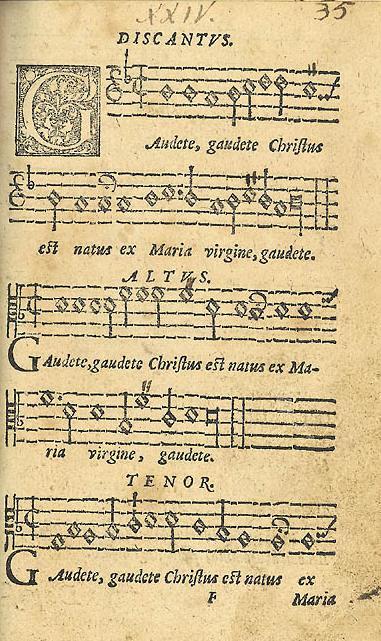
Gaudete from Piae Cantiones 1582

I was looking for a version to play for the Faith and Music group.

Version 1: In my CD collection I had a CD I bought at Portsmouth Cathedral with their choir under Dr David Price. Their version of Gaudete was arranged by Luke Fitzgerald who brings in percussion and the organ to express the celebratory nature of the carol. This is close to what I think fulfils the definition of simplicity, hilarity, popularity and being modern.

From CD Verbum Caro Factum Est Choir of Portsmouth Cathedral Director David Price (Herald CD HAVPCD407 2018)

Version 2: However, the one I chose to play to the group was a version by the British folk-rock group Steeleye Span from the 1970s and 80s. It became very popular reaching the Top40 charts – one of the only two Steeleye Span had- the other was ‘All around my hat’. This version of Gaudete has simple harmonies and the singing by the soloist, Maddy Prior and the rest of the group, has a ‘roughness’ and ‘boldness’ giving a ‘in-your-face’ feel to it.  The words are also pronounced in a ‘non-liturgical Latin’ or ‘Italianated Latin’  way making it sound more ‘popular’ – of the people, rather than ‘of the choir and educated clergy.’

Taken from one of many online Youtube videos Steeleye Span – live performance.

Which one do you like most? Which version is truly a carol? Feel free to message me in the comments.

While searching I came across a parody version entitled Crudité rather than Gaudete and if you listen carefully to the words, pre-dinner snacks are more to the fore than rejoicing over the birth of Jesus! This version perhaps uses the definition of ‘hilarious’ in its modern rather than archaic way!

Found on YouTube. Song by Blanche Rowen and Mike Gulston
My Favourite Carol 2023 Version:

Tomorrow shall be my
dancing day.

Each year as Christmas comes round and as choir members start practicing carols, one carol seems to stand out and have a particular effect on me, leading to the desire to explore the words (and music) in more detail.

A few years ago it was John Rutter’s What sweeter music, the words of which were by Robert Herrick (see https://dappergeni.co.za/wp/2021/12/17/christmas-day-reflection-what-sweeter-music-than-a-carol/ ). Last year it was ‘That Chord’ in the organ part of the last verse of O come all ye faithful by David Willcocks. (see  https://dappergeni.co.za/wp/2022/12/ )

This year it has become the exciting and very rhythmical setting of Tomorrow shall be my dancing day by John Gardner.

I think I need to look at this carol both from a musical and a text point of view.

Text
Gardener’s setting, like most others sung at Carol Services only uses the first four verses of this carol by an anonymous author.

1. Tomorrow shall be my dancing day;
I would my true love did so chance
To see the legend of my play,
To call my true love to my dance;
        Chorus
        Sing, oh! my love, oh! my love, my love, my love,
       This have I done for my true love.

2. Then was I born of a virgin pure,
Of her I took fleshly substance
Thus was I knit to man’s nature
To call my true love to my dance. Chorus

3. In a manger laid, and wrapped I was
So very poor, this was my chance
Betwixt an ox and a silly poor ass
To call my true love to my dance. Chorus

4. Then afterwards baptized I was;
The Holy Ghost on me did glance,
My Father’s voice heard from above,
To call my true love to my dance. Chorus

There are, in fact, eleven verses which describe the whole of Jesus life dealing with his temptation in the wilderness (v5), his teaching and miracles (v6), his betrayal by Judas (v7), his trial (v8), his crucifixion (v9), resurrection (v10) and ascension (v11), concluding with the whole purpose of the incarnation: … now I dwell in sure substance/ On the right hand of God, that man/ May come unto the general dance.

Perhaps I need to place this carol into an historical context. Although much older, it appeared in William Sandys Christmas Carols Ancient and Modern published in London by Richard Beckley in 1833. On the internet and on CD liners and introduction to Carol Books there has been much discussion about this carol. But first we need to understand more clearly what a carol is.

One site defined the following: CAROL (0ld French carole), a hymn of praise, especially such as is sung at Christmas in the open air. The origin of the word is obscure. Some suggest that the word is derived from chorus. Others link it with corolla, a garland, circle or coronet, in the earliest sense of the word being apparently a ring or circle, a ring dance. So perhaps we are getting close to Tomorrow shall be my dancing day…

Interestingly, Stonehenge, often called the Giants Dance, was also frequently known as the Carol; thus Harding, Chron. lxx. x.,
Within (the) Giauntes Carole, that so they hight,
The (Stone hengles) that nowe so named been.

The crib set up in the churches at Christmas was the centre of a dance, and some of the most famous of Latin Christmas hymns were written to dance tunes. These songs were called Wiegenlieder in German, noels in French, and carols in English. Strictly speaking, therefore, the word should be applied to lyrics written to dance measures; in common acceptation it is applied to the songs written for the Christmas festival.

Another internet source suggests that according to Christmas Carol legend, all old carols that were written in 3/4 time were written as Creche dances. As these carols were sung, people would dance around the creche or the manger. One of the most famous Creche songs is “Away in a Manger”.


Thus, the idea is that Tomorrow shall be my dancing day is a carol that one can dance to. “Dancing Day” in the text is a reference to the dance around the creche, or dancing on the birthday of Christ. Notice that the speaker/singer of the text is Christ. There is a suggestion that line “To see the legend of my play,” could be a reference to a mystery play and just like the Coventry Carol, this could have been derived from a mystery play. The actor playing Christ singing the verses while the audience would join in with the chorus. Sing, oh! my love, oh! my love, my love, my love, /This have I done for my true love. This creates a delightful image of Christ viewing humankind as his ‘true love’ for whom he was willing to come to earth and go through what the next ten verses describe so well.

Each line of verse one needs a brief explanation:
Tomorrow shall be my dancing day; Sung at Christmas so Christ would start dancing/ be born the next day or perhap speaking about the end of time?
I would my true love did so chance  ‘My true love’ is humankind or perhaps the church – depending on one ecclesiology.
To see the legend of my play, Legend could be story and play could be life or a hint at being part of a mystery play.
To call my true love to my dance; Christ life was to call us – humankind’ to join him in the ‘dance’

The other three verses are more directly descriptive, even if the language is a bit stilted in old-fashioned English. I have already mentioned the last line: “that man may come unto the general dance.” and how this wonderfully summarises the incarnation.

Music
I said above that carol tunes that were in 3/4 time were for dancing. The original ‘Traditional’ tune as it appears in Sandy’s Carols Ancient and Modern is in 3/4 time but in a fairly legato style. John Gardner (1917 – 2011) has written a completely different tune from the original. It has a drum and cymbal accompaniment in the opening and in between the verses with staccato chords on the organ. The verses and choruses are sung unaccompanied. The staccato and dance rhythms make it a very exciting carol to hear.

Here is the carol sung by the Portsmouth Cathedral Choir under the direction of Dr David Price. It is from the CD, Verbum Caro Factum Est: Advent and Christmas from Portsmouth from Herald HAVPCD 407.

Tomorrow shall be my dancing day by John Gardner.

Why did I like this Carol?

The use of the image of dance, of love and the idea of Jesus addressing us directly relating his life (‘dance’) to us and asking us to join in the dance, is a wonderful way of evangelising without bible-bashing and that last line of verse eleven hoping that ‘Man may come under the general dance’ — Thus ‘the general dance’ is revealed to be not only our earthly life with Christ but also the heavenly wedding banquet—as well the literal dance that may have accompanied the finale of the mystery play. The whole concept of the image of dance in religion is the next thing I need to explore!

Musically, its rhythm is what attracted me to this tune. It is vibrant and exciting and certainly makes me, not so much want to dance, but to join in the drum beats by stamping or beating time on the pew in front!

The complete text.
1. Tomorrow shall be my dancing day;
I would my true love did so chance
To see the legend of my play,
To call my true love to my dance;
        Chorus
        Sing, oh! my love, oh! my love, my love, my love,
        This have I done for my true love

2. Then was I born of a virgin pure,
Of her I took fleshly substance
Thus was I knit to man’s nature
To call my true love to my dance. Chorus

3. In a manger laid, and wrapped I was
So very poor, this was my chance
Betwixt an ox and a silly poor ass
To call my true love to my dance. Chorus

4. Then afterwards baptized I was;
The Holy Ghost on me did glance,
My Father’s voice heard from above,
To call my true love to my dance. Chorus

5. Into the desert I was led,
Where I fasted without substance;
The Devil bade me make stones my bread,
To have me break my true love’s dance. Chorus

6. The Jews on me they made great suit,
And with me made great variance,
Because they loved darkness rather than light,
To call my true love to my dance. Chorus

7. For thirty pence Judas me sold,
His covetousness for to advance:
Mark whom I kiss, the same do hold!
The same is he shall lead the dance. Chorus

8. Before Pilate the Jews me brought,
Where Barabbas had deliverance;
They scourged me and set me at nought,
Judged me to die to lead the dance. Chorus

9. Then on the cross hanged I was,
Where a spear my heart did glance;
There issued forth both water and blood,
To call my true love to my dance. Chorus

10. Then down to hell I took my way
For my true love’s deliverance,
And rose again on the third day,
Up to my true love and the dance. Chorus

11. Then up to heaven I did ascend,
Where now I dwell in sure substance
On the right hand of God, that man
May come unto the general dance. Chorus

Sources used:
https://en.wikipedia.org/wiki/Tomorrow_Shall_Be_My_Dancing_Day
http://www.hymnsandcarolsofchristmas.com/Hymns_and_Carols/tomorrow_shall_be_my_dancing_day.htm 
And numerous other bloggers who wrote about this carol

Celtic Eucharist

A few of my Facebook followers have asked if they could have a copy of the Celtic Eucharist Service I used on Tuesday 12 April 2022 at St Margaret’s, Fish Hoek.  It is a similar service I’ve used in the past at St Paul’s Rondebosch and St Francis Simon’s Town.  Here is the ‘full script’ edition.  The passages in red in the service itself are from David Adam’s book The Open Gate: Celtic Prayers for Growing Spiritually published by Triangle-SPCK in 1994.  The opening explanation has texts from numerous other books on Celtic Poetry etc.  I had great fun compiling, editing and DTP’ing it.  Other parishes may use it with pleasure.  Can I suggest that you get a good reader of poetry to read the parts in red so as to create a contrast from the priest and try to choose hymns that either have Celtic words or music to keep the theme throughout.

Click here for a pdf document of the complete script, but without the words for the hymns.

If you would like to see the Celtic Eucharist as celebrated on Tuesday 12 April 2022, click here for the link to St Margaret’s Facebook Page.

Sermon for All Saints Day

St Francis of Assisi, Simon’s Town.
Sunday 1 November 2020

A pdf version for downloading and printing available here

When I was in my 20s, I was in the choir at St Margaret’s, Fish Hoek and one evensong Fr Tim Peacock preached.  He told us that if we wanted to explore Scripture we would have to ask ourselves four questions all starting with a WH.  WHO wrote the passage, WHY did they write it, WHAT did it mean to the first readers of the passage and finally, WHAT does it mean for us today?  I remembered this as I was thinking about this sermon because these four WH type of questions need to be asked as we look at SAINTS and in particular ALL SAINTS.  The order of the WH questions change but otherwise they are a good springboard for us this morning.  WHAT is a saint? WHO are saints?  WHY do we need saints? and WHAT do saints mean to me today?


Let’s begin by asking WHAT IS A SAINT?  I think in every All Saints sermon I’ve ever preached I’ve asked this question.  I think mainly because we so often have strange ideas about saints.  We say “Be a saint and carry this parcel for me” or at funerals “the deceased was an absolute saint as he cared for his wife who had dementia.”  We seem to imply that saints have to suffer to earn their title. 


In John Henry Newman’s poem, Dream of Gerontius which was set as an oratorio by Edward Elgar, has the Soul of Gerontius ascending to heaven and as he passes, the Demons call out him.  It is interesting that Elgar had the men of the choir singing the Demons part!  They call out “What’s a saint?  One whose breath doth the air taint”.  Now, that is something all of us know about, wearing our face-masks!  The demons carry on and say that saints are “Low-born clods of brute earth, they aspire to become gods.”  But think about it…isn’t that what all of us are striving to do, to become more like Jesus, who is God?   In our Gospel reading Jesus gives us the beatitudes.  Eleven verses of encouragement as we strive to become saints.  Mahatma Gandhi said of Christ’s Sermon on the Mount of which the beatitudes begin it, that it fills him “with bliss even today. Its sweet verses have even today the power to quench my agony of soul.”  Does it quench your Soul?  Or do you dismiss it, saying, “Not this passage again!”  


Wikipedia says A saint is a person who is recognized as having an exceptional degree of holiness or likeness or closeness to God.  So even Wikipedia agrees with those demons!  But it also says that the definition of a saint will vary depending on the Christian denomination you belong to.  All of the faithful departed in Heaven are considered to be saints, that is why we are having this Festival today, but some are considered worthy of greater honour or emulation.  Certainly, for Paul anyone who belongs to the Christian faith, living or departed, can be called a Saint.  He writes to the Roman Church: To all God’s beloved in Rome, who are called to be saints: Grace to you and peace from God our Father and the Lord Jesus Christ.


But what about us Anglicans, what does a saint mean to us?   For us the title of Saint refers to a person who has been elevated by popular opinion as a pious and holy person, a person worthy of imitating.


But then WHO IS A SAINT?  The saints are models of holiness to be imitated, and a ‘cloud of witnesses’ that strengthen and encourage us during our spiritual journey.  As Hebrews 12:1 says Therefore, since we are surrounded by so great a cloud of witnesses, let us also lay aside every weight and the sin that clings so closely, and let us run with perseverance the race that is set before us.” If you look at our Church Calendar you will find a lot of Saints who didn’t suffer in anyway, who didn’t go the extra mile to help others, who weren’t martyred.  In fact, died in their beds.  Many wrote poems or experienced oneness with God in their lives.  They will be part of what Bp William Walsham How calls in my favourite hymn, For all the Saints:  O Blest communion, fellowship divine or as Bp. Christopher Wordsworth describes them: Patriarch and holy prophet, who prepared the way of Christ, king, apostle, saint, confessor, martyr and evangelist, saintly maiden, godly matron, widows who have watched in prayer, joined in holy concert, singing to the Lord of all, are there. 


Are you there?  You who are the Saints of Simon’s Town beloved by God?  Boet Domisse wrote that little book entitled The Six Saints of Simon’s Town.  Agreed, he was referring to the six saints that the local churches are dedicated to, but I believe there is no reason why there should not be hundreds of saints of Simon’s Town.


But WHY COMMEMORATE SAINTS at all?  So many of them, we discover, were perhaps not as holy or pious as we originally thought.  Another All Saints hymn by James Montgomery says They were mortals too like us, O, when we like them must die, may our souls translated thus triumph, reign, and shine on high.”  During Lockdown I have watched streamed services from Portsmouth Cathedral.  I choose that Cathedral because my family originally came from there in the 19th Century, my son lives in the Portsmouth Diocese and the Dean, the Very Rev. Anthony Cane was educated at Bishops and UCT before returning to the UK, so I feel a strong connection.  In a sermon last month the Dean spoke about walking home from the Cathedral to the Deanery following two visitors to Portsmouth and as they entered the Grand Parade where there was a statue to Lord Horatio Nelson – appropriate for any town with a Royal Navy connection, he heard the one say to the other, “Oh! so it’s not Nelson Mandela then!”  The Dean went on to show how Lord Nelson in spite of being a hero and hero-worshipped by the English, was no saint, and I’m sure there are many things in Nelson Mandela’s life that are not really saintly.   The Dean indicated that he often, when going to meetings in Church House near the Houses of Parliament in London, had to cross Parliament Square.  “There,” he said, “is a statue to Nelson Mandela, and Churchill and Gandhi and Millicent Fawcett, the suffragette and Jan Christian Smuts.”  None of these would fit into that hymn which asks, “Who are these like stars appearing… these are they who have contended for their saviour’s honour long…” but there are their statues and we commemorate them just as we do for All Saints today.


So, WHAT DO SAINTS MEAN TO US TODAY?  Certainly, they are examples to follow, to imitate and because of their very humanity, we might find it less of a burden to follow their way of living.  Three years ago, Fr Richard asked me to help out by becoming your Priest-in-charge for six months.  I immediately said yes which I think surprised him a bit because he told me to go home and speak it over with Karen.  I said, “No, I want to be able to help in this parish.”  Though I must admit I didn’t think it would be for three whole years!  But I have really enjoyed being you Priest-in-Charge.  I am sure many of you could see my faults and my failings.  My failure to be as pastorally-caring as Fr Rodney obviously is, my sermons being too academic and long, my over indulgence with traditional hymns and choir music.  “I am no saint,” as the old saying goes and one starts to expect a “but…”  There is no but from me!  


There is a delightful book I owned, but with downsizing it has disappeared from my bookshelf so I can’t remember the title or the author.  It tells of a man called George who felt that his life was empty and worthless and he needed to do something to make it all worthwhile.  He decided that he would like to go a quest.  His wife thought he had lost his mind but one day while he was preparing to go on his quest, a dragon suddenly appeared and asked in a very bored voice what he was doing. “Going on a quest”, said George. “To do what?” asked the dragon, “I don’t know,” said George, “perhaps to find Truth or the Holy Grail.”  The Dragon then asked him, “What’s your name?”  “George” said George.  “What! Plain George? Not St George?” “I’m not holy enough to be saint!” said George. “No, not Saint George but S-E-N-T, Sent George because you have been sent on a quest.”  That was just the opening part of the first chapter of the book, but I think the message for us is clear.  Yes, we are all SAINTS because we are SENT, sent by God to make a difference in people’s lives.  I was sent to be your priest-in-charge for three years.  You are sent to do what God is calling you to do.


Around St Francis Day I found a quote from Francis, as his life was drawing to an end, just as my ministry among you has now drawn to an end.  St Francis said: “I have done what is mine to do.  May Christ teach you what is yours.”  That is quite a challenge to you all.  What is your task to do?  I found that quote on twitter from a priest who is a tertiary of the Franciscan Order.  He added to some words of his own to his tweet and I want to address them to you, as I end my sermon today.  “May you know the freedom of what it means to be you, and know that God rejoices in you as you are. You are beautiful!”  Amen.


Oh yes, you all know me and my famous saying “Google is your friend!”.  I googled and found that the book is called St George and the Dragon and the quest for the Holy Grail by Edward Hays.

Churches re-opening

As Anglican Church in the Cape Town area re-open for limited public worship, this prayer by the Dean of Southwark, Andrew Nunn is worth praying.

Holy God,
as we open our doors
and welcome in those who will come
may we recognise you among them.
As we make our churches safe to enter
and care for those who come
may we recognise you
as our strong defence.
As we say our prayers and light our candles
may we recognise you in the midst.
As we resume our life and live our life
may we recognise you as our life
today, tomorrow, and always. Amen.


The Very Rev. Andrew Nunn, Dean of Southwark