A Sermon by Derek Pratt
If you are anything like me, you’ve had moments in your life when you’ve done something stupid that you regret doing. Perhaps it was something inappropriate you said at the wrong moment, and you just wish you could swallow your words. Or perhaps something you did which was hurtful to someone else – perhaps someone you love. Or perhaps it was something you failed to do, when someone else needed a bit of love and attention.
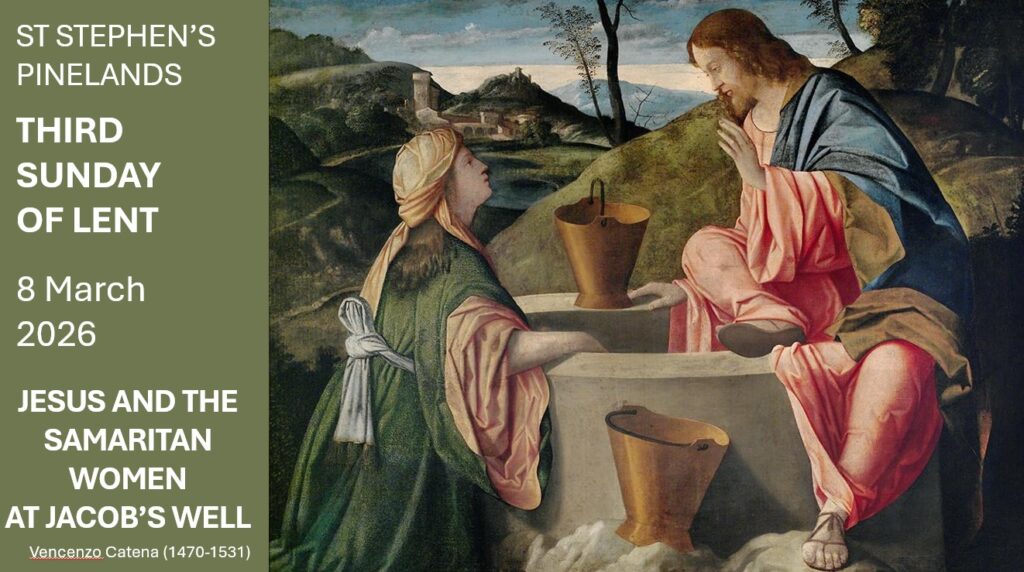
Think about such moments in your life right now. [Keep silent] I’m sure you can feel your cheeks going slightly red – you were embarrassed when you did or said it and although you’ve tried to forget about it, it keeps coming back to you and you re-live your embarrassment as you’ve just done now. You want it to be forgotten. Do you know what, you can do that? In fact, Jesus does just that with the woman at the well that we heard about in our gospel reading. He turned her need to forget thing in her past, if you like, for forgetfulness into memory, memories she can live with and acknowledge without fear of embarrassment.
Our Gospel reading this morning was thirty-seven verse long and this mainly because of the dialogue Jesus has with the Samaritan woman. Do you know this is the longest dialogue he has with anyone in the Gospels. Because John thinks it important, I’m going to consecrate on it too. I want to explore the subtle interchange of views between Jesus and the woman. To see how Jesus counselled her and show how his counselling changed her. And then to encourage you to explore this passage, or as some writers put it, for you to pray this passage and see how Jesus is not only answering the woman issues but also speaking directly to you.
That is one of the wonderful things that John, the gospel writer, is able to do in his Gospel. William Temple who has written a brilliant book on John said, his Gospel is like an onion, as you peel away one layer another appears, also needing to be peeled away to get to the heart of the matter. (Readings in St John’s Gospe4l: First and Second Series. William Temple. (London: Macmillan. 1939.)
Let’s start our journey to the heart of the matter. Let’s begin with the context of the story. Jesus is tired out; he is both hungry and thirsty. He sends his disciples into the city to get some food, and he sits down and rests at Jacob’s Well. A woman, who was a Samaritan, comes to the well to collect water. Now, this is unusual. Surely it was better to collect water early in the morning or perhaps as evening approached…but at noon? In the heat of the day? Was she trying to avoid going to the well when other women were there? Into this unusual situation we find Jesus and the woman starting to interact.
There were social obstacles which would normally prevent this happening. He was Jewish and she a Samaritan – Jews and Samaritans did not get along. They usually ignored each other. In modern terms we could say that each treated the other, as “Them”. You know what I mean… we say things like, ‘Well, what do you expect from them. They do this all the time, they naturally behave like that.’ But there was also an additional obstacle. Jesus was a man and, in those days, Jewish men and women do not converse in public. A Jewish man would not even speak with his wife in public.
John is so clever in his writing of this story showing the opposite poles that these two people represent. He was Jewish and male, she was a Samaritan and a female. He was superior she was inferior because of her lifestyle. But a dialogue begins between them, but as I’ve already said this dialogue goes deeper than merely talking about water and thirst, about holy mountains and husbands. Let me place that dialogue in seven parts on the screen for you.
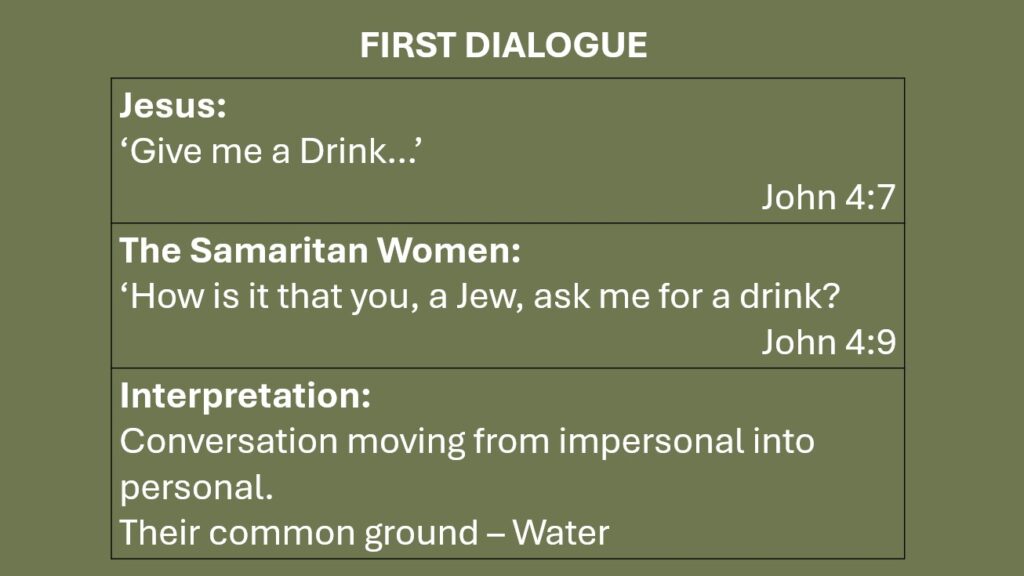
1st Dialogue: Already we see the conversation moving from the impersonal – water – to the personal- you a Jew me a Samaritan.
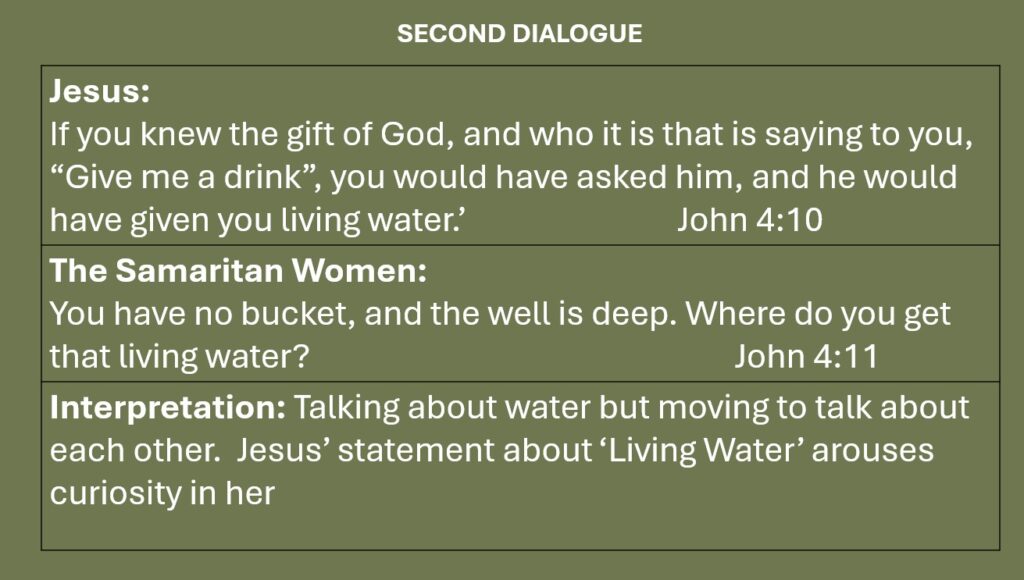
2nd Dialogue: It is still on water but now more directly personal. She addresses him personally ‘You’ and she is very curious about this living water.
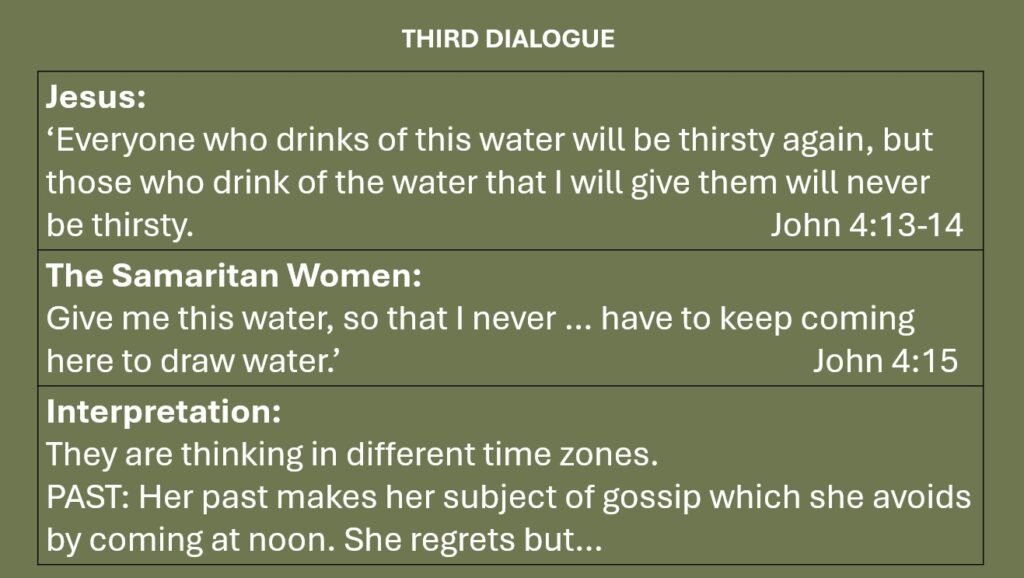
3rd Dialogue: She is thinking of the past and she has been the subject of Gossip. So she avoids others by coming at noon. She regrets the past and it causes her discomfort in the present… she wants more but …
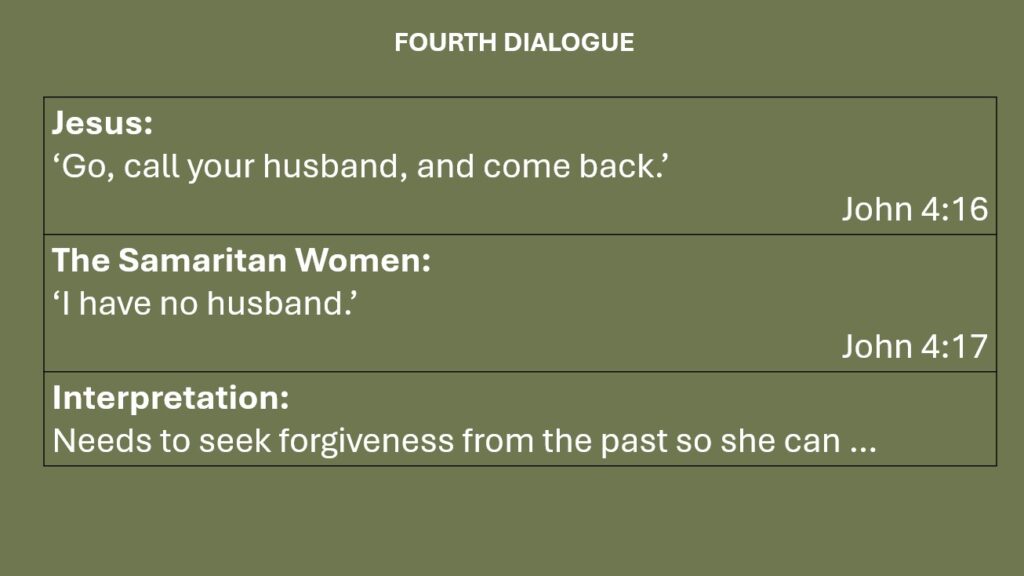
4th Dialogue: She needs forgiveness for the past in order to move on…
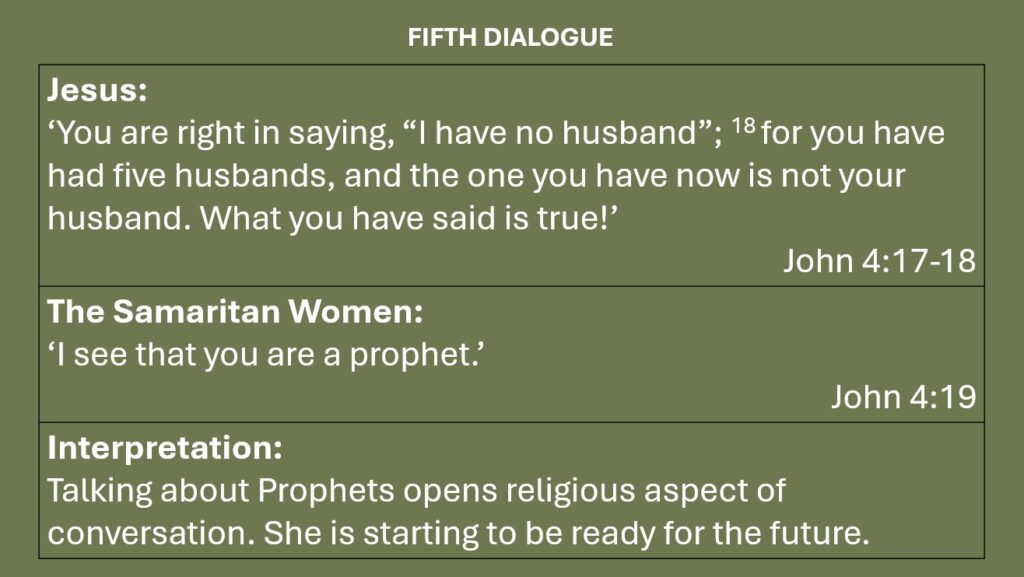
5th Dialogue: She starts talking about prophets. This means the dialogue is moving into the religious or spiritual realm. She is starting to be ready for what the future brings.
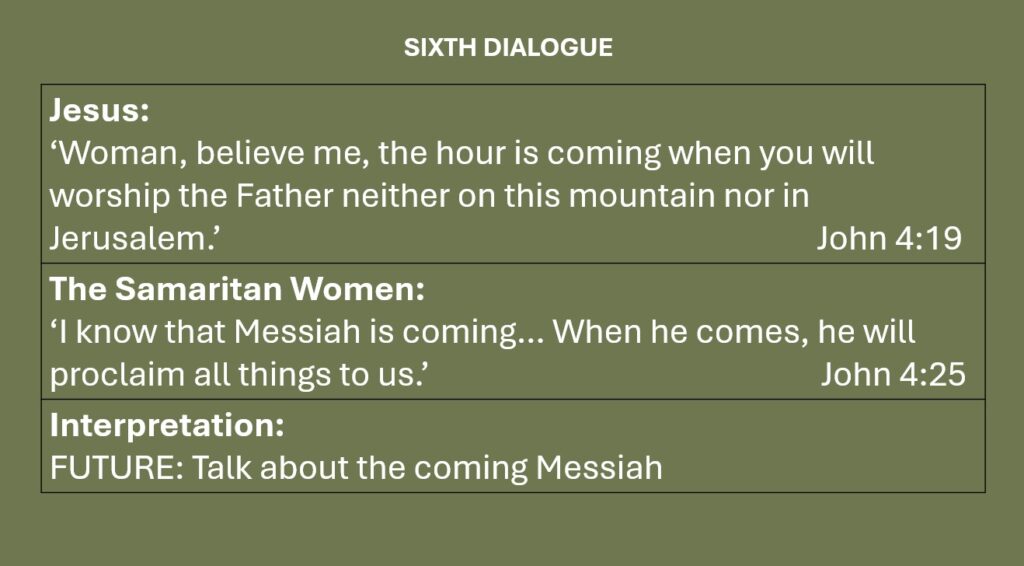
6th Dialogue: Now her thoughts are in the future, she is aware of the Messiah and what that means and what that will mean in her life
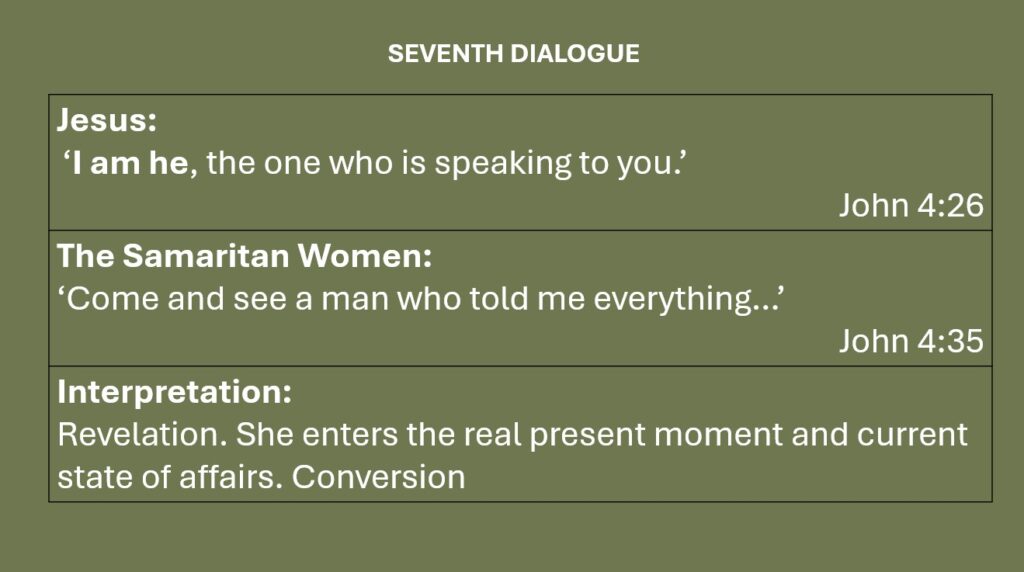
7th Dialogue: Jesus says I am he – for her that is a revelation leading to a conversion so she goes and tells other, ‘Come and see…’
In these seven interactions Jesus is gradually revealing who he is and as the woman responds she is gradually accepting who she is. For her this leads to an expansion of vision and as this occurs in her, so she starts to see the uniqueness of Jesus. Through this interchange he takes her from a place of forgetfulness – a place where she doesn’t want to look back at her past, she moves to a place of memory where she can let go all the denials and illusions of the past and finally come home to the reality of her life. Who she is and who God wants her to be.
The woman at the well starts by seeing Jesus as ethnically a Jew, then to seeing him stereotypically as a prophet, then to seeing him archetypically as Messiah to see his totality as revealer who ‘told me everything I have ever done!’
The woman is led away from her compulsive behaviour which is behaviour in bondage to the past. She no longer needs to repeat in a driven and unconscious way the patterns of the past. The energy previously locked-up in her defence of the past, is now free for her to use in witnessing, “Come and see a man who told me everything I have ever done!”
Do you know something? Her story can become your story. This woman, who questioned being compassionate to a Jewish man, Jesus, in his need for water, is just like us. Don’t we use the same excuse she used for not being compassionate to those who are different from us ethnically, ethically or from a different religious persuasion?
In us so often there are the same needs and emotional upheaval as this woman had. Her face is the face of all of us, showing the inferiorities and incompleteness that we have kept pushed down and hidden in our memories.
Can I suggest that later today or during the week we re-read this story, and as we pray through this Gospel reading, we look into this woman’s face and we will see our own faces mirrored back at us. This Samaritan woman is in fact an anonymous part of us. We live in that experience… but is it not real for us? So as we read and pray this gospel story we, like her, are drawn to Jesus.
This story, this special dialogue between the woman and Jesus can, should awaken us into a desire, a calling, to want to live in response to something other than worldly pleasures. I don’t know about you, but I want my life to be a response to meaning and value, I want to know that my life made a difference. All this leads me, leads us to transformation.
The story began with water and I want to end with a quotation from a book by Diarmuid McGann entitled Journeying within Transcendence: The gospel of John through a Jungian Perspective. (London: Collins. 1988):-
The Water Jesus speaks of to [the Samaritan woman] is best called “living” water. That is a unique quality. It is not stagnant water, fresh water, purifying water, washing water. It is living water. It is water that is active and dynamic. It becomes a fountain, springing up, bubbling over, surging and cascading water that is overflowing and constantly renewing itself. Jesus makes it clear that this water is a gift, and that it is given to her, and to [us], in the dynamic movement from forgetfulness to memory.
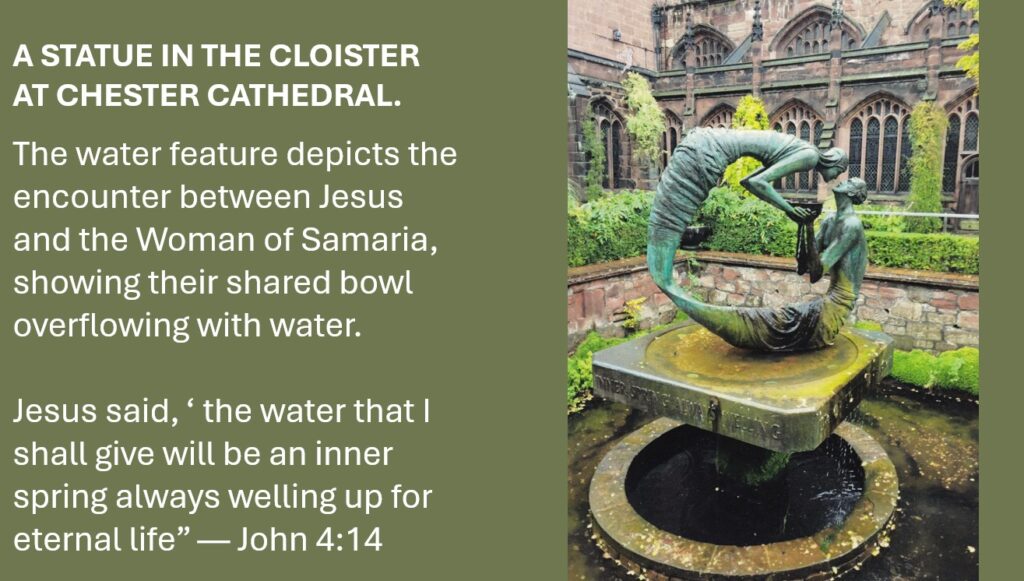
A final image of that interaction as depicted by a statue in Chester Cathedral Cloister which I will leave on the screen during the rest of the service.