Wet or Dry

The Pratts have done a different thing from most people. After eight years of retirement in the seaside suburb of Fish Hoek, we have moved nearer the city, to Pinelands.

We were warned by friends that Pinelands was ‘dry’. Having lived in Fish Hoek since 1957 (with a gap from 1994 to 2016 while serving as a priest) I knew exactly what that meant, what with the ’Defenders of Fish Hoek’ and all that! Another friend told us how she had heard that Pinelands was dry and had wondered why the infamous Western Cape winter rains didn’t reach Pinelands while soaking Newlands a mile or two nearer the mountains! Then the Pinelandians or is it Pinelanders had to explain to her that there had been, up to the formation of the uni-city in the late 1990s, no shops or restaurants serving alcohol.

In Fish Hoek that situation has now completely reversed. All the supermarkets in Fish Hoek have their adjacent bottle stores and most of the restaurants are licensed. Here in Pinelands they have only gone halfway. The restaurants serve alcohol but there are still no off-license or bottle stores within the old Pinelands municipality boundaries, though there are many just ‘over the border’ in Maitland and Mowbray and maybe at other sites I haven’t discovered yet.

Living Fish Hoek from the late-1950s I knew that ‘dry’ meant no sale of alcohol. I first came across it while in Wynberg Military Hospital to have my tonsils out aged ten years old. In the waiting room there was a sign saying that the SADFI Canteen was a dry canteen.  I had to ask my parents what that meant. SADFI or South African Defence Force Institute was a shop or store selling all manner of goods to service personnel and their families living or working in the military camp. As thius was a ‘Dry Canteen’ no alcohol would have been sold.

Although I knew what ‘dry’ meant I wondered if there was an opposite? Could a canteen selling alcohol be called a ‘wet canteen’? I discovered that there was. The term ‘wet’ was used to describe stores which had alcohol among the items for sale.

Many years later I came across these terms, ‘wet’ and ‘dry’ while researching my master’s thesis. The subject was the Anglican Church’s mission to the Muslim in the Western Cape. Although over the years many priests had been asked to take on this task by the Bishop of Cape Town, many saw a greater need elsewhere in the diocese. A good example were the Cowley Fathers (SSJE- Sacred Society of St John the Evangelist). They had been asked to come to the Cape to do the mission work among Muslims but found that little of no work was being done among the migrant Xhosa men working as stevedores at the docks or those constructing the dams on top of Table Mountain. Thus, the Cowley fathers re-directed their efforts in this direction.

In my research I had to ensure that there wasn’t any Muslim mission work being done by individual Cowley Fathers. I came across a reference to one father who had given evidence to the Cape Colonial Government Commission on the drunkenness of the so-called ‘Coloured’ people and other indigenous people in the Colony. In this Blue Book Report the Cowley Father giving evidence spoke about large number of ‘Wet Canteens’ in the poorer areas enabling easy access to alcohol for lowly paid workers. Having previously had the knowledge about ‘wet’ and ‘dry’ I knew what a Wet Canteen was and that it was not a bar through which a river flowed!

I wonder how much longer Pinelands will remain ‘dry’? I am told that a mall containing a Checkers supermarket is being built on the old Conradie Hospital site. This is just out of Pinelands but if customers want to purchase liquor as well as groceries I wonder how many will stop grocery shopping at the local Pick n Pay or Spar and drive to Conradie Park and kill two birds with a one-stop-shop. This could lead to a loss of trade, force these supermarkets also applying for a grocery store liquor licenses. Personally, I have no problem but let’s see how it all develops.
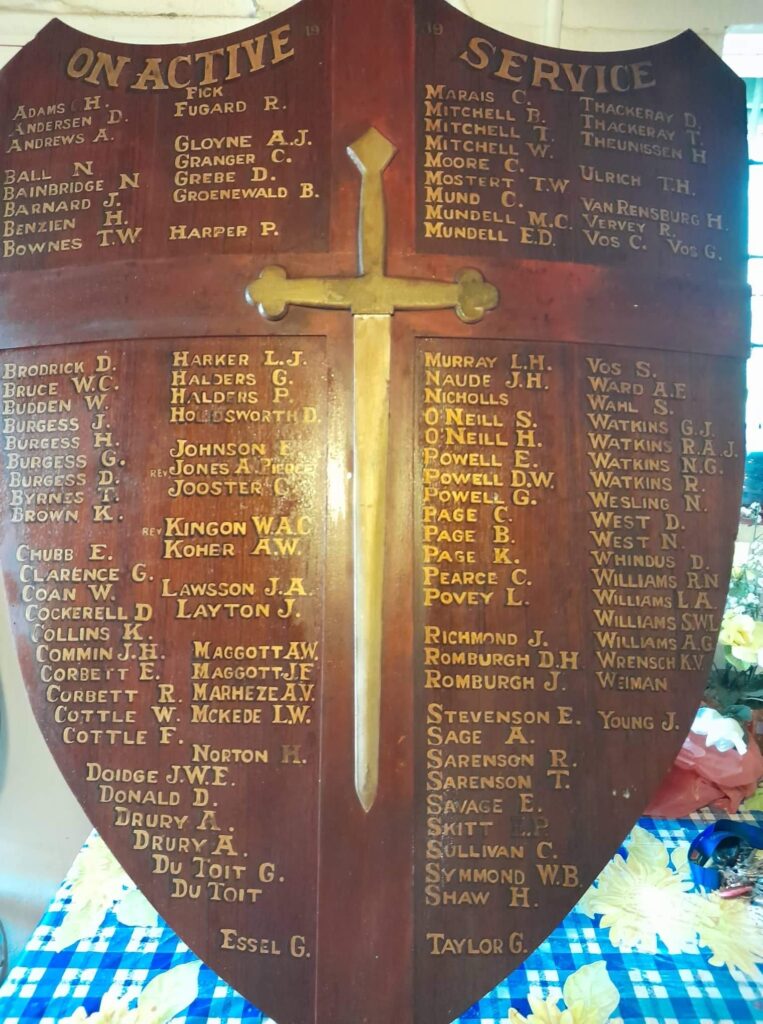
On Active Service

I Need some help!

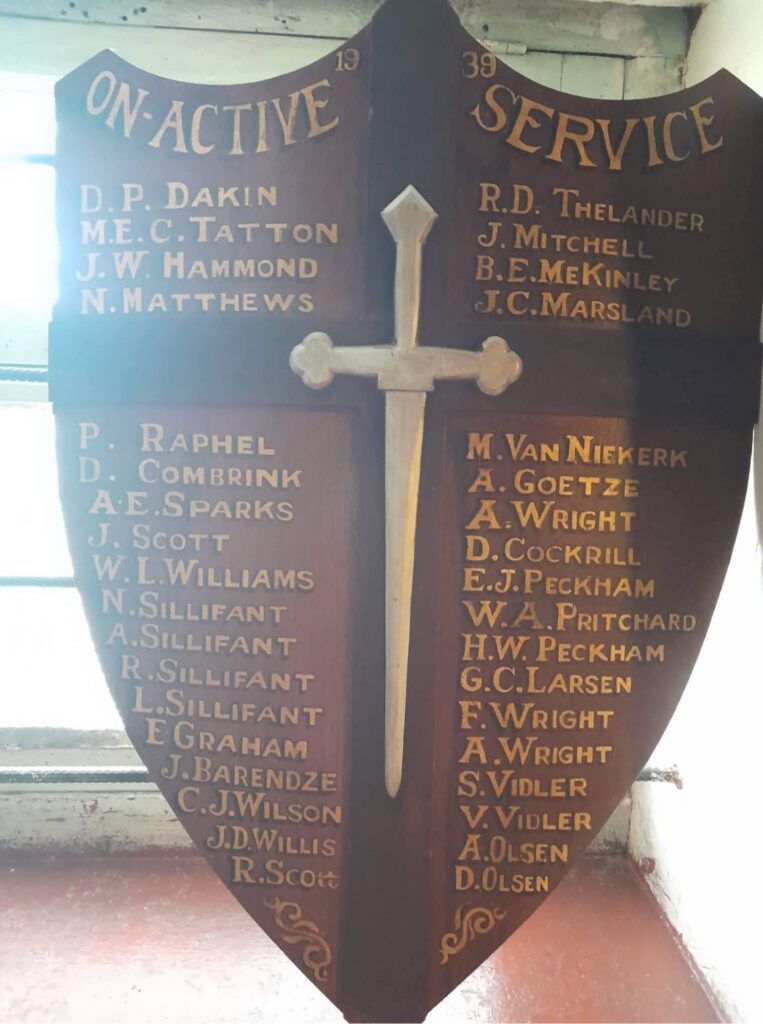
I was approached by the part-time secretary at All Saints’ Church in Roodebloem, Woodstock.  She was clearing out the church cellar and found the two shields pictured below.  They have 150 names on them and they both have a heading ‘On Active Service’ but one has the year 1939 on it.  I suspect that they were placed on the wall of the church so that worshippers could prayer for the safety of these men on active service.  The secretary asked me how she could find out more about these people.  Unfortunately, there are only initials and no first names and many of the surnames are quite common names like BROWN and WILLIAMS.  I have been doing some searches for the less common names and found quite a few who were baptised and married in All Saints Church but others I could find no entries on www.familysearch.org , www.gendatabase.com and NAAIRS.

I am wondering if anyone can help.  If you recognise a name and you know they had a Woodstock connection do let me know – especially if you have their first names.


I’ve Found My Grandad!

In January 2022 at the zoom meeting of the Cape Town Family History Society I gave a talk on the 1921 UK Census and how it seemed to give me a new paternal grandfather.  You can watch the whole talk at

Basically, the widowed Sarah BOARDMAN born PARISH married Charles PRATT on 21 June 1919.  On the 26 Sep 1919, my father, Thomas PRATT was born.  All I knew about my grandfather was that he was called Charles, was aged (according to the marriage certificate) 49 years, was living at a hostel for working men, Rawton House, and that his father was a mechanical engineer called Thomas PRATT and was deceased.  I also obtained Charles PRATT’s death certificate from 18 May 1924 (less than 5 years after my father was born).  His age is given as 54 years which matches the age on the marriage certificate. 

Charles PRATT was only part of my family from 1919 and had died by 1924 so it was hard to find definitive data on him.  I presumed (wrongly) that he must have come from Birmingham or the Midlands as ‘people, especially poor people, didn’t move about much in those days.’  I found a Charles PRATT from Birmingham whose birth year approximately matched that on Sarah BOARDMAN’s marriage certificate of 1919.  However, there was always a nagging doubt that I had the wrong man.  It was with eager anticipation that I looked forward to the 1921 Census, as this could tell me whether he was born in Birmingham or not.

The 1921 Census blew my paternal family tree wide open as it told me Charles PRATT was born in Bradford, Yorkshire and not Birmingham.  This meant starting my search for my grandfather from scratch.  I duly found a Charlie [sic] PRATT born about 1871 whose father was a ‘Steam Engine fitter’ which I suppose could be called an engineer as on the marriage certificate.  So was this the right Charles PRATT?

Following this Charles or Charley or Charlie PRATT through, I found he married a Mary Ann WILSON in July 1891.  By the 1901 Census they had three children, two girls (Annie PRATT 9y and Elizabeth PRATT 7y) and a son (Harold PRATT 5y).  I also found that Charlie PRATT was a drinker and assaulted his wife for which he appeared in court.  This assault must have made Mary Anne PRATT born WILSON decide to leave him and make her way to Philadelphia in the USA, taking the three children with her.

I then researched her and the children in the USA and found that she married Frank REGAN.  I also found Harold Thomas PRATT growing up, serving in the US forces in WW1 and marrying a Jessie KYNOCH in 1922.  They only had one son, Harold James PRATT.  He married Maria Madelaine WINTERBERGER in 1948 and had five children including another Harold, HAROLD ALAN PRATT.

I had asked someone in this family that I found if any had had a DNA test done.  He didn’t respond so I left it until a few weeks ago when I decided to delete from my family tree the other Charles PRATT from BIRMINGHAM and take a chance and enter Charles PRATT from Bradford as my grandfather.  While doing that I went to www.findagrave.com to get Harold Thomas PRATT’s date of death.  There I found that in 2018 a Harold PRATT had left digital flowers at his digital grave.  When one does this, there is a hyperlink to the person’s email.  As 2018 was relatively recent I thought the Harold Pratt who had left flowers would still be alive so I emailed him.

After some to-ing and fro-ing of emails, Harold said that he had done DNA via Ancestry.  I had done mine via Family Tree DNA (FTDNA) and thus could not upload it to Ancestry but he could download the raw data and upload it to Gedmatch.com where I had placed my DNA too.  This he kindly did.

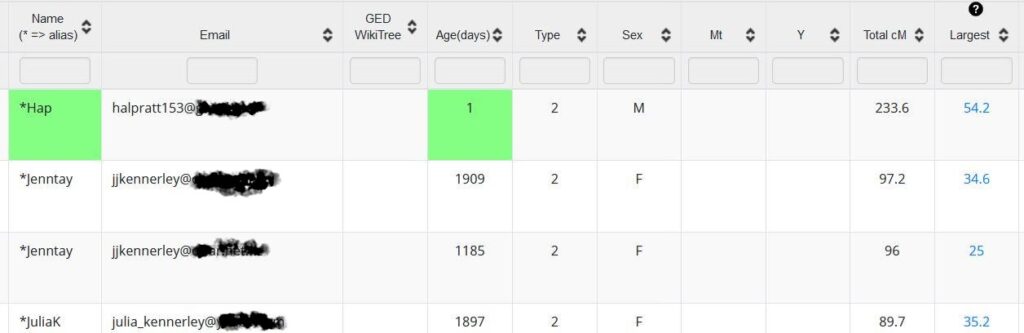
On Sunday 22 May 2022 I check out my possible matches of DNA and to my joy I found the following


This shows that Harold Pratt (Hap) and I have 233.6 cM of matching DNA, the largest string being 54.5

The two other entries on this screen-shot are from my maternal side.  Jennifer KENNERLEY has only 97.2 cM in common with me and her daughter Julia 89.7 cM.   They are my Third Cousin (3C) and Third Cousin Once Removed (3C1R) respectively.

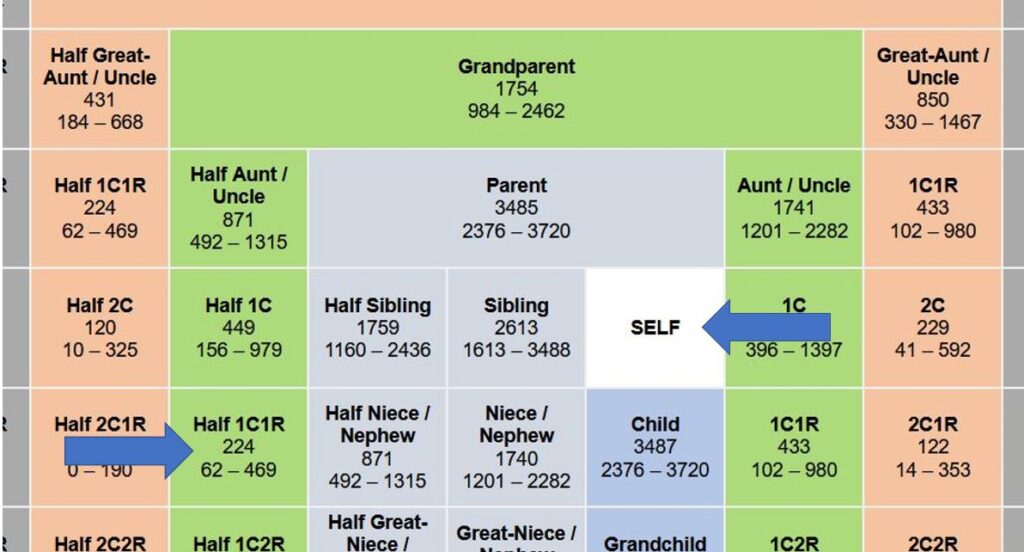
I worked out Hal PRATT’s relationship to me using https://dnapainter.com tool of projecting cM similarity.


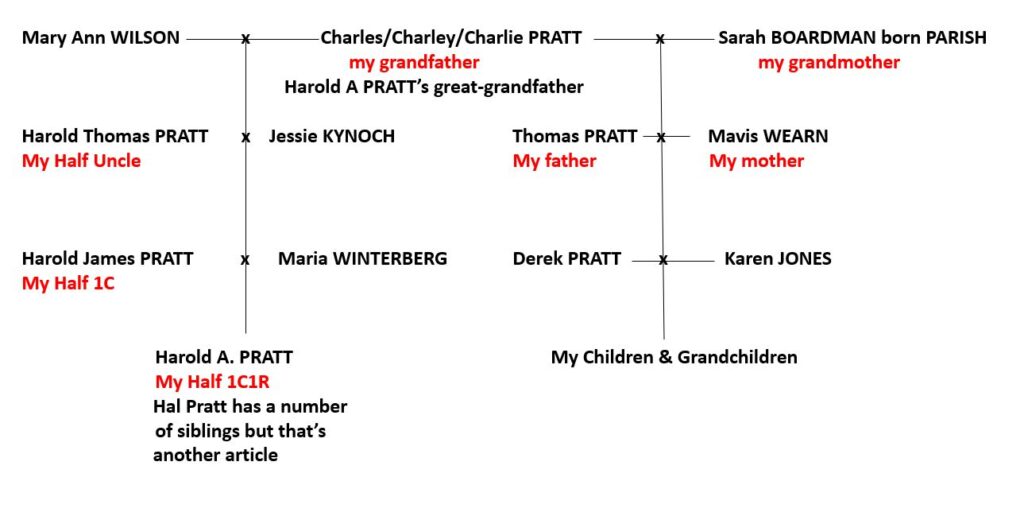
Self is me (Derek Pratt) and Half 1C1R is Half First Cousin Once Removed.  My Parent is my father (Thomas PRATT b. 1919), my Grandparent is Charles PRATT (1871-1924).  Then my half Uncle is Harold Thomas PRATT, my Half First Cousin is Harold James. His son is Harold Alan PRATT who is my Half First Cousin once removed.  Or to make it more visual 

Hal Pratt doesn’t have pictures of my granddad, Charles PRATT and nor do I.  He did comment that his great-grandmother Charles’s first wife, Mary Ann PRATT born WILSON later REGAN would get all upset when Charles name was even mentioned. 

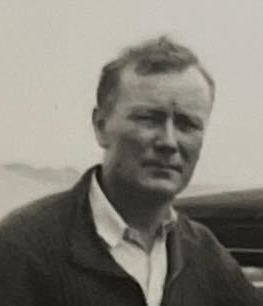
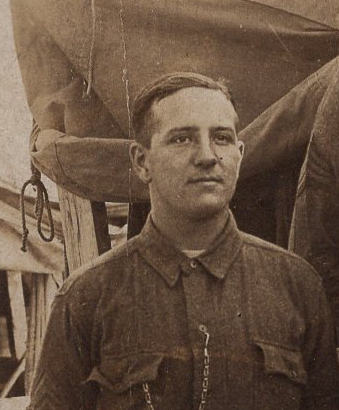
Hal kindly sent me a picture of his grandfather Harold Thomas PRATT when he joined the US Army in WW1.  I’ll put that alongside an early picture of my father.  Can you see any likeness between these two half-brothers?  Their age gap was twenty-three years.

Thomas PRATT, my father        Harold Thomas PRATT, my father’s half-brother

Baptism

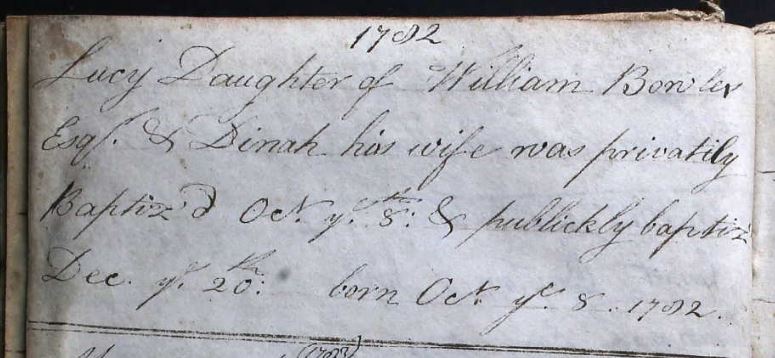
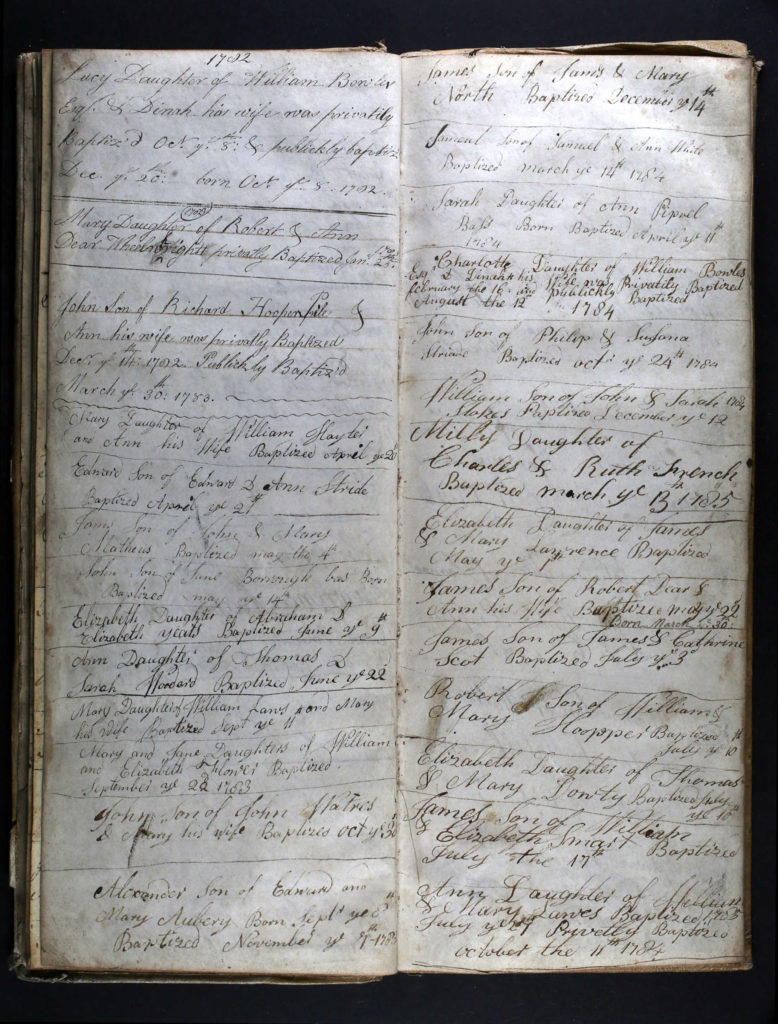
While searching for the BOWLES family of Woodford, Wiltshire, I found a few of the children of William and Dinah BOWLES whose entry into the Baptism Register of the local parish read the same as this entry for Lucy BOWLES.  I am just giving hers as an example:
Lucy daughter of William BOWLES Esq., and Dinah his wife was privatily baptized Oct. 8th and publickly baptized Dec. 20th  born Oct 8th 1782.

Now, this is not a blog-post to argue for or against infant baptism.  Infant baptism is the norm in Anglicanism, in this case the Church of England.  In those days (1780s) so often children died before reaching adulthood and confirmation or what we might call today ‘believers’ baptism’, that parents would have their children baptised as soon as possible.  Private Baptism does occurs when a child is sickly and could die before the parents could bring the child to baptism in the church.  Lucy was at least the third child to be baptised privately on her day of birth and a couple of months later ‘Publickly’.  I wonder why?

I have thought of a few reasons. 

  1. The entry in the baptism register does not show a hand of a hugely educated person. Lucy’s entry is one of the neater ones.  Was the local vicar a poorly educated cleric who did not have enough theology to know that one cannot be baptised twice?
  2. The BOWLES family lived in the local ‘big house’, Heale House.  Was the ‘living’ owned by William BOWLES and so the poor cleric did whatever he was asked to do by William?  Was William the squire and so able to throw his weight around. 
  3. Did the cleric just misuse the term ‘publikly baptised’ to mean ‘welcomed into the church’?
  4. Perhaps this was a common feature – a two-fold baptism months apart – at that time?
  5. Was William BOWLES away? He was a Royal Navy officer and might have been ‘at sea’ with an unknown return date so Dinah BOWLES went ahead and had a baptism on the day of birth and then a public baptism (if the child survived) when the child’s father had returned.

So many possible.  Which reason do you like?  Do you have any further suggestions?  Add a comment or email me via “Contact”