Advent 3 – Joy of Heaven, right here right now.

On twitter earlier this week I saw this tweet from Fleming Rutledge.
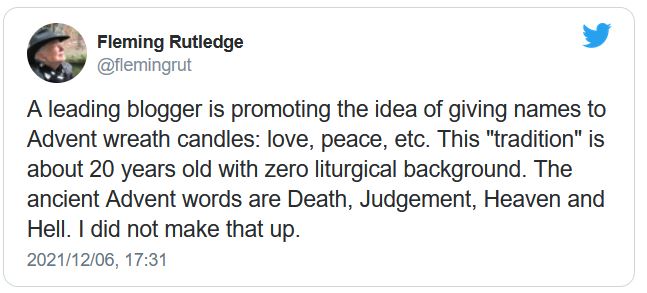
I must admit that while serving in a parish I promoted the idea of giving names to candles in the Advent Wreath in order to link that candle-lighting to the rest of the service.  Now that I’m out of parish ministry without the need to explain the lighting of Advent Wreath candles to the congregation, I’m tending to agree more with Fleming Rutledge.  In fact, looking back at the previous two Sundays online sermons1,  I see that on Advent 1 I wrote on ‘the Three Comings’ which includes the coming of Christ at the end of time, so it seems to speak about ‘Death’ and how we need to be ready for the coming of Christ to us even before the Final Trumpet is heard.  Last week I wrote about ‘Change’ and how we need to change.  Change is something that judgement brings.  If we just carry on without that change then we will be judged again and again till we do change.

This week the word given by that tweet is ‘Heaven’.  The readings for this Sunday seem to ring out about rejoicing and if (or when/) we get to heaven, we will be rejoicing!  This comes through so clearly in the three readings.2  

The First Reading tells God’s people to shout for joy.  Zephaniah 3:14
14 Sing aloud, O daughter Zion; shout, O Israel!
Rejoice and exult with all your heart, O daughter Jerusalem!

The Second Reading exhorts Christians to rejoice always. In fact, this passage gives the name to this Sunday Gaudete Sunday .3
Philippians 4:4,6 Rejoice in the Lord always; again I will say, Rejoice. … Do not worry about anything, but in everything by prayer and supplication with thanksgiving let your requests be made known to God.

I well remember singing Henry Purcell’s anthem Rejoice in the Lord, always (also known as The Bell Anthem) at St Margaret’s in Fish Hoek with the rector, Canon John Aubrey singing the Bass solo part in the verse and Mr Charles Foot singing the tenor.  I can’t remember who sang the alto part.
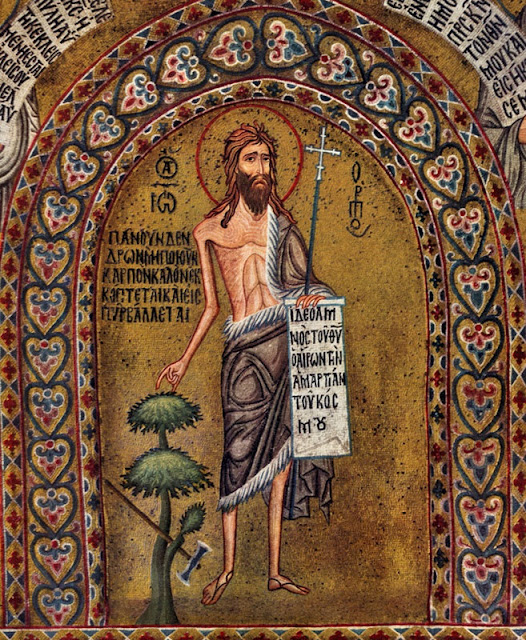
Icon of John the Baptist

Even the Gospel Reading that has that usual prophet of doom4 John the Baptist preaching, doom but more importantly Good News to the people.  Christ will ‘baptize you with the Holy Spirit, and the Holy Spirit will then dwell in you.  I baptize you with water; but one who is more powerful than I is coming; I am not worthy to untie the thong of his sandals. He will baptize you with the Holy Spirit and fire. 17His winnowing-fork is in his hand, to clear his threshing-floor and to gather the wheat into his granary; but the chaff he will burn with unquenchable fire.’ Luke 3:16-17
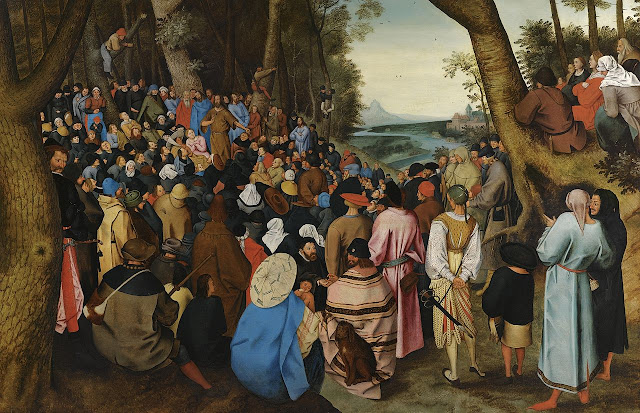
John the Baptist preaching to the crowd. Pieter Brueghel the Younger.

We all know the famous question, ‘What do you want to hear first, the Good News or the Bad News?’  When thinking about what is Good News, it helps to have some sense of what the bad news is. 

Notice in the Second Reading that the call to rejoice is followed by an exhortation to have no anxieties. Do not worry about anything v6.  My thinking then, is that the bad news is everything that raises those anxieties. The First Reading spells out some of those anxieties.  There are enemies; there are misfortune—sickness, poverty, unemployment, natural disaster, and all the rest.  It is possible to find some peace about all these things by bringing them to God in prayer and putting your trust in him.  Eleonore Stump says: ‘At any rate, that is the antidote to these anxieties recommended by this reading.’5 
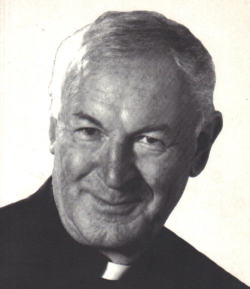
The Very Rev Edward King, Dean of Cape Town for thirty years 1958-1988

Although I agree that this is the antidote, I am not sure how she sees this in the reading.  This reference brought to mind an Advent sermon of the late Dean Ted King that I was reading the other day.  He was exploring how Advent was a time for self-examination and he commented on how we brush off people and events with remarks like, “‘Of course I will pray for you, my dear’ – but we don’t.  ‘You are often in my prayers.’ We say it, but they are not”. 6

But a person can have anxieties that are harder to bring to God. There are the relationships that have broken, the wreckage that is happening in our home, the failures that we are culpable for at work.  Sin can paralyze any effort at joy, in loving relationship with God and others.  Eleonore Stump makes a telling comment, ‘We can put our trust in God; but what happens when we know that God can put no trust in us? What happens to joy, in the face of this thought?  That is the bad news.

But what is so interesting is that this is also where the good news comes in. The First Reading from Zephaniah promises that Godwill rejoice over you.   Why?   The answer is also in the First Reading: God will renew you; and when he does, you will be so lovely that God himself will make songs about you and for you, and God, Gods-self will sing these songs to you.

The Lord, your God, is in your midst,
   a warrior who gives victory;
he will rejoice over you with gladness,
   he will renew you in his love;
he will exult over you with loud singing
18   as on a day of festival.
v17,18

That is amazing good news, isn’t it?  But there’s more, as the TV adverts say about any special offers.  In the Second reading from Philippians, the writer tells us:

7And the peace of God, which surpasses all understanding, will guard your hearts and your minds in Christ Jesus.

But how can it be? 

This is where the good news from John the Baptist comes in.  He tells his hearers that Christ will baptize with the Holy Spirit, and the Holy Spirit will then dwell in us.  Christ is Emmanuel, God with us, and he brings God the Holy Spirit into us.  When God is with us and in us, how can we ???keep from singing for joy?

Certainly, Henry Purcell could not help singing for joy.

This reflection is based on an idea of Eleonore Stump from: https://liturgy.sluhostedsites.org/3AdvC121221/reflections_stump.html


  1. Are they sermon which are never preached? They are an opportunity for me to think more about my faith but I am loathed to call them meditations? ‘Thought-piece’ sounds a bit pretentious so if any of you can think of another name for them do let me know. []
  2. For full versions of the readings go to: https://lectionary.library.vanderbilt.edu/texts.php?id=97 []
  3. Gaudete Sunday is the third Sunday of Advent. The name comes from the Introit for Gaudete Sunday, which is taken from Philippians 4:4,5 Gaudete in Domino semper, or “rejoice in the Lord always.” On Gaudete Sunday, having passed the midpoint of Advent, the Church lightens the mood a little, and the priest may wear rose vestments. https://www.learnreligions.com/what-is-gaudete-sunday-542429 []
  4. Luke 3:7,8 ‘You brood of vipers! Who warned you to flee from the wrath to come? 8Bear fruits worthy of repentance.’ []
  5. https://liturgy.sluhostedsites.org/3AdvC121221/reflections_stump.html []
  6. Edward King. Discovering God: A selection of sermons by Edward King, Cape Town, privately published, 1988, p.40 []

Thoughts on Advent Sunday

ADVENT SUNDAY 28 Nov 2021

The Readings[1]

Jeremiah 33:14-16

14 The days are surely coming, says the Lord, when I will fulfil the promise I made to the house of Israel and the house of Judah. 15In those days and at that time I will cause a righteous Branch to spring up for David; and he shall execute justice and righteousness in the land. 16In those days Judah will be saved and Jerusalem will live in safety. And this is the name by which it will be called: ‘The Lord is our righteousness.’

1 Thessalonians 3:12-4:2

12And may the Lord make you increase and abound in love for one another and for all, just as we abound in love for you. 13And may he so strengthen your hearts in holiness that you may be blameless before our God and Father at the coming of our Lord Jesus with all his saints.

4Finally, brothers and sisters,* we ask and urge you in the Lord Jesus that, as you learned from us how you ought to live and to please God (as, in fact, you are doing), you should do so more and more. 2For you know what instructions we gave you through the Lord Jesus.

Luke 21:25-28,34-36

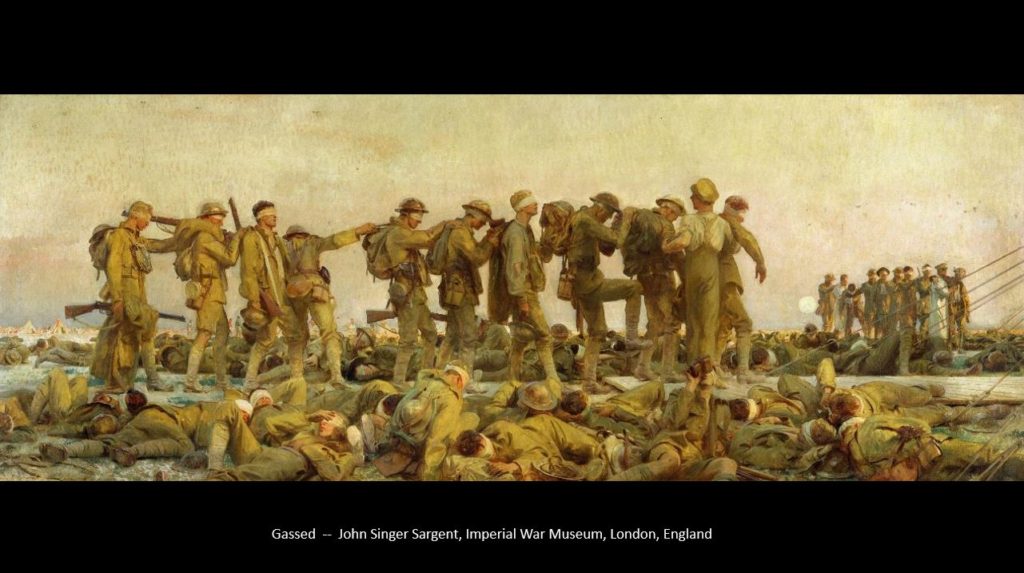
25 ‘There will be signs in the sun, the moon, and the stars, and on the earth distress among nations confused by the roaring of the sea and the waves. 26People will faint from fear and foreboding of what is coming upon the world, for the powers of the heavens will be shaken. 27Then they will see “the Son of Man coming in a cloud” with power and great glory. 28Now when these things begin to take place, stand up and raise your heads, because your redemption is drawing near.’

34 ‘Be on guard so that your hearts are not weighed down with dissipation and drunkenness and the worries of this life, and that day does not catch you unexpectedly, 35like a trap. For it will come upon all who live on the face of the whole earth. 36Be alert at all times, praying that you may have the strength to escape all these things that will take place, and to stand before the Son of Man.’

Some Thoughts on the readings

The Jesuits of Ireland run a very interesting website[2]  with brief meditations of the scripture reading for each day of the year.  In the Advent Sunday Year C readings, the commentator (unnamed) makes an interesting point that they speak of three ‘comings’.  That is the actual meaning of Advent.  The term “advent” comes from the Latin word (adventus) meaning ‘coming, arrival’.  We have tended to think that this refers to the coming of Jesus at Christmas and that is correct, but, as the commentator points out, it is not the whole story.  The commentator suggests that there are three comings of the Lord, all of which are referred to in the Scripture readings for Advent Sunday in Year C.

The Three ‘comings’

The First Reading from the prophet Jeremiah refers prophetically to the coming of Jesus, our King and Saviour: In those days and at that time I will cause a righteous Branch to spring up for David; and he shall execute justice and righteousness in the land.  This is, of course, the coming of the child Jesus in Bethlehem.  This is what we anticipate and prepare for in the four weeks leading to Christmas. The commentator calls this the First Coming.

Today’s Gospel reading speaks in ominous terms of the end of the world and what we refer to as the Second Coming of Jesus at the end of time: Then they will see “the Son of Man coming in a cloud” with power and great glory.

I always find it a bit irritating that the three readings used at the Eucharist are in the order Old Testament, New Testament and then Gospel.  Most preachers preach on the Gospel reading so having it read just before they preach is a good thing but it is irritating when we realise that the New Testament reading is the response to the Gospel, as it is, in some ways, today. 

The Gospel reading is telling us about the end of time.  You might think this strange on the day, Advent Sunday, that preachers proudly proclaim to be the beginning of the new church’s year.   

Now all that I’ve said demonstrates our human way of thinking.  Us human beings typically live with a fairly linear view of time, that one event (or reading) comes after another.  But the church’s liturgical and lectionary calendar is cyclical where patterns of events repeat themselves.   That is the reason that the church’s year that begins in Advent and the reading we hear are about the end of history before the move, in later weeks of Advent, to prepare us for the coming of the Christ child and the dawn of a new age.

But today we hear Luke being down right vague about when Jesus will return.  For us on this Advent Sunday with the appearance of the Omicron variant of COVID occurring this past week, we might think that Jesus’ return will be sooner rather than later.  But Luke does not give us any hint of a timetable, whether it is now or later.  Instead, he asserts that, just as budding fig leaves unmistakably herald the advent of summer, so also will the signs of the coming kingdom be transparent to the Christian community – to us who call ourselves Christian.  So, his emphasis is not on ‘when’ but on the way of discipleship the Christian Community should be following right now.  This Luke does in the last part of today’s Gospel but it also leads us, the hearers of the three readings on this Advent Sunday to the New Testament reading.

This is the third coming that is spoken about in the Second Reading and which forms an important and indispensable link between the First and Second Comings.  It is the welcoming of Jesus into our lives in the here and now. This is something which takes place every day.  By it we both acknowledge the First Coming of Jesus in Bethlehem and prepare for the Second Coming at an unknown future date.

In our journey of life, Advent Sunday Eucharist readings suggest what our approach should be.  If we want to celebrate the First Coming of Jesus and prepare for his Second Coming, then the way to do it is to be aware of his coming into every moment of every day.  And how can we do this?

The Jesuit commentator[3] uses a delightful image of the journey of life being like a bus journey.  The Scripture readings for today tells us that on our bus journey of life we should:

  1. Be ready to get off the bus at any point, that is, be ready to meet the Lord whenever he calls us to himself, whether that be in the very near future or many years away. The important thing is: Be prepared.
  2. Not to be afraid, not to worry.  Fear, worry and anxiety do not solve any problems. Fear, worry and anxiety are about things which do not yet exist and most probably will never exist as we imagine them. As Antony de Mello used to say: “Why worry? If you worry, you will die; if you don’t worry, you will die. So why worry?”
  3. Improve our relations with the people around us.  A good life consists not so much in the kind of work we do or how “successful” we are but how we have related with other people – with family, other relatives, friends, colleagues and total strangers.

[1] From http://bible.oremus.org/

[2] https://livingspace.sacredspace.ie/

[3] https://livingspace.sacredspace.ie/

The illustrations used are from https://lectionary.library.vanderbilt.edu