Sermon: 9 Oct 2022

On Sunday 9 Oct and 16 Oct 2022 the Rector of St Clare’s, Ocean View, Fr Ulrich Groenewald asked me to do the 8am Eucharists services. Here is the sermon I preached on Sunday 9 Oct 2022.
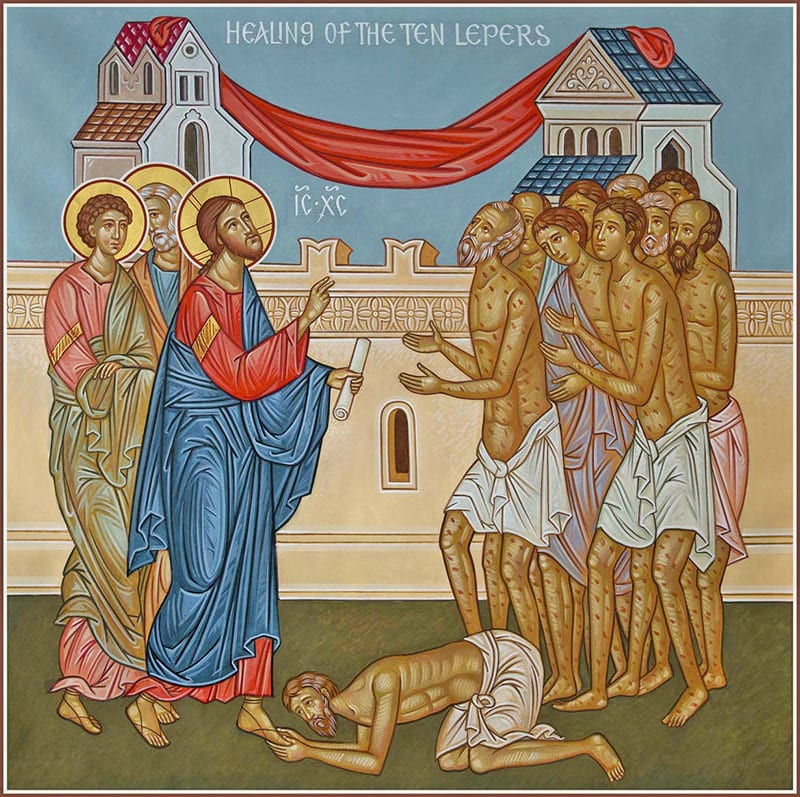
Jesus Healing the ten Lepers. Luke 17:11-19

In today’s Old Testament and Gospel readings we hear about leprosy being healed.  What is this leprosy we hear about in these readings?  Leprosy is a chronic infectious disease caused by a bacillus, Mycobacterium leprae. It mainly affects the skin, the peripheral nerves, mucosa of the upper respiratory tract, and the eyes.  It begins with skin lesions affecting the nerves so the person has no feeling in that area.  If left untreated, leprosy can cause progressive and permanent damage to the skin, nerves, limbs, and eyes.  Those living with untreated leprosy suffer from paralysis and crippling of hands and feet, with the shortening of toes and fingers due to re-absorption as well as nose disfiguration. 

Now, don’t for a moment think that leprosy is something from the past, only found in the pages of the Bible. Perhaps you do not know of anyone with leprosy today, but here in Cape Town I know of at least two sites where leprosy was treated in the 1800s and 1900s.  Robben Island, before it became a gaol for political prisoners, was both a psychiatric hospital as well as a hospital for lepers.  It was here that the Anglican monastic order, the Society of St John the Divine commonly known as SSJD or the Cowley Father’s ministered.  One of these father’s Fr Congreve, wrote in his biography about how he spent time on Robben Island and received communion in the Church of the Good Shepherd there.  He knelt down at the altar rail to receive, right next to person with advanced leprosy and Fr Congreve felt moved that as he lifted his hands to receive the Body of Jesus in the form of a communion wafer, the leper kneeling next to him lifted his damaged hands with shorten fingers to receive that same body of Christ.  ‘We who are many are one body for we all partake of the one bread.’

Some of you might have been to the Retreat Centre, St Raphael’s in Faure.  In the early 20th Century St Raphael was isolated from the city of Cape Town which now encircles it with suburbs, but in the early days the Anglican Church ran St Raphael’s as a leper hospital.  In the small chapel at St Raphael’s, you will see on the altar a picture of a leper saying to Jesus “Lord, if you are willing, you can make me clean.” This is from Mark’s Gospel and Mark tells us that Jesus reached out his hand and touched the man and said: “I am willing.”  When I was at St Raphael’s on my ordination retreat 26 years ago, I was greatly moved by these two statements.  “Lord, if you are willing, you can make me clean.” Jesus Christ reached out his hand and touched him. “I am willing,”   Isn’t it wonderful to have Jesus say to us… I am willing?

In our Gospel reading today there is not one but ten lepers that are healed.  They have gathered as a group outside a town.  They had to do that because the people of the town knew that leprosy was infectious and so they didn’t want those with leprosy, who they saw as being unclean, in their neighbourhood.  But these lepers had to live somehow, so as a group they stayed just outside the town to beg from those coming and going to and from the town.  On this day Jesus and his band of followers came that way and so they call out to him ‘Jesus, Master, have mercy on us!’.  When he saw them, he told them to go and show themselves to the priests.  This was because the Jewish people lived in what could be called a theocracy.  God was their ruler.  Because they could not see God, it had to be God’s intermediaries, the priest, who made decision on whether the lepers were clean and could re-enter society, go back and live in their town again. 

Now notice there was one among them one who was not a Jew.  He was a Samaritan.  Jews despised and even hated Samaritans.  Those other nine lepers, when they were rejected so was the non-Jew among them, the Samaritan.  As they had all been rejected, they were willing to have him in their group.  But now they were healed and hurrying to the priests to get the all clear.  That Samaritan man realised he was no longer acceptable to them.  He turns, not to the priest to get the all clear, but to the man who had healed him, Jesus Christ. Notice what Jesus said:  ‘Were not ten made clean? But the other nine, where are they? 18Was none of them found to return and give praise to God except this foreigner?’ Then he said ‘Get up and go on your way; your faith has made you well.’  What faith?  That Samaritan didn’t believe in the same God as the other nine Jews who were healed but that didn’t make any difference to Jesus.  ‘Get up and go on your way; your faith has made you well.’ 

What can we learn from the Gospel reading?  Is it merely that we have to say thank you?  I have a 3y old grandchild called Elias and when he asks for something I keep on saying to him, ‘Say please?’ and when I’ve given it to him, I ask him: ‘Do I hear a thank you?’  Please and thank you is what my mother drilled into me when I was young as I’m sure your mothers did too.  But does this story of healing carry a deeper teaching for us than just saying thank you?

I think it does.  You know we all have people with leprosy in our family, in our community and within our nations.  No, not the disease caused by that bacteria, but rather the way we treat others as if they had leprosy.  We chase them out of family, our community, our nation.  And if we can’t chase them away from us, we treat them as if they no longer exist.  Perhaps someone in your family who fell pregnant while still at school, or someone who is gay, basically anyone who is radically different from you.  You reject them and treat them as if they had leprosy.  And in the Ocean View Community, what about the gangsters and the drug-dealers?  In our nation, what about the foreigners?  Let each of us think for a moment of someone, some group we have treated as if they have leprosy………

How did Jesus respond to those with leprosy?  “‘Go and show yourselves to the priests.’ And as they went, they were made clean.”  What can you do to help people you reject to be made figuratively clean?  That is something between you and God but God has given you Jesus as the example.  What does he do?  Can you do the same?

I want to end by giving a personal story, a sort of testimony.  When I was rector of St Andrew’s in Steenberg I was on my way up Military Road to go to the Blue Route.  The railway crossing booms at Steenberg Station were down so I decided to sneak past the waiting traffic and make my way along the road that runs parallel to the Railway line and cross at White Road.  Unfortunately, as I tried to sneak past, I slightly scratched a bakkie in front of me which had a pile a young men in low-slung jeans and hoodies sitting in the back.  One leapt off and started cursing me in some choice language.  Realising I was at fault I nervously got out the car and the bakkie driver did the same.  He was tall, thickset man with a shaved head and to me had the typical look of a gang-leader.  He indicated to me the scratch on the bakkie, which I could barely see.  My car was fine but he said that I would have to pay R150 for his car to be repaired.  It was a small amount compared to most panel-beating quotes so I thought, ‘Let’s just pay this man and get it over with.’  Basically, I was treating him like those lepers outside the town we heard about in the gospel – I was just throwing money at him to get him out of my hair.  I said I didn’t have any cash on me then but if he came to my house in Bothma Street at 5pm I’d give it to him.  At first, he didn’t believe that any white people lived in Bothma Street but I told him I did because I was the Anglican priest at St Andrews.  So he agree to come at five.

At five the front door bell went and there he was.  I thought, ‘I’m not going to invite you in because you might check out my possessions and decide to come and burgle the house later’, so we chatted on the front door step. – See I’m still treating him as a leper.  After I had given him the money, he started talking about himself and his girlfriend and their son.  He would have liked to have his son baptised so that the son would have a better chance in life than he did.  I said to him that if he came to church on Sunday, I would enrol him in the Baptism Preparation classes and we could then talk about him and his girlfriend getting married.   Our conversation was taking so long my wife kept looking through the glass pane on the side of the door to make sure that I hadn’t been kidnapped or stabbed.  But I was quite safe talking to this gangster. 

I would love to tell you that the following Sunday he was in Church.  Unfortunately, he wasn’t but maybe because I was willing to listen to his story and encourage him, he felt less rejected, less like a leper.  Perhaps he came to church after I had moved on to my next parish and perhaps the priest who succeeded me, baptised his son and married him and his girlfriend.  And perhaps he then heard Jesus say: ‘Get up and go on your way; your faith has made you well.’

You, too, can make a difference.  To know how and to do what, will depend on your relationship with Jesus.  You must listen to what he is saying to you, through his word and through your prayers.
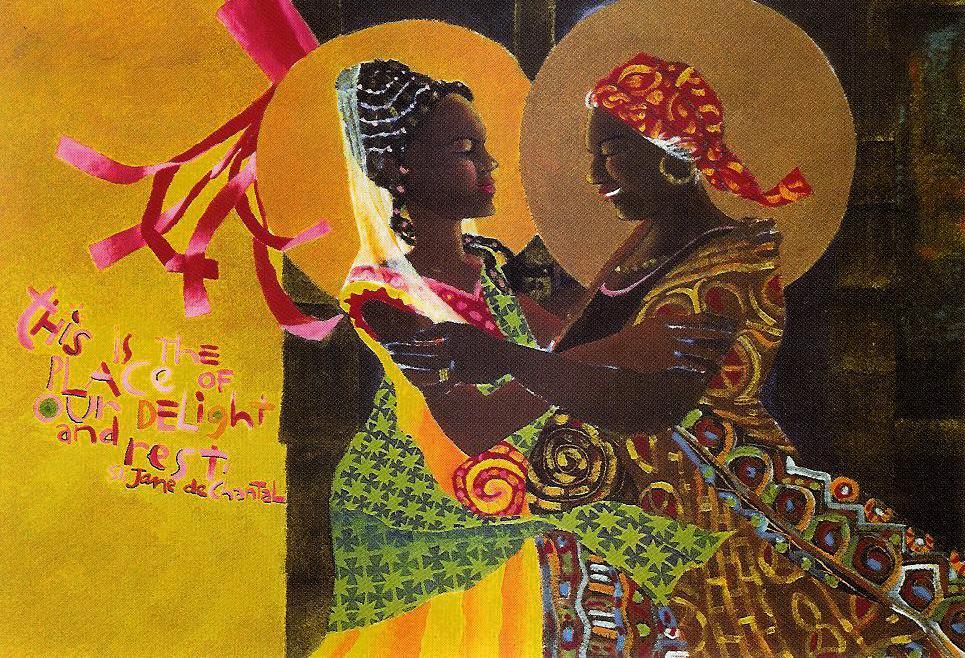
A New Commandment

Sermon 5 Sunday of Easter preached at St Clare’s. Ocean View.

Each Sunday we have a set of readings.  In these Sundays after Easter we have a reading from the Book of the Acts of the Apostles, a psalm and a reading from a Gospel.  Have you ever wondered how they decide which reading should go on which Sunday and how reading fit together?  I think what they do is try to find a theme in the Gospel reading and then find the other readings to fit into that theme.  Then the same message is given in each reading.  Any guesses what the message is in today’s readings? Well, I’ve spent the last few days thinking about this, I’ve come to the conclusion that the theme in today’s readings is the wideness of grace and salvation offered by God.  Okay I’ve just said two theologically loaded words, so let me explain: grace is God’s free gift to us.  And what is that free gift?  Salvation.  God saves us.  Yes, God does save us.  But is the salvation and grace offered by God restricted to a small group of people only?  Or are the gates of salvation wide open for all?  

I’m afraid to say that often we believe that God will only save people like us.  Only save good Anglicans, who have been confirmed and come to church regularly.  I’m also afraid to say that our faith is often xenophobic – we don’t want to worship with people foreign to us or different from our way of life.  We make it worst by saying that our brand of spirituality and church is the only way to God.  We say to ourselves that our culture, our ethnicity, our traditions, and all that we hold dear spiritually is the only thing God accepts.  Well I’m here today to say that if we think like that, we are wrong.  God is generous with grace and salvation.  God reveals God-self and saves all who turn to God.  You see, our ways of thinking are not God’s ways.  There is that wonderful hymn that says that there is a “wideness in God’s mercy”, a wideness that far exceeds our own.

So, do our readings today show us this wideness of God’s mercy to all? Let’s have a quick look.

In the 1st reading from the Book of Acts, Peter defends breaking down the barriers between Jews and Gentiles.  The Gentiles were considered inferior and unworthy of receiving the early church’s message and being offered the salvation of God.  Peter tells of his encounter with Cornelius and he proclaims that all are chosen, not just one nationality or one way of worship and one sort of lifestyle.

Now this wasn’t just because Peter was a liberal or he just felt like saying it.  It was the result of what God did.  God gave Cornelius and his family a full portion of the Holy Spirit and so Peter affirmed those former “outsiders” as full-fledged members of the new emerging Christian movement, that we now call the Church.  Their acceptance was grounded in God’s blessing.  The early Church was acknowledging that diversity was and still is a gift of God and that God will be revealed in a variety of ways, according to culture, ethnicity, and personal experience.   The Church today must do the same. 

[Omit at 8am. Who are in the confirmation class?  Put up your hands.  Congregation, look around you at these young people.  Are they diverse in their culture, their ethnicity and their personal experience?  Yes they are and so we must welcome them as fully fledged members of our Christian movement, our Church.]

After every sermon you hear, you should be asking yourself, “What does that mean for me?”  So, what is my sermon today saying to you?  It is saying that we should be open to the different ways of God’s revelation to us and to others around us.  We should be welcoming those who are different from us with hospitality and not with fear.  We should be willing to expand our faith through meeting and interacting with others.  The church must embrace diversity, embrace those who are ethnically, racially, theologically, or sexually different from us.   But let me hasten to say that embracing the diversity of others does not always mean acceptance of all behaviours and opinions of other, but it means being open to the experience of others.  If we believe God is everywhere and God is active in all things then there is no place where God isn’t revealed to us.  Our faith will grow when we seek God in all everything.   What do I mean by that?  You see a movie or a TV show – have you thought about seeking God in those?  Have you asked yourself:  What is God saying to me in this TV drama?  When you read scripture you ask yourself that, why not ask yourself that in everything you see or do? What is God telling me in this?

And this leads into this morning’s psalm 148, because that is what the writer of the Psalm asked as he or she proclaimed a world filled with praise.   For the psalm-writer everything praises God.  We must look at our world with that attitude:  the beauty of a sunset, the sound of birds in the trees, the grasshopper sitting on a flower in our yard, our Muslim neighbour bowing in prayer, our friend, a faithful Roman Catholic praying with her rosary, your rector spending time studying God’s word, and even young children playing with toys.  All things, at their deepest, praise God by their very being.   

Thomas Merton a great spiritual writer once said that a tree, just simply growing in a field is praising God because it is doing what God created it to do.  The tree wasn’t doing anything special; it was just a tree in the middle of a field but it was doing what God created it to do- to just be a tree.   The tree praises God and God praises it.  In the same way God praises us in and through doing what we were created to do.  And what we are created to do?  We are called to “love one another”.

And that leads us into our Gospel reading.  Did you hear Jesus’ command in today’s Gospel reading?  He told his followers, and tells us, to “Love one another.”   The “one another” that Jesus mentioned is not just fellow followers of Jesus but all people and in fact, also all creation, beginning where we are and expanding to include all human beings and the whole of our planet.

Love is hard work and challenging, even among people we love – just ask your partner or your teenage children.  Yes, there is going to be some conflict.  In the course of our lives, we may even participate in forms of destruction, in order to survive, but we need to minimize our destructive behaviour towards others and towards the environment that we live in.   

Do we have an example we can follow in order to live this way? Yes, our love must mirror God’s love for us.  And our love must also reflect God’s love for all creation in its diversity.  Our love must show the same all-encompassing love, albeit from our own limited and imperfect point of view.

Do today’s readings help us see the wideness in God’s mercy?  I would say they do.  They invite us to play a role in saving, by loving others – those who are Christians and those who might not be.  By loving our planet we will save our planet and we will contribute to God’s world-saving quest.

Celtic Eucharist

A few of my Facebook followers have asked if they could have a copy of the Celtic Eucharist Service I used on Tuesday 12 April 2022 at St Margaret’s, Fish Hoek.  It is a similar service I’ve used in the past at St Paul’s Rondebosch and St Francis Simon’s Town.  Here is the ‘full script’ edition.  The passages in red in the service itself are from David Adam’s book The Open Gate: Celtic Prayers for Growing Spiritually published by Triangle-SPCK in 1994.  The opening explanation has texts from numerous other books on Celtic Poetry etc.  I had great fun compiling, editing and DTP’ing it.  Other parishes may use it with pleasure.  Can I suggest that you get a good reader of poetry to read the parts in red so as to create a contrast from the priest and try to choose hymns that either have Celtic words or music to keep the theme throughout.

Click here for a pdf document of the complete script, but without the words for the hymns.

If you would like to see the Celtic Eucharist as celebrated on Tuesday 12 April 2022, click here for the link to St Margaret’s Facebook Page.

Fifth Sunday of Lent

Something new, both practical and mystical

Lent 5 Sunday 3 April 2022

Readings Fifth Sunday in Lent
Isaiah 43:16-21
16 Thus says the Lord,
   who makes a way in the sea,
   a path in the mighty waters,
17 who brings out chariot and horse,
   army and warrior;
they lie down, they cannot rise,
   they are extinguished, quenched like a wick:
18 Do not remember the former things,
   or consider the things of old.
19 I am about to do a new thing;
   now it springs forth, do you not perceive it?
I will make a way in the wilderness
   and rivers in the desert.
20 The wild animals will honour me,
   the jackals and the ostriches;
for I give water in the wilderness,
   rivers in the desert,
to give drink to my chosen people,
21   the people whom I formed for myself
so that they might declare my praise.

Philippians 3:4-14
4If anyone else has reason to be confident in the flesh, I have more: 5circumcised on the eighth day, a member of the people of Israel, of the tribe of Benjamin, a Hebrew born of Hebrews; as to the law, a Pharisee; 6as to zeal, a persecutor of the church; as to righteousness under the law, blameless.

7 Yet whatever gains I had, these I have come to regard as loss because of Christ. 8More than that, I regard everything as loss because of the surpassing value of knowing Christ Jesus my Lord. For his sake I have suffered the loss of all things, and I regard them as rubbish, in order that I may gain Christ 9and be found in him, not having a righteousness of my own that comes from the law, but one that comes through faith in Christ, the righteousness from God based on faith. 10I want to know Christ and the power of his resurrection and the sharing of his sufferings by becoming like him in his death, 11if somehow I may attain the resurrection from the dead.

12 Not that I have already obtained this or have already reached the goal; but I press on to make it my own, because Christ Jesus has made me his own. 13Beloved, I do not consider that I have made it my own; but this one thing I do: forgetting what lies behind and straining forward to what lies ahead, 14I press on towards the goal for the prize of the heavenly call of God in Christ Jesus.

John 12:1-8
12Six days before the Passover Jesus came to Bethany, the home of Lazarus, whom he had raised from the dead. 2There they gave a dinner for him. Martha served, and Lazarus was one of those at the table with him. 3Mary took a pound of costly perfume made of pure nard, anointed Jesus’ feet, and wiped them with her hair. The house was filled with the fragrance of the perfume. 4But Judas Iscariot, one of his disciples (the one who was about to betray him), said, 5‘Why was this perfume not sold for three hundred denarii and the money given to the poor?’ 6(He said this not because he cared about the poor, but because he was a thief; he kept the common purse and used to steal what was put into it.) 7Jesus said, ‘Leave her alone. She bought it so that she might keep it for the day of my burial. 8You always have the poor with you, but you do not always have me.’

Thoughts and Reflections
The Prophet Isaiah wrote: I am about to do a new thing; now it springs forth, do you not perceive it?

… do you not perceive it?  I’m afraid all too often we don’t.  The passage is asking us to acknowledge that God is bringing us an exciting future but they also call us to honour the past. ‘I am about to do a new thing…’ God is constantly doing a new thing, and God’s new thing builds on God’s past faithfulness.  God is really an interfering God, because God interferes in our world and in our history.  By doing this God takes us beyond our pre-conceived limits of faith to unimagined new possibilities of faithful service.

All too often in the Church, we believe that faith means sticking to our human-made institutional structures.  But faith does not mean that.  True faith leads us into chaos, an iconoclastic chaos that pushes us onward.  While that is exciting, innovative faith does need to be balanced by honouring tradition and discovering the order that enlivens and inspires.  Maybe I’m bias, (Surely not?) but I think Anglicanism can provide that.

In the Old Testament reading Isaiah proclaims that God is about to do a new thing! The One who has delivered the children of Israel in the past will deliver them again in the future, bringing them from captivity to freedom, from the heaviness of the past to the openness of the future.  God is taking the initiative and presenting new possibilities to a people who, like their parents in Egypt, could see no way forward.  

‘I am about to do a new thing; now it springs forth.‘  This is an important message for post-pandemic churches to hear.  Even before the pandemic closed churches for a period, we were fearful of our budget deficits, our shrinking memberships, and our aging congregations.  And because of this fearfulness, we were, and still are, tempted to stop right where we are and just tick over as long as we can.  The result is that we end up struggling between tradition and innovation, the past and the future- neither fish nor fowl.

I saw a wonderful quote from Martin Luther King this week.  He said “the Church has been an echo rather than a voice, a tail light behind … secular agencies, rather than a headlight guiding men progressively and decisively to higher levels of understanding.”  Yes, all too often the 21st Century church has been a red tail light we see chasing after secular institutions who took the lead, but God wants the Church to be a headlight, illuminating a new positive future for itself and the world.  Our way forward takes us beyond the past, even the positive past, to God’s creative future.

Today’s scripture invites us to explore spiritual disciplines that open us to God’s provocative possibilities for the future.  God calls us to be a headlight aimed at the horizons of peace and care and love.  Today’s readings remind us that even the small and struggling churches can be vital and missional, provided they are open to God’s new thing. Saving one soul can save the world, and any congregation can be a world-saver.

This comes through clearly in the New Testament reading where Paul challenges us to go forward in faith with eyes on the prize which is being one with Christ.  Faith is not backward-looking.  God invited Paul to something more than the rabbinical training he underwent where he became righteous under the law.  God was inviting him to a living relationship with a living God.  But Paul is not jettisoning his past. His moving forward depended on his past just as our moving forward as congregations depend on the commitment of those who have gone before us.  Still, Paul challenges us to keep our eyes on the prize.  Healthy faith – abundant living – looks ahead, and is inspired by visions of the future, grounded in the accomplishments of the past.

The Gospel reading portrays two essential facets of love but also shows us two sides of faith that we are called to follow, the active and the contemplative.  In the reading Martha is serving others in a practical way. She makes sure that the guests are receiving appropriate hospitality. Perhaps Martha tends to be too task-oriented and anxious – she wants things just right – but her service is essential to the evening and makes it possible for Mary’s attentiveness to Jesus.

In the Church we need people concerned with bricks and mortar, and we need mystics and imaginative thinkers, too.  They are the yin and yang of congregational life.  The Marthas in our congregations pay the bills, so the Marys can love extravagantly.  We need housework and romance in a relationship and consistency and mysticism in the church as well as our personal lives.  There is a time for building the infrastructure and ensuring institutional well-being for the long-haul, this is Martha’s gift, and there is a time to throw caution to the wind, Mary’s contribution.  Perhaps, in their own spiritual growth, Mary will become more earthly-minded and Martha more imaginative and mystical.

Yes, God does call us to something new, and our novelty in this time and place is grounded in God’s novel inspirations throughout history and embodied in this present moment.

Fourth Sunday of Lent

Manna, Parched Wheat and Fatted Calf

Lent 4 27 March 2022

Joshua 5:9-12
10 While the Israelites were encamped in Gilgal they kept the passover in the evening on the fourteenth day of the month in the plains of Jericho. 11On the day after the passover, on that very day, they ate the produce of the land, unleavened cakes and parched grain. 12The manna ceased on the day they ate the produce of the land, and the Israelites no longer had manna; they ate the crops of the land of Canaan that year.

Luke 15:1-3, 11-32

3 So Jesus told them this parable: 11 ‘There was a man who had two sons. 12The younger of them said to his father, “Father, give me the share of the property that will belong to me.” So he divided his property between them. 13A few days later the younger son gathered all he had and travelled to a distant country, and there he squandered his property in dissolute living. 14When he had spent everything, a severe famine took place throughout that country, and he began to be in need. 15So he went and hired himself out to one of the citizens of that country, who sent him to his fields to feed the pigs. 16He would gladly have filled himself with the pods that the pigs were eating; and no one gave him anything. 17But when he came to himself he said, “How many of my father’s hired hands have bread enough and to spare, but here I am dying of hunger! 18I will get up and go to my father, and I will say to him, ‘Father, I have sinned against heaven and before you; 19I am no longer worthy to be called your son; treat me like one of your hired hands.’ ” 20So he set off and went to his father. But while he was still far off, his father saw him and was filled with compassion; he ran and put his arms around him and kissed him. 21Then the son said to him, “Father, I have sinned against heaven and before you; I am no longer worthy to be called your son.” 22But the father said to his slaves, “Quickly, bring out a robe—the best one—and put it on him; put a ring on his finger and sandals on his feet. 23And get the fatted calf and kill it, and let us eat and celebrate; 24for this son of mine was dead and is alive again; he was lost and is found!” And they began to celebrate.

25 ‘Now his elder son was in the field; and when he came and approached the house, he heard music and dancing. 26He called one of the slaves and asked what was going on. 27He replied, “Your brother has come, and your father has killed the fatted calf, because he has got him back safe and sound.” 28Then he became angry and refused to go in. His father came out and began to plead with him. 29But he answered his father, “Listen! For all these years I have been working like a slave for you, and I have never disobeyed your command; yet you have never given me even a young goat so that I might celebrate with my friends. 30But when this son of yours came back, who has devoured your property with prostitutes, you killed the fatted calf for him!” 31Then the father said to him, “Son, you are always with me, and all that is mine is yours. 32But we had to celebrate and rejoice, because this brother of yours was dead and has come to life; he was lost and has been found.” ’

Thoughts and Reflections

Each week for me one of the exciting mental exercises I like to do is to work out how the different Sunday readings connect to each other.  Sometimes it is easy, other times it is a bit cryptic.  And the Fourth Sunday in Lent in Year C is one of those days. 

Old Testament Reading
The Israelites are finally in the promised land where they eat the parched grain produced in the land.  Certainly, the Exodus had been a tough time for them.  In any desert there is always the threat of no water and no food.  Water from a rock and food that was magically good came from the hand of God to sustain God’s own people.  We have always known the magical food that appeared to be ‘manna’ but I only recently discovered that the word is derived from the Hebrew word ‘Man Nah’ directly translated as “What’s that?”.  That question was answered when they tried it and found it unbelievably nourishing, delicious and light.  It had something of the taste of coriander about it; and there was a suspicion of honey in it, too.  Who would want to give up manna?  But when the Exodus ended, the manna did too.

One night the Israelites ate the parched grain from the promised land, and the next day there was no more manna.  I am not sure what parched grain is, but it doesn’t sound as nice as manna. It certainly doesn’t come from the hand of God and you have to get it for yourself.  You have to work to grow it.  It doesn’t just magically appear on the ground in the morning.  However, the parched grain was the beginning of life in the promised land, where the Israelites found a home.  The comforting sweetness of manna came out of the harshness of the conditions of the Exodus. Out of the sorrow of trading manna for parched grain there came the consolation of home.

This is how this reading and the Gospel are connected.  They both talk about coming home.

The Gospel Reading is one of the most famous parables of all.  There is always discussion in sermons on this parable about what it should be titled.  Some say, including some bibles in their heading, that it is ‘The Parable of the Two brothers.’  Others say it should be called ‘The parable of the forgiving father’.  Tradition of course has called it ‘The Parable of the Prodigal Son’.

What does that word ‘prodigal’ actually mean?  I don’t know about you but every three years, when this parable comes up in the Lectionary, I’ve got to go and look up the meaning to remind myself again.  I keep on thinking it means someone who comes to his senses as in ‘The son came to his senses and returned to his father and so he became “the prodigal son”‘.  Of course it doesn’t mean that at all.  It more or less means the exact opposite!  The online Oxford Language website gives it two meanings: 1. spending money or using resources freely and recklessly; wastefully extravagant. Or 2. having or giving something on a lavish scale.

All of us, Christian and non-Christian, know the story of the prodigal son; some of us through the bible and some of us through our experiences in our families.  We all know a family – or are a part of a family – whose child has gone astray through addiction, incarceration, mental illness, or alienation.  We all know the “lost child” or “black sheep” of the family, whose relatives speak of them in whispers and with a sense of judgment.  We know the embarrassment some families feel about a sibling or child who has gone astray. 

As a genealogical researcher, I am always being told that ‘in those days our parents never spoke about him, because he was a bit of a black sheep’ and now they come to me and want me to find out more about the lost brother, sister, uncle, aunt or grand-parent.   If is true now, it was just as true in Jesus’ time.  One commentator, from a Palestinian background spoke about this in terms of ‘honour and shame’.  Although the family’s black sheep is alienated, those who do the alienation feel bad because they think they are being judged by others and by God. They feel that they must have done something wrong to merit having a family member who is “lost”, who, they feel, is outside of the realm of grace.  Maybe some of you who are reading this may have been the “lost” member of the family in need of acceptance and restoration.

Jesus told this parable of being lost and finding ones way home, as the third of three parables about things lost and found.  Read the whole of Luke 5:1-32 to get the other two.  He told these parables in response to an angry and judgmental audience, who were certain of who will be saved and those whom God had abandoned.  Just like those old people from years ago who won’t talk about missing uncles or aunts or grandparents, they are so sure of their righteousness, they built a barrier between themselves and the sinners in their family.  In response to this way of thinking from his audience, Jesus tells the story of two lost sons and a loving parent as the third of three of parables describing God’s care for the lost.

In the three parables in this chapter Jesus shows various ways of ‘getting lost’: the lost sheep, who simply wanders off, stupidly and innocently perhaps, like a toddler in the supermarket, pursuing something bright and beautiful, and then finding herself alone and frightened; a lost coin, misplaced and out of sight.  Or for us today those who get lost simply due to the accidents of birth, intelligence, poor parenting, and poverty; and finally the lost son, who wilfully turns his back on his parents’ love and way of life, going into a far country, addicted, debased, and discarded.

In Jesus’ parable, a boy has turned his back on his parents and run away, seeking independence and ecstasy, something beyond the humdrum of family life.  Although he falls off the grid, his parents continue to seek him. Perhaps they sent out servants or employees to see if they could find him.   But it is the son who reaches the point of ultimate humiliation and rejection: But when he came to himself he said, “How many of my father’s hired hands have bread enough and to spare, but here I am dying of hunger!  I will get up and go to my father, and I will say to him, ‘Father, I have sinned against heaven and before you; I am no longer worthy to be called your son; treat me like one of your hired hands.’ ”  By this point he would even have eaten the food of the unclean animals! The listening Pharisees would have found this scandalous. The phrase “no one gave him anything”, further demonstrates his humiliation.  He had reached rock bottom.

We all know the end of this parable.  How the son on returning is met on the road by his father, a father willing to lift up his robe and run down the road to meet his son.   We know about the feast with the fatted calf and the older brother returning home and hearing music from the party.  We know about how the father goes out to persuade the older brother to rejoice with the rest of the family.  And the poignant phrase from the older brother in his angry response to the father: “You have never given me even a young goat…” (v29).  Many of us may feel sympathy for this older brother.

Both brothers have a real or imagined scarcity and need.  Whether or not they choose humility is the key to their different responses and why the story ends with one brother partying and the other outside in a furious huff.  What is interesting too, is Jesus doesn’t tell us the final outcome.  Does the older brother relent and go in to the party?  What was the relationship between the two brothers the next day?  The nest week?  The next year?  An open ended story because we are called to live the rest of the story. 

Manna from heaven, parched grain from the promised, a fatted calf from a loving Father.  imagine if the Israelites had said, ‘No thanks.  We prefer receiving manna every morning.’  By taking that parched grain grown in the land that God had promised, they reached out in humility to do what God wanted for them.  One brother chooses, in humility, to reach out towards the father and enjoys the fatted calf, the other, in pride, stays away.

‘Welcome home’ is still on God’s lips, whether to welcome the Israelites home in the promised land or the so-called prodigal son back into the bosom of the family.   God never gives up, never abandons, never condemns.

One of the commentators I read gave this parable another name: The parable of God’s Prodigal Love.    Here the second dictionary mean of prodigal comes into its own: giving something on a lavish scale.  God gives us love on a lavish scale.

Third Sunday in Lent

Life, Death and Figs!

Lent 3 20 Mar 2022

Readings

Isaiah 55:1-9, 1 Cor. 10:1-13, Luke 13:1-9

Luke 13:1-19

13At that very time there were some present who told him about the Galileans whose blood Pilate had mingled with their sacrifices. 2He asked them, ‘Do you think that because these Galileans suffered in this way they were worse sinners than all other Galileans? 3No, I tell you; but unless you repent, you will all perish as they did. 4Or those eighteen who were killed when the tower of Siloam fell on them—do you think that they were worse offenders than all the others living in Jerusalem? 5No, I tell you; but unless you repent, you will all perish just as they did.’

6 Then he told this parable: ‘A man had a fig tree planted in his vineyard; and he came looking for fruit on it and found none. 7So he said to the gardener, “See here! For three years I have come looking for fruit on this fig tree, and still I find none. Cut it down! Why should it be wasting the soil?” 8He replied, “Sir, let it alone for one more year, until I dig round it and put manure on it. 9If it bears fruit next year, well and good; but if not, you can cut it down.” ’

Today’s Gospel Reading is so relevant to current affairs.  As I was reading through it and as I read various commentaries on it, all I could think of was Ukraine and the Western Nations trying to find a way of avoid a Third World War perhaps by blaming others or saying it is “part of God’s plan”.  It is into this type of situation that Jesus is asked to give his opinion in today’s Gospel reading.  After all, isn’t that what prophets do, place local situations into a cosmic framework?  Yes, and this is what Jesus does by unveiling a divine imperative to his hearers.

With this in mind one can see the connection to the Old Testament Reading from Isaiah: Listen carefully to me, … Incline your ear, and come to me; listen, so that you may live. (vv2,3).  And see how the passage closes:  For my thoughts are not your thoughts, nor are your ways my ways, says the Lord.  For as the heavens are higher than the earth, so are my ways higher than your ways and my thoughts than your thoughts.  (vv8,9).  There is a vast difference from the way we think of things like the war in Ukraine and who is to blame and the way God thinks.  We can apply this to so many other situations, just as Jesus does in the Gospel.  As if to demonstrate this difference, Isaiah contradicts what I suppose is a modern saying but it is appropriate here.  We all know that modern saying, “There is no such thing as a free lunch,” yet here Isaiah shows us a free lunch that God is offering if we listen to God.  Ho, everyone who thirsts, come to the waters; and you that have no money, come, buy and eat!  Come, buy wine and milk without money and without price.  Why do you spend your money for that which is not bread, and your labour for that which does not satisfy?  Listen carefully to me, and eat what is good, and delight yourselves in rich food.  (vv1&2).  We don’t believe in free lunches; God, in divine grace does.  God’s way is different from ours.

The event that the people are asking Jesus about was the execution, by Governor Pilate, of Galileans who were carrying out some ritual practice.  Such an event could have personally affected Jesus on many levels.

  1. He was a Galilean, so this event could have impacted people from his own town, people he knew.
  2. Pilate was a direct appointee of the Roman empire who had a track record for being a blood-thirsty, violent ruler. It was this oppressive regime that people like Jesus, experienced daily, either directly or indirectly and wanted to be freed from it.
  3. The notion that Pilate mingled the Galileans blood with sacrifices insinuates that Pilate violated the Galileans ritual practice.

Luke is a clever writer – he is already dropping hints to his readers about Jesus’ death on the cross because at the end of the gospel, Pilate will mix the blood of Jesus, a Galilean, with Passover sacrifices.

What is interesting is that Jesus does not discuss Pilate in his response.  Instead, he asks if his fellow Galileans who were slaughtered were worse sinners than other Galileans because of how they suffered.  Both in the Torah (Deuteronomy 20-28) as well the popular understanding was that divine retribution from God required that punishments be proportionate to the crime or sin. To all that logic Jesus emphatically says, “No!”. My NRSV translation puts it politely, “No, I tell you” but it is given twice in the passage.

Jesus then refutes their logic for at least two reasons.

  1. The decisions of Pilate and Rome’s agents are not the same as God’s justice.
  2. Bad events that occur are not the result of human iniquity or divine penalty.

Here Jesus reminds the audience of the eighteen people who were crushed under a tower in Jerusalem. Like those Galileans murdered by Pilate, their unfortunate circumstance does not indicate the degree of their moral sinfulness. They were victims of a surprising, unforeseen disaster. Jesus uses these unpredictable, unchangeable incidents to prompt his audience to change what they can — their minds.  Don’t change the unchangeable, change what you can.

What Jesus tells his listeners is that they can change. The word he uses for change is the Greek word metanoeo – often translated as ‘to repent’.  To change their mind about their current commitments to injustice and unrighteousness is what he is call them to do.  Changing one’s mind in this way leads to a change in one’s conduct.  To repent means to go back and Jesus invites the audience to adjust the direction they are heading and to go back to God.  If they opt to not return or choose to not change their minds, ‘unless you repent, you will all perish just as they did.’  Jesus is not saying that repentance will prevent them (or us) from a physical, catastrophic death.  Rather, he is stating that changing their minds will prepare them for whatever they will experience, including producing fruit.  And this leads into the Parable of the Fig Tree.

Paul Nuechterlein of Girardian Lectionary Study website say that this is a wonderful parable of prediction of the passion, but presented in a very subtle way.  For him the tree represents the biblical promise to the people of Israel.  It’s not bearing fruit. The voices of the prophets have died out, the hardness of the Pharisees who insisted on keeping the letter and not the spirit of the Law is what separates the people from God.  The shameful thing for me, as a church historian is that the same thing can be said in just about any age in Christian history.  God says, “Cut it down.” ‘Let’s start over.’

Jesus is the gardener, however says, “Give it one more year.”  He says this on the way to Jerusalem to die. The Jesus as described by Luke knows exactly why he’s going up there.  “Give me one more year and let me work the soil a bit and put some manure down.”  Jesus understands that the revelation can’t happen this side of the cross, and so he begins to prepare his followers for the metanoia that will happen afterwards. “I’m just going to be working the soil right now so that next year…” — which is just another way of saying that a little while later it will bear fruit. The “it” that will bear fruit is the cross.

We often think of Jesus as a teacher. But he’s not primarily a teacher. He taught, but he’s more than that. He’s a revealer, the icon of the living God.  He’s working the soil so that metanoia (change) can happen. Metanoia doesn’t happen because of teaching but his living example.

N T Wright in his book on Luke’s Gospel and the parable of the fig tree, takes an interesting line of interpretation.  Jesus has been trying for three years to help his fellow Jews learn another way to peace besides armed rebellion.  He continues to work for repentance.  But Luke wrote his Gospel after 70 A.D. and so his listeners and readers know that the Jews failed to repent and so were cut-down by the Romans and Jerusalem destroyed.  The fig tree was cut down.

This point about repentance for the Jews does no good unless we hear it for ourselves.  The people who call themselves Christian… have they repented of living by the sword?  No, not really, and because of that we have paid for it mightily — 50 million dead after two World Wars last century alone and many dead in other wars including the one in Ukraine where many debate whether Putin’s invasion was really done for religious purposes – the unification of the Russian Orthodox Churches.

We are now in a post-Christian era — the fig tree is once again being cut-down.  Can a Post-Christian church finally get it right?  The parable brings Good News: Jesus is the Gardener who not only wins more time for us but who, within a year’s time of having spoken this parable, literally hung on the tree himself and bore the fruit of God’s way of peace.  Today, he still acts as the Gardener.  One year has become two thousand, and our Lord comes to us in the Sacraments to dig around us and spread the manure.  He feeds and waters us with faith in us, that because he was able to live God’s way of peace we can, too.

Thanks for some of the ideas and the good quotes taken from the following websites:

Jeremy L. Williams at https://www.workingpreacher.org/commentaries/revised-common-lectionary/third-sunday-in-lent-3/commentary-on-luke-131-9-5

Paul Nuechterlein at http://girardianlectionary.net/reflections/year-c/lent3c/

Second Sunday in Lent

Fear and Faith

Lent 2 13 Mar 2022

Readings: Genesis 15:1-12, 17-18. Philippians 3:17-4:1. Luke 13:31-35.

One of the commentators I use for these thoughts (Scott Hozee at the Centre for Excellence in Preaching) remarked that Luke is an excellent story teller.  That I could certainly agree with – all the parables of Jesus we know and love, such as the Good Samaritan and the Prodigal Son are told so well in Luke’s Gospel.  There is also Luke’s use of many  literature techniques that demonstrate that he knew what he was about when he wrote his Gospel as well as the Book of Acts.  Our gospel today (Luke 13:31-35), however, appears a bit disconnected.  It helps if we read the whole of chapter 13 but that would be too long for a Sunday Gospel, so what we get is the ending.  Scott Hozee says it reminds him of Winston Churchill who once sent a pudding back to a restaurant kitchen, because it lacked a theme!  Actually, with a bit of digging and thinking on today’s readings a theme does emerge.  For me, these reading join fear and faith.

Karen and I had an old friend around for lunch last Sunday.  She and I were ordained on the same day, although she now lives and works in Scotland.  After retirement she has been unable to make up her mind whether to return to South Africa or stay in the UK.  What surprised me was her comment that if the Ukraine-Russian conflict developed into a nuclear war, she would rather die in the UK, closer to the centre of the conflict than be left alive to die slowly on the edges of the devastated world.  Perhaps this is the sort of fear that the “Breaking News” ribbon that moves across the screen of TV News Channels brings to us because it is not just nuclear conflagration but also other things like gun violence, government corruption, violence against women, and countries’ leaders gaslighting the reality of global climate change. There is much we can be afraid of, but these reading call us to faith.  That hymn which seems to be at every funeral these days, Amazing Grace tells us that our lives can be transformed. “Twas grace that taught my heart to fear and grace my fears relieved.”

Certainly, this is the case for Abram in the Genesis reading.  He is fearful that he will die without an heir. He is afraid that his genetic line, and the memory of his life, will end at his death.  One of the commentators I read (Bruce Epperly at The Adventurous Lectionary website) speaks of us desiring several forms of immortality: biological immortality, creative immortality, natural immortality, theological immortality, and experiential or mystical immortality.  The most primal form is biological – we live on through our descendants and, as a genealogist, I know that feeling very well.  We want to leave an heir, “bone of our bone and flesh of our flesh”, to carry on our legacy, achievements, and our blood line.  That was where Abram was when our reading happens. No child has been born from his marriage to Sarah. He has fathered a child from a slave, but this will not suffice in his own eyes and the eyes of his culture.

He feels he is lost, knowing that with his death, everything that is “him” will perish. In that moment of despair, God tells him to look at the heavens and count the stars. God is telling him to look beyond himself and his self-interest and survival to see the deeper realities of life, because Abram is star stuff.  His origins are beyond his imagination and they will be long after he is gone, God’s world will continue.  He is assured by God to trust the Creative Wisdom of the Universe, rather than his own fears and mortality.  God’s path is everlasting and infinite, and Abram’s life, your life and my life are part of this incredible journey.  We too are “star stuff.”  God is telling Abram that a child is coming to him and Sarah, be ready for it but, first recognize the wonder of God’s universe within which this child will be born.

Abram believes and God responds. Our trust in God opens up new possibilities and energies. A way will be made where we see no way. New life emerges amid death and hope amid failure. This is not necessarily some easy “alles sal reg kom” sort of thing, but merely saying that living faith is born in the face of the complexities of life and by discovering that, new possibilities are born.

Similar theme occurs in the New Testament reading.  Paul’s advice to the Philippians is to imitate him in standing firm in the faith.  Paul indicates that we are citizens of two worlds, the divine and the everyday.  The divine permeates everyday life.  We live in the real world with its fears, but we also have faith and thus see our reality with a heavenly perspective.  If God is omnipresent and omni-active, we are already in heaven, regardless of what is going on today.  We have everlasting life. We can stand firm because this world is filled with divine wisdom and glory. Our heavenly home shapes our earthly commitments. We can trust in the future and focus on today. Our times are in God’s hand, and when we trust God, even in adversity, we can experience God’s realm on earth as it is in heaven.

And so, onto what that commentator called a gospel passage without a theme.  I’m already starting to see a theme.  Fear and faith appear in this passage in a slightly different format.  The fear appears in the Pharisees and in what Jesus calls simply ‘Jerusalem’.  Really this passage expresses the wants or the desires of three groups, Herod, Jesus and Jerusalem.  The wants or desires are both fear and faith.

Herod’s Desire
It is the Pharisees who tell Jesus Herod’s desire.  It is to kill him.  Jesus sends the Pharisees back to Herod with a message that they must tell “that fox” that he answers to a higher authority than Herod.  Jesus is insisting that Herod, the tetrarch of Galilee, cannot hinder his work of casting out demons.  Nor will King Herod’s threat prevent him from curing the people and bringing them the Good News.  Jesus declares that he will keep working “today, tomorrow and the third day” when he will be completed. Now for us Christian mention on the third day would imply the resurrection. For Luke this third day is associated with God’s divine purpose at work, especially in the life (and death) of Jesus.

Jesus’ Desire
Luke characterizes Jesus as a prophet who takes upon himself the image of the divine bird. Jesus uses an unusual and delightful image, not as a grand eagle but a hen.  Jesus’ desire is to provide shelter under his wings.   Jesus’ work since chapter four of Luke 4 has been to live out the words of an earlier prophet, Isaiah, whom he quotes saying:

“The Spirit of the Lord is upon me,
         to bring good news to the poor.
 He has sent me to proclaim release to the captives
  and recovery of sight to the blind,
 to proclaim the year of the Lord’s favour.” (Luke 4:18-19 NRSV)

This message was not always accepted, but he does not cower from intimidation, he counters it by calling Herod a fox.  Jesus’ priority does not seem to be his own safety.  It is not fear.  He instead is primarily concerned about following the divine purpose.  This divine purpose does not lead him away from danger but leads him directly into it and ultimately through it.

Jerusalem’s Desires
So, Luke presents Jesus as a prophet and like so many of the prophets of old this prophetic identity has Jerusalem’s negative response to prophets.   Jerusalem does not desire what Jesus desires.  The texts portray the civic leaders of Jerusalem as understanding the prophet’s messages as divisive, controversial, and dangerous.  A threat to them from the Roman occupiers.  Rather than desiring the prophet’s message, they opt to stone those sent by God.

Fear and Faith.  They are both part of God’s story of salvation. Viktor Frankl in his book written in the Nazi concentration camps, quotes Friedrich Nietzsche, “Those who have a ‘why’ to live, can bear with almost any ‘how’.” Jesus knew ‘why’ he was living.  His sense of purpose, his vocational sense, enabled him to face his fear of suffering and abandonment (his ‘how’), trusting that his life had meaning and that God’s purposes for him were more enduring than Herod’s hatred, Jerusalem rejection.

Thinking back to my priest friend as well as myself and perhaps many of you reading this, when we are faced with the desperate and apparently unsolvable crises of our time, let us not give up heart. Let us not be afraid. But let us respond with hope and courage to the struggles of day-to-day life, of global uncertainty, the threat of nuclear conflict, the impact of the pandemic on the church, the shrinking congregations, climate change and our own personal dramas – whatever they be.  Let us like Abraham, and with faith, count the stars in the sky, knowing that we are part of God’s story and that by our lives, we help heal the world.

First Sunday in Lent

The Wilderness

Lent 1 – 6 Mar

READINGS:
Deuteronomy 26:1-11

26When you have come into the land that the Lord your God is giving you as an inheritance to possess, and you possess it, and settle in it, 2you shall take some of the first of all the fruit of the ground, which you harvest from the land that the Lord your God is giving you, and you shall put it in a basket and go to the place that the Lord your God will choose as a dwelling for his name. 3You shall go to the priest who is in office at that time, and say to him, ‘Today I declare to the Lord your God that I have come into the land that the Lord swore to our ancestors to give us.’ 4When the priest takes the basket from your hand and sets it down before the altar of the Lord your God, 5you shall make this response before the Lord your God: ‘A wandering Aramean was my ancestor; he went down into Egypt and lived there as an alien, few in number, and there he became a great nation, mighty and populous. 6When the Egyptians treated us harshly and afflicted us, by imposing hard labour on us, 7we cried to the Lord, the God of our ancestors; the Lord heard our voice and saw our affliction, our toil, and our oppression. 8The Lord brought us out of Egypt with a mighty hand and an outstretched arm, with a terrifying display of power, and with signs and wonders; 9and he brought us into this place and gave us this land, a land flowing with milk and honey. 10So now I bring the first of the fruit of the ground that you, O Lord, have given me.’ You shall set it down before the Lord your God and bow down before the Lord your God. 11Then you, together with the Levites and the aliens who reside among you, shall celebrate with all the bounty that the Lord your God has given to you and to your house.

Romans 10: 8-13

8… ‘The word is near you,
   on your lips and in your heart’
(that is, the word of faith that we proclaim); 9because if you confess with your lips that Jesus is Lord and believe in your heart that God raised him from the dead, you will be saved. 10For one believes with the heart and so is justified, and one confesses with the mouth and so is saved. 11The scripture says, ‘No one who believes in him will be put to shame.’ 12For there is no distinction between Jew and Greek; the same Lord is Lord of all and is generous to all who call on him. 13For, ‘Everyone who calls on the name of the Lord shall be saved.’

Luke 4:1-13

4Jesus, full of the Holy Spirit, returned from the Jordan and was led by the Spirit in the wilderness, 2where for forty days he was tempted by the devil. He ate nothing at all during those days, and when they were over, he was famished. 3The devil said to him, ‘If you are the Son of God, command this stone to become a loaf of bread.’ 4Jesus answered him, ‘It is written, “One does not live by bread alone.” ’

5 Then the devil led him up and showed him in an instant all the kingdoms of the world. 6And the devil said to him, ‘To you I will give their glory and all this authority; for it has been given over to me, and I give it to anyone I please. 7If you, then, will worship me, it will all be yours.’ 8Jesus answered him, ‘It is written,
“Worship the Lord your God,
   and serve only him.” ’

9 Then the devil took him to Jerusalem, and placed him on the pinnacle of the temple, saying to him, ‘If you are the Son of God, throw yourself down from here, 10for it is written,
“He will command his angels concerning you,
   to protect you”,
11and
“On their hands they will bear you up,
   so that you will not dash your foot against a stone.” ’
12Jesus answered him, ‘It is said, “Do not put the Lord your God to the test.” ’ 13When the devil had finished every test, he departed from him until an opportune time.

Text from New Revised Standard Version taken from Oremus.org

Lent 1: Some thoughts

The Church of Scotland has a website that gives aids for sermon-writers for each Sunday.  They began their First Sunday in Lent commentary by saying:

On this first week in Lent with the forty days stretching out before us it might be of value to spend time setting our intentions for Lent. Intentions inspired by the themes in these passages of Scripture.

So, what are the themes of the readings?

The gospel appears at first to be relatively clear.  It is Jesus’s temptation in the wilderness.  But perhaps it is really The Wilderness that is the subject of the theme and not Jesus and his temptation. 

An exploration of the word ‘Wilderness’ as used in the Old and New Testaments is fascinating.  For the people of the Old Testament, The Wilderness helped to form them.  The years wandering in the Wilderness made them into the people they were and this they carried with them to subsequent generations.  It became a mixed experience of wild landscape, of searching for a promised land, and of encounters with God.

We have all heard that the Inuit language has so many words to describe snow.  So, too, the Hebrew language seems to have many words to describe what we call ‘wilderness’.  The people of Israel wandering in the wilderness for forty years took place in the midbar, uninhabited land where humans are nomads.  This common Hebrew word refers often to a wild field where domestic animals may be grazed and wild animals live, in contrast to cultivated land.  Another word is arabah, also translated into English as desert.  Isaiah tells us: “The wilderness [midbar] and the dry land [arabah] shall be glad, the desert [arabar] shall rejoice and blossom; like the crocus.”  There are further Hebrew words that describe what we might simply call Wilderness in English, chorbah, land that lies waste and yeshimon which is land without water. 

Are these differences relevant to us today as we read about ‘The Wilderness’?  I think they are because it makes us realise the deep significance of The Wilderness to the Hebrew people and God’s response.  The wilderness is a place of intense experiences—of stark need for food and water (manna and quails), of isolation (Elijah and the still small voice), of danger and divine deliverance (Hagar and Ishmael), of renewal, of encounters with God (Moses, the burning bush, the revelation of the divine name, Mount Sinai).  There is a psychology as well as a geography of wilderness, a theology gained in the wilderness.  The Hebrews evidently knew the experience of confronting the wild. 

But what about Luke, a man from a Greek background?  Does The Wilderness plan a part in his thinking as he describes Jesus going into the wilderness.  And what about the rest of the New Testament? The New Testament is written in Greek and the word most often translated as “wilderness” is eremos (or eremia), an isolated place.  The Wilderness figures at important moments in the life of Jesus. Jesus is baptized by John and then is driven by the Spirit into the wilderness for forty days. The Devil is there, but so is the Spirit. “A great while before day, he rose and went out to a lonely place, and there he prayed” (in Mark’s version of this same reading Mark 1:35). This records a search for solitude, for self-discovery, for divine presence.

For the people of Israel in biblical time (both Old and New Testament), the wilderness was a complicated place. It was both a place of encounter with God and a place of testing, of punishment, of danger.  It was in the wilderness that God met them in cloud and fire, and it was in the wilderness that God’s law was revealed.  But it was also in the wilderness that they wandered for 40 years and they hungered and thirsted; it was in the wilderness that they succumbed to the temptations of power and comfort and worshiped a golden calf instead of the God who had rescued them.  So, The Wilderness has positive and negative characteristics for them and for us. It is in The Wilderness that our greatest vulnerabilities and needs are laid bare before God.  There is an interesting Arabic proverb that says, ‘The further you go into the desert, the closer you come to God.’  And that to me seems is a positive thing.

However, in a negative way, it is in solitude that the many inner voices of life often emerge. It is in the Wilderness that Jesus is visited by temptation. The temptations Jesus experiences involve good things, but good things that can come between God and ourselves.   In principle, there is nothing wrong with comfort food, nothing wrong with safety, and nothing wrong with power used for good.  Yet, all of these, when they become the sole focus of our lives, can lead us away from our deepest calling and relationship with God.

In the forty years of wandering in the wilderness the People of Israel were able to develop a relationship with God and this is demonstrated in the Deuteronomy reading.  This reading is the conclusion of Moses very, very long final address to the nation.  Our OT reading for the First Sunday in Lent gives clear instructions on the rituals for this once-oppressed people when they arrive in the land promised to them. The entire passage is, in fact, a liturgy for them to follow when presenting the first harvest to the Lord, even down to the words that they need to say.

Why does Moses give these detailed instructions for this liturgy?  By practising this liturgy, the people would loosen their grip on the belief that all possessions were theirs to own.  Presenting the first fruits back to the one from which they have been given was a helpful reminder that all of the earth is the Lord’s.

The liturgy also echoes the theme of remembering where they had come from when they finally arrive at the long-anticipated destination – the Promised Land. The people are called to remember the long literal journey – 40 years in the Wilderness – that they had been on.   ‘A wandering Armenian was my ancestor’ they are called upon to say in this liturgy.  To remember the affliction that was endured under harsh Egyptian captivity, and their dependence on God for a dramatic liberation.  This liturgy for arrival and settling on the land is used to demonstrate that they understood what the Lord had provided. They were called to remember God for God’s goodness and grace of liberating and guiding – even when things were challenging. 

Wilderness – positive and negative.  This reading from Deuteronomy 26 gratefully celebrates God’s deliverance of the Hebrew people.  Grace alone saved this wandering community. Against the odds, God brought the people out of captivity.  Thanksgiving was the appropriate response. The first fruits were given not to earn God’s favour, but in response to God’s blessings.

The practice of a Liturgy of Thankfulness is an outward demonstration of what one has in one’s heart.  And that is what Paul is telling the Romans, as well.  He is encouraging them to align their inner and outer faith.  Did you notice the number of times in our short passage the words ‘lips’ (outward) and ‘heart'(inner) were used?  Three times in the five verses.

And us in Lent? 

We have an opportunity in Lent to allow our inner and outer faith to become more and more aligned.  Lent becomes a time of allowing our shame and insecurities to be healed in the justifying and healing grace of God.  The negative things of our wildernesses are made positive by God’s grace.  Lent is forty days to walk closer with God.  It is forty days of trusting in God in the wilderness.  It is forty days giving us space and time to learn to imitate the Son of God.

Christmas Day Reflection: What Sweeter music… than a carol…

I recently became a follower on twitter of a person who goes by the name of “In quires and places where they meme“.  For older readers who don’t know what a meme is Wikipedia will tell you it is an image, video, piece of text, etc., which is typically humorous in nature, and is copied and spread rapidly by internet users, often with slight variations.  Hence the writer’s name is not “In quire and places where they sing” but …where they meme.

In quires and places where they meme has been having a thread of tweets entitled ‘Harkageddon’.  Its object is to go as long as possible without hearing or singing “Hark! The herald Angels sing”.  The game ends, the tweet assures us at midnight on 24 December.  The last Christmas that I celebrated as a parish priest was in 2019 at St Francis in Simon’s Town.  I asked them whether they found Christmas Carols a blessing or a curse?  I proudly told them after the 9:30 service on Christmas morning I would have sung Hark the herald Angel sing five times.  It has a high tessitura because it is proclaiming an exciting event and by the end of the third verses my throat is all tensed up and I’m wondering if I will ever speak again!  So, I was quick to sign up for Harkageddon!

Carols are not all loud proclamations. Unfortunately, in 2021 we all have to be home by midnight in SA, so Midnight Mass is started at 9pm!  But usually among the carols sung at midnight are some softer quiet ones expressing the wonderful fact that God is born as a vulnerable human baby here on earth, in Bethlehem.  And is asleep in a manger, no crib for a bed.   When Jesus ascended to heaven, when he returned to the Father it was in bodily form apparently on a cloud, but when he came, he came, as the early anonymous carol says…

He came all so still
Where His mother was,
As dew in April
That falleth on the grass.

He came all so still
Where His mother lay,
As dew in April
That falleth on the spray.

He came all so still
To His mother’s bower,
As dew in April
That falleth on the flower.

Mother and maiden
Was never none but she!
Well might such a lady
God’s mother be. 

Carol: I sing of a maiden Music: Patrick Handley Chorister of Ely Cathedral

And that Baby was placed in a manger in Bethlehem, just as the Baby Jesus lies in a manger in our home nativity scenes we have on display.  What we have to realise is that although Christmas commemorates the birth of a baby, as T. S. Eliot says so clearly in The journey of the Magi : ‘There was a Birth, certainly, We had evidence and no doubt.  I had seen birth and death but thought they were different; this Birth was hard and bitter agony for us, like Death, our Death.’ 

I believe that we cannot just celebrate a baby being born at Christmas.  We have to celebrate Jesus’ whole life.  Before Charles Dickens came along and sentimentalised Christmas, early medieval carols did this very thing.

A babe is born I wys,
This world to joy and bliss,
His joy shall never fade and miss,
And Jesus is his name.

On Christmas day at morn,
This little child was born
To save us all that were forlorn,
And Jesus is his name.

On Good Friday so soon
To death He was all done,
Betwixt the time of morn and noon,
And Jesus is his name.

On Easter Day so swythe
He rose from death to life
To make us all both glad and blithe,
And Jesus is His name.

And on Ascension Day
To heaven He took His way,
There to abide for aye and aye,
And Jesus is His name.

A Babe Is Born I Wys (After an English Carol from 15th Century) Music: Edgar Bainton. Choir of King’s College, Cambridge · David Willcocks

I remember many years ago after the Choir had sung carols such as that last one at their Carol Service, my mother said to me; “Why can’t we sing the good old favourite carols and not these peculiar medieval ones.”  Well, we can and we do, at least five times in the week before and maybe even after Christmas Day.   And some of these old favourites have wonderful verses in them that we can and should memorise and use as short prayers every day and not just at Christmas.  Like the last verse of O Little town of Bethlehem
O holy Child of Bethlehem,
   descend to us, we pray;
cast out our sin, and enter in:
   be born in us to-day.
We hear the Christmas angels,
   the great glad tidings tell:
O come to us, abide with us,
our Lord Emmanuel.

Or equally as attractive the last verse of Christina Rosetti’s In the Bleak Midwinter.  In the third line of the first verse, she sounds as if she has run out of ideas: “snow had fallen, snow on snow, snow on snow,” but then in the final verse comes the sublime:
What can I give him, poor as I am?
If I were a shepherd, I would bring a lamb;
if I were a Wise Man, I would do my part;
yet what I can I give him: give my heart.

When I was at Theological College in Grahamstown, I was in the Fort England Module.  Every Saturday we went up to Psychiatric Hospital and took communion to the those mainly in the dementia word.  Every Saturday one patient used to ask, “Can I prayer please?” Of course, we said yes and each week he said:
What can I give him, poor as I am?
If I were a shepherd, I would bring a lamb;
if I were a Wise Man, I would do my part;
yet what I can I give him: give my heart.

Carols?  A Blessing or a curse?  I suppose hearing in shopping malls Boney-M singing repeatedly Mary’s Boy Child at a loud volume will make even the most holy of us curse!  Man will live for evermore because of Christmas Day say the lyrics.  Yes, indeed that is the right theology even if the language is a heavily patriarchal!  The coming of the Baby Jesus, his growing up, his teaching, his death, resurrection and ascension, have turned everything upside down.  We even number our years from the year he was born.

One carol, however, resonates with me and brings a frog to my throat every time I hear it in a Christmas Service. The words were written by Robert Herrick, who perhaps is well-known by his poem To virgins, to make the most of time, with it wonderful opening verse:
Gather ye rose-buds while ye may,
   Old Time is still a-flying;
And this same flower that smiles today
  Tomorrow will be dying.
 

Besides love poems Herrick also wrote what he called Noble Numbers, spiritual poems which were short and easily remembered.  This one was called What sweeter musick. 
What sweeter music can we bring
Than a carol, for to sing
The birth of this our heavenly King? 
… Dark and dull night, fly hence away,
So for Herrick Christi’s birth chases away the northern hemisphere’s dark winter and he goes on
And give the honour to this day,
That sees December turned to May. 
Why does the chilling winter’s morn Smile,
like a field beset with corn?
Or smell like a meadow newly-shorn,
Because …
‘Tis He is born, whose quickening birth
Gives life and lustre, public mirth,
To heaven, and the under-earth

Because Jesus is born Darkness becomes light, December becomes May the frozen ground smells not of snow and mud but of new mown lawn.  Why?  Because God is Born in a stable in Bethlehem.  Now that is something to celebrate, that is something to sing about and as Robert Herrick says “What sweeter music can we bring, Than a carol, for to sing The birth of this our heavenly King?” 

What Sweeter Music. Music: John Rutter (b.1945) Words: Robert Herrick (1592-1647) sung by the Choir of New College Oxford. Edward Higginbottom.

Carols?  A blessing or a curse? – Oh, most definitely a blessing and what sweeter music can we bring than a Carol for to sing the birth of this our heavenly King.

Full text from the carol by John Rutter  
What sweeter music can we bring           
    Than a carol for to sing            
    The birth of this our Heavenly King?    
    Awake the voice! awake the string!
              

               Dark and dull night fly hence away!        
    And give the honour to this day           
    That sees December turn’d to May.
               Why does the chilling winter’s morn       
    Smile like a field beset with corn?            
    Or smell like to a mead new shorn,     
    Thus on a sudden?  Come and see       
    The cause why things thus fragrant be:             
    ’Tis He is born, whose quickening birth              

    Gives life and lustre, public mirth,           
    To heaven and the under-earth.           
 

               We see Him come, and know Him ours, 
    Who with his sunshine and his showers            
    Turns all the patient ground to flowers.            
               The darling of the world is come,                     
    And fit it is we find a room      

    To welcome Him.  The nobler part       
    Of all the house here is the heart,        
    Which we will give Him; and bequeath              
    This holly and this ivy wreath         
    To do Him honour, who’s our King       
    And Lord of all this revelling.  

               What sweeter music can we bring           
    Than a carol for to sing            
    The birth of this our Heavenly King?    
    Awake the voice! awake the string!
     

Robert Herrick (1591-1674)
Music John Rutter (b. 1945)

Fourth Sunday of Advent: Leaping for Change

Gospel Reading

Luke 1:39-45

Mickey McGrath Windsock Visitation

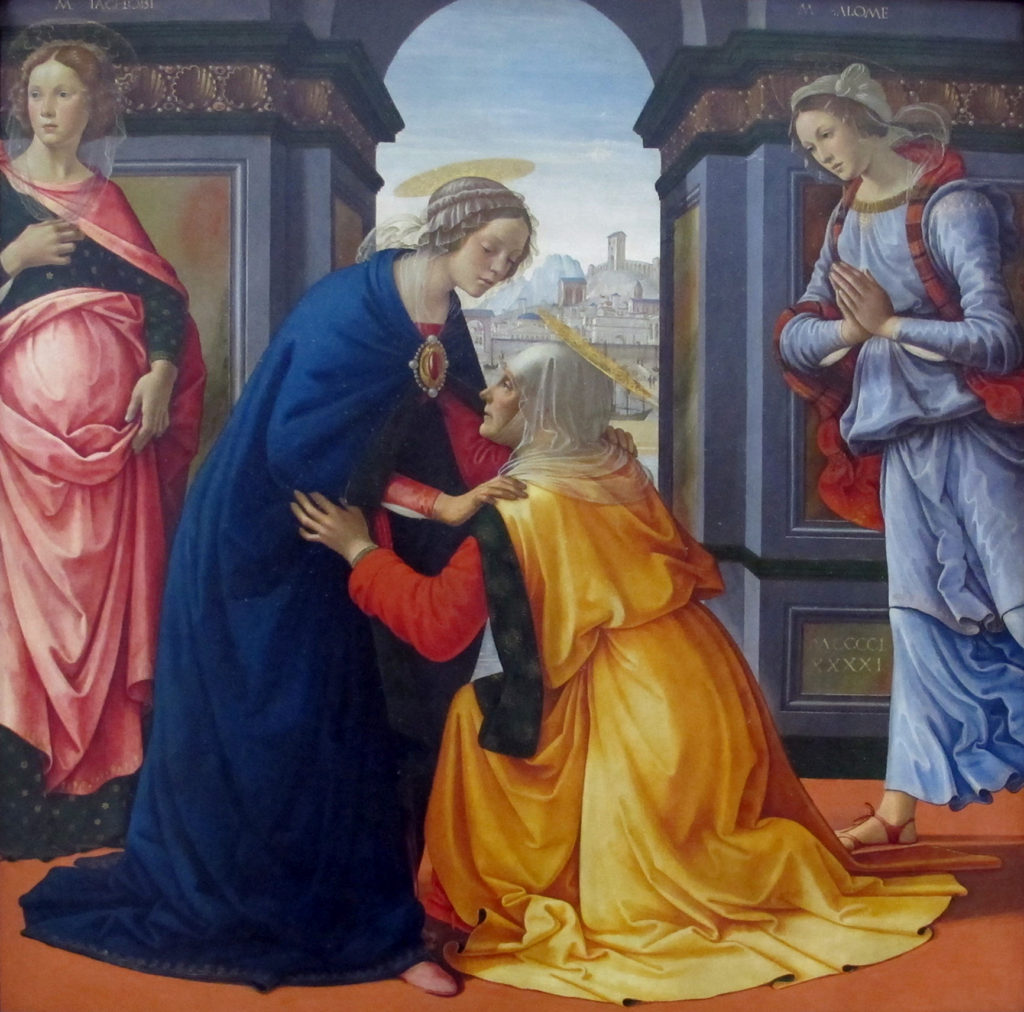
39 In those days Mary set out and went with haste to a Judean town in the hill country, 40where she entered the house of Zechariah and greeted Elizabeth. 41When Elizabeth heard Mary’s greeting, the child leapt in her womb. And Elizabeth was filled with the Holy Spirit 42and exclaimed with a loud cry, ‘Blessed are you among women, and blessed is the fruit of your womb. 43And why has this happened to me, that the mother of my Lord comes to me? 44For as soon as I heard the sound of your greeting, the child in my womb leapt for joy. 45And blessed is she who believed that there would be a fulfilment of what was spoken to her by the Lord.’

Acrylic on canvas, 24 x 30″

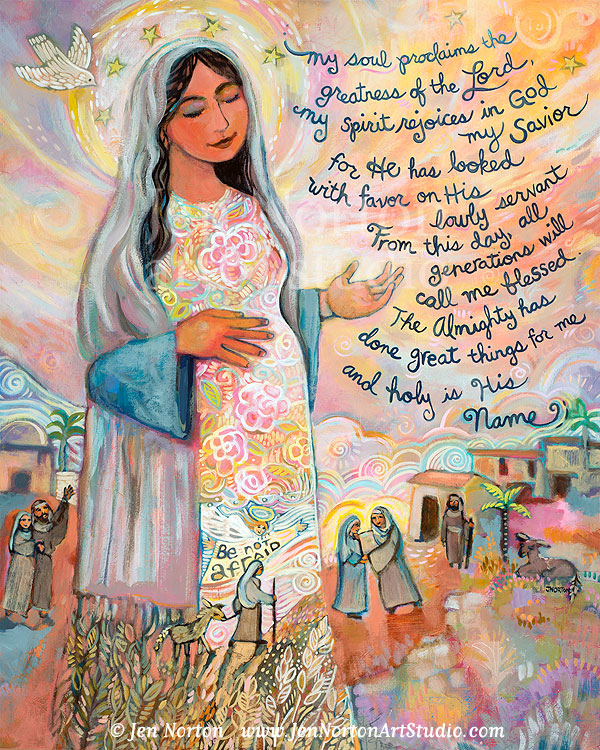
46 And Mary said,
‘My soul magnifies the Lord,
47   and my spirit rejoices in God my Saviour,
48 for he has looked with favour on the lowliness of his servant.
   Surely, from now on all generations will call me blessed;
49 for the Mighty One has done great things for me,
   and holy is his name.
50 His mercy is for those who fear him
   from generation to generation.
51 He has shown strength with his arm;
   he has scattered the proud in the thoughts of their hearts.
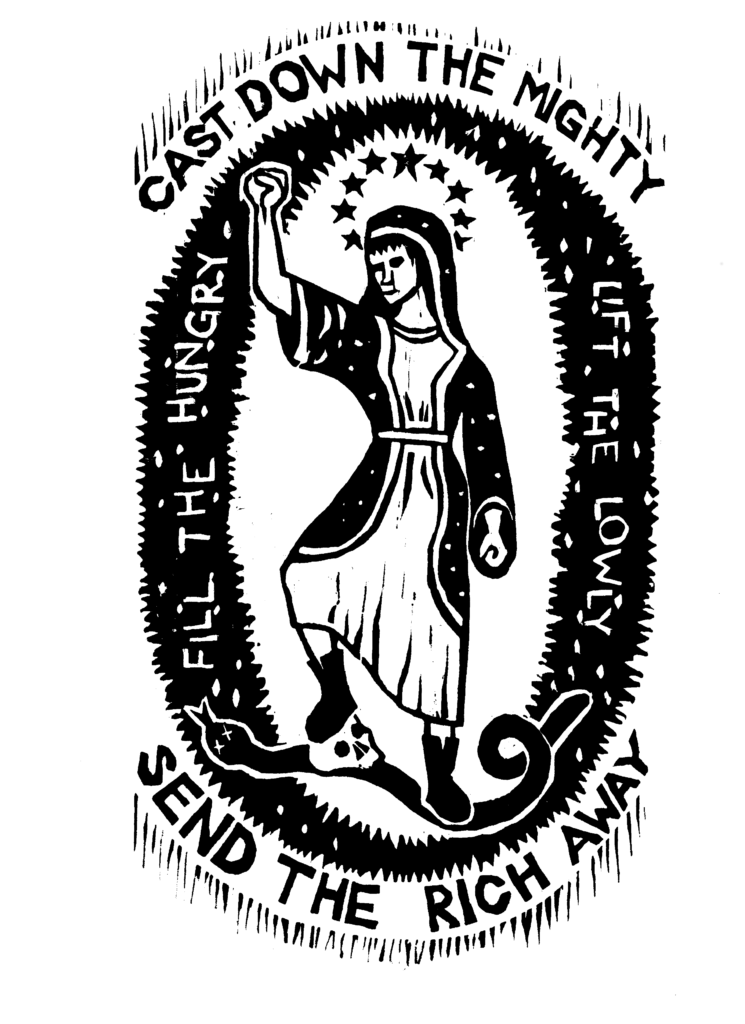
52 He has brought down the powerful from their thrones,
   and lifted up the lowly;
53 he has filled the hungry with good things,
   and sent the rich away empty.
54 He has helped his servant Israel,
   in remembrance of his mercy,
55 according to the promise he made to our ancestors,
   to Abraham and to his descendants for ever.’

Reflection

Astrid Shiloh

Last Wednesday Karen and I became grandparents for the second time with the birth of a baby sister for Elias.  On Sunday we visited the new baby, just named Astrid Shiloh [meaning ‘divine strength’ and ‘peace’].  I was amazed at this tiny (just over three kilogram) bundle, with her perfectly formed little fingers, toes and ears.  Yes, I’m sounding like a soppy old granddad but I am also now realising, a little bit, how Elizabeth must have felt when Mary visited her.

This event has also made me think, how did Luke know about a baby leaping in Elizabeth’s womb?  How did he know what it felt like for her to be able to speak about it as she does in this Sunday’s Gospel reading?  Afterall he was a man, so what did he know about babies in the womb and what did he know about expectant mothers’ emotional feelings when the baby moves – or leaps, if you like – in the womb?  Agreed, Luke was a doctor so maybe he had a better understanding than the other Gospel writers Matthew, Mark or John. 

Visitation, by Domenico Ghirlandaio (1491)

I decided to try and find out what the scholars thought about this ‘leap’.  I used the internet to do some research.  Those who know me will know this is my go-to place for information, which I am aware is not always accurate.  The first site I found used this verse of John the Baptist leaping in Elizabeth’s womb to condemn abortion – an area I am going to avoid as it needs a long-considered response and not a quick throw-away few lines, a week or two before Christmas.  Another site’s approach was to get all technical, discussing the actual meanings of the original Greek words used by Luke.  I always find these discussions interesting but often ask at the end of this sort of exegesis, “How has this interesting knowledge changed my life?”  But let’s look at it anyway.1

The Webpage starts by saying ‘The Greek here for “womb” (koilia) actually means “belly” or “stomach.”’  Yes, I was wondering when it was that doctors realised babies were born in the womb and not in a mother’s belly or stomach.  I’m sure it was well after Luke wrote his Gospel.  The website goes on to say that ‘koilia‘ was also the word used in the Greek translation of the Old Testament Book of Genesis where the snake is punished and made to walk on its belly. The website then triumphantly says “snakes don’t have wombs” but begrudgingly admits that “womb” is still a reasonable translation. ‘And certainly, we know that the “child” was in the womb, not some other part of Elizabeth’s anatomy, even if the original text was less clear.’  Yes, but did the writer of the Gospel, Luke, know that?  Is womb a modern word placed in this context to satisfy modern thought?  And does it matter, I wonder?

This website’s author obviously believes we should take the Bible literally and goes on to say the Greek word used here for “child” (brefos) refers to literally an infant, but, just as the shift from “stomach” to “womb,” is acceptable, we too can accept “child” instead what the author thinks should be translated as “foetus.”  Obviously, the website author has no poetry in him (and I suspect it is a ‘him’).  He wants medically accurate translations.  But once again is the author trying to use contemporary medical accuracy to criticise the translation of the anachronistic Greek words used in the NRSV? 

The next subject tackled is the leaping? ‘What was this child or infant or foetus doing?’ the author asks.  In this case the Greek word used is skirtao. We are told that the Greek verb is used elsewhere in the bible but only in only two contexts: figuratively, and dealing with children in the womb (though the author prefers ‘foetuses in the womb’).  In Greek version of the Old Testament, skirtao is used in Genesis 25:22 where Rebekka’s twin children ‘struggled together within her.’ So skirtao used here, is ‘struggle’.  But it is used in more poetic and figurative ways as well – as in the Psalms e.g. Psalm 114 where it is the mountains that ‘skip’; in Malachi 3:20, those who revere God’s name shall ‘leap’ like calves; in Jeremiah, plunderers ‘frisk about’ like a cow; and in Luke 6:23, God’s chosen should rejoice and ‘leap for joy.’  All of these examples use the Greek word skirtao.  Very scientifically the author says that it looks like “leap” is only one possible translation but he would prefer ‘moved in the way that foetuses do’.  Then he does open up to the poetic sense by saying that maybe ‘leaped’ could be seen in the same metaphoric sense of the English phrase, ‘leap for joy’ which indicates joy but not necessarily actual leaping (Hello!).

All of this is super-interesting but have the last thirty-odd lines added anything to my/your spiritual well-being?  Have they brought us closer to God?  Which is something I felt with the birth of our granddaughter, Astrid Shiloh.  As I’ve already said, I seemed to be connected somehow to that tiny bundle of babygrow and living-and-breathing-flesh held in my daughter’s arms.  This bundle also seemed to connect me closer to God.  Seeing both my daughter sitting quietly with Astrid, looking down at this miracle that she had brought forth from her womb and our son-in-law holding tiny Astrid gently in his arms, I realised that family trees were not merely names and dates joined by lines on a piece of paper but real living people. 

In the same way there is in the Gospel reading an energetic harmony that joins John and Jesus from the very beginning.  Bruce Epperly2 says that they were spiritual soul friends, bound by God’s vision, from the very beginning.  Certainly, they were both conceived in a remarkable way and both destined to become world-changers by the message they brought.  Today, we know from our scientific research that foetuses are aware of their environment, and are shaped by the emotional and environmental lives of their parents.  There are CDs especially compiled with the right music to keep the unborn foetus calm and peaceful.  Foetuses can ‘know’ each other by an energetic field and they feel encouraged and uplifted in utero by loving parents and communities. This passage also reminds us to love the children living in our midst.  With the birth of our granddaughter at this time I found this Sunday’s reading more meaningful than in previous years.

At the same time, our granddaughter’s birth has occurred at what we all hope is the last dying surges of the COVID virus.  I mentioned last week the four words of Advent.3  This week’s word is Hell.  For many it might be like hell if they have to say farewell to loved ones without actually being in contact with them, without holding them or hugging them.  There is so much of the World that needs to change and the last part of our Gospel (used in what I think is an inappropriate place in the service to replace the Psalm) is Mary’s Magnificat.  This wonderful song given in Luke’s gospel, provides an image of hope for the vulnerable and oppressed, for those suffering because others refuse to change.  Mary’s hymn speaks of a world turned upside down.  The poor will become affluent and the affluent will lose their fortunes, the powerful will be dethroned and ordinary people will take the reins of power. This is an impossible dream for so many citizens of our own land, as privileged South Africans gain more and more power and wealth.  But it is more than that.  The Magnificat is a dream that tells us that our current situation fails the test of divine affirmation.  Homelessness, unemployment, and economic instability, must provoke an uneasy conscience in us, especially among the powerful, whose wealth is built upon the poverty of others.

Elias and Astrid

Can we dream of a new era for humankind?  Mary could.  The fruitions of her hopes start at Christmas, when someone is born that will mobilize our hopes and hands to change the world that God loves.  May the hope Mary spoke about come to fruition in the lifetime of Elias and Astrid.

Magnificat in B flat by Sir Charles Villiers Stanford (1852-1924) sung by the Choir of Durham Cathedral with Keith Wright, Organist and James Lancelot, Director.

  1. It is found at https://goddidntsaythat.com/2015/09/24/whats-this-leaping-in-luke-141/ []
  2. https://www.patheos.com/blogs/livingaholyadventure/2015/12/the-adventurous-lectionary-fourth-sunday-of-advent-december-20-2015/ []
  3. https://dappergeni.co.za/wp/2021/12/10/advent-3-joy-of-heaven-right-here-right-now/ []