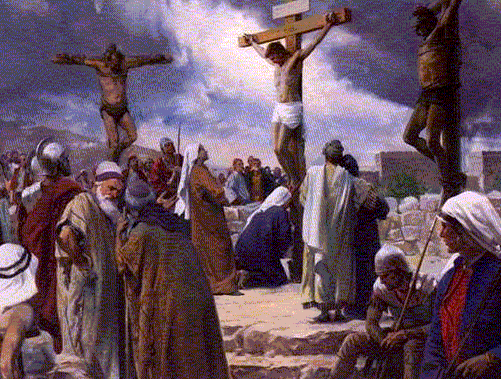
My Favourite Carol 2023 Version:

Tomorrow shall be my
dancing day.

Each year as Christmas comes round and as choir members start practicing carols, one carol seems to stand out and have a particular effect on me, leading to the desire to explore the words (and music) in more detail.

A few years ago it was John Rutter’s What sweeter music, the words of which were by Robert Herrick (see https://dappergeni.co.za/wp/2021/12/17/christmas-day-reflection-what-sweeter-music-than-a-carol/ ). Last year it was ‘That Chord’ in the organ part of the last verse of O come all ye faithful by David Willcocks. (see  https://dappergeni.co.za/wp/2022/12/ )

This year it has become the exciting and very rhythmical setting of Tomorrow shall be my dancing day by John Gardner.

I think I need to look at this carol both from a musical and a text point of view.

Text
Gardener’s setting, like most others sung at Carol Services only uses the first four verses of this carol by an anonymous author.

1. Tomorrow shall be my dancing day;
I would my true love did so chance
To see the legend of my play,
To call my true love to my dance;
        Chorus
        Sing, oh! my love, oh! my love, my love, my love,
       This have I done for my true love.

2. Then was I born of a virgin pure,
Of her I took fleshly substance
Thus was I knit to man’s nature
To call my true love to my dance. Chorus

3. In a manger laid, and wrapped I was
So very poor, this was my chance
Betwixt an ox and a silly poor ass
To call my true love to my dance. Chorus

4. Then afterwards baptized I was;
The Holy Ghost on me did glance,
My Father’s voice heard from above,
To call my true love to my dance. Chorus

There are, in fact, eleven verses which describe the whole of Jesus life dealing with his temptation in the wilderness (v5), his teaching and miracles (v6), his betrayal by Judas (v7), his trial (v8), his crucifixion (v9), resurrection (v10) and ascension (v11), concluding with the whole purpose of the incarnation: … now I dwell in sure substance/ On the right hand of God, that man/ May come unto the general dance.

Perhaps I need to place this carol into an historical context. Although much older, it appeared in William Sandys Christmas Carols Ancient and Modern published in London by Richard Beckley in 1833. On the internet and on CD liners and introduction to Carol Books there has been much discussion about this carol. But first we need to understand more clearly what a carol is.

One site defined the following: CAROL (0ld French carole), a hymn of praise, especially such as is sung at Christmas in the open air. The origin of the word is obscure. Some suggest that the word is derived from chorus. Others link it with corolla, a garland, circle or coronet, in the earliest sense of the word being apparently a ring or circle, a ring dance. So perhaps we are getting close to Tomorrow shall be my dancing day…

Interestingly, Stonehenge, often called the Giants Dance, was also frequently known as the Carol; thus Harding, Chron. lxx. x.,
Within (the) Giauntes Carole, that so they hight,
The (Stone hengles) that nowe so named been.

The crib set up in the churches at Christmas was the centre of a dance, and some of the most famous of Latin Christmas hymns were written to dance tunes. These songs were called Wiegenlieder in German, noels in French, and carols in English. Strictly speaking, therefore, the word should be applied to lyrics written to dance measures; in common acceptation it is applied to the songs written for the Christmas festival.

Another internet source suggests that according to Christmas Carol legend, all old carols that were written in 3/4 time were written as Creche dances. As these carols were sung, people would dance around the creche or the manger. One of the most famous Creche songs is “Away in a Manger”.
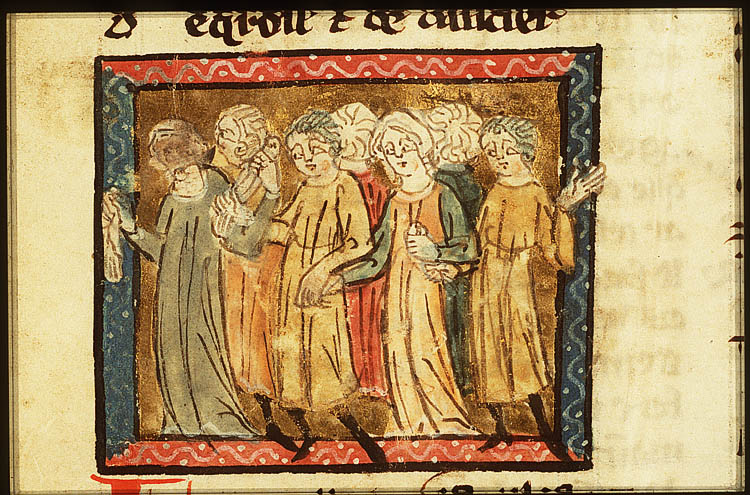

Thus, the idea is that Tomorrow shall be my dancing day is a carol that one can dance to. “Dancing Day” in the text is a reference to the dance around the creche, or dancing on the birthday of Christ. Notice that the speaker/singer of the text is Christ. There is a suggestion that line “To see the legend of my play,” could be a reference to a mystery play and just like the Coventry Carol, this could have been derived from a mystery play. The actor playing Christ singing the verses while the audience would join in with the chorus. Sing, oh! my love, oh! my love, my love, my love, /This have I done for my true love. This creates a delightful image of Christ viewing humankind as his ‘true love’ for whom he was willing to come to earth and go through what the next ten verses describe so well.

Each line of verse one needs a brief explanation:
Tomorrow shall be my dancing day; Sung at Christmas so Christ would start dancing/ be born the next day or perhap speaking about the end of time?
I would my true love did so chance  ‘My true love’ is humankind or perhaps the church – depending on one ecclesiology.
To see the legend of my play, Legend could be story and play could be life or a hint at being part of a mystery play.
To call my true love to my dance; Christ life was to call us – humankind’ to join him in the ‘dance’

The other three verses are more directly descriptive, even if the language is a bit stilted in old-fashioned English. I have already mentioned the last line: “that man may come unto the general dance.” and how this wonderfully summarises the incarnation.
Music
I said above that carol tunes that were in 3/4 time were for dancing. The original ‘Traditional’ tune as it appears in Sandy’s Carols Ancient and Modern is in 3/4 time but in a fairly legato style. John Gardner (1917 – 2011) has written a completely different tune from the original. It has a drum and cymbal accompaniment in the opening and in between the verses with staccato chords on the organ. The verses and choruses are sung unaccompanied. The staccato and dance rhythms make it a very exciting carol to hear.

Here is the carol sung by the Portsmouth Cathedral Choir under the direction of Dr David Price. It is from the CD, Verbum Caro Factum Est: Advent and Christmas from Portsmouth from Herald HAVPCD 407.

Tomorrow shall be my dancing day by John Gardner.

Why did I like this Carol?

The use of the image of dance, of love and the idea of Jesus addressing us directly relating his life (‘dance’) to us and asking us to join in the dance, is a wonderful way of evangelising without bible-bashing and that last line of verse eleven hoping that ‘Man may come under the general dance’ — Thus ‘the general dance’ is revealed to be not only our earthly life with Christ but also the heavenly wedding banquet—as well the literal dance that may have accompanied the finale of the mystery play. The whole concept of the image of dance in religion is the next thing I need to explore!

Musically, its rhythm is what attracted me to this tune. It is vibrant and exciting and certainly makes me, not so much want to dance, but to join in the drum beats by stamping or beating time on the pew in front!

The complete text.
1. Tomorrow shall be my dancing day;
I would my true love did so chance
To see the legend of my play,
To call my true love to my dance;
        Chorus
        Sing, oh! my love, oh! my love, my love, my love,
        This have I done for my true love

2. Then was I born of a virgin pure,
Of her I took fleshly substance
Thus was I knit to man’s nature
To call my true love to my dance. Chorus

3. In a manger laid, and wrapped I was
So very poor, this was my chance
Betwixt an ox and a silly poor ass
To call my true love to my dance. Chorus

4. Then afterwards baptized I was;
The Holy Ghost on me did glance,
My Father’s voice heard from above,
To call my true love to my dance. Chorus

5. Into the desert I was led,
Where I fasted without substance;
The Devil bade me make stones my bread,
To have me break my true love’s dance. Chorus

6. The Jews on me they made great suit,
And with me made great variance,
Because they loved darkness rather than light,
To call my true love to my dance. Chorus

7. For thirty pence Judas me sold,
His covetousness for to advance:
Mark whom I kiss, the same do hold!
The same is he shall lead the dance. Chorus

8. Before Pilate the Jews me brought,
Where Barabbas had deliverance;
They scourged me and set me at nought,
Judged me to die to lead the dance. Chorus

9. Then on the cross hanged I was,
Where a spear my heart did glance;
There issued forth both water and blood,
To call my true love to my dance. Chorus

10. Then down to hell I took my way
For my true love’s deliverance,
And rose again on the third day,
Up to my true love and the dance. Chorus

11. Then up to heaven I did ascend,
Where now I dwell in sure substance
On the right hand of God, that man
May come unto the general dance. Chorus

Sources used:
https://en.wikipedia.org/wiki/Tomorrow_Shall_Be_My_Dancing_Day
http://www.hymnsandcarolsofchristmas.com/Hymns_and_Carols/tomorrow_shall_be_my_dancing_day.htm 
And numerous other bloggers who wrote about this carol

Sermon for Advent Sunday 2023

Preached at St George’s Cathedral, Cape Town

May I begin by thanking Dean Michael Weeder for inviting me to be the preach on this Advent Sunday the first Sunday of the liturgical year. Many priests complain that once they retire, they are often forgotten about, so thank you, Father, for this invitation to preach this morning.

I wonder how many of you are old enough to remember the Cuban Missile Crisis of 1962? The Soviet leader, Nikita Khrushchev wanted to place a guided missile base on the island of Cuba. President J. F. Kennedy sent the US Navy to force the Russian cargo ships carrying the missiles to turn back. I was in Std 4 or Grade 6 as they call it today and I remember watching my classmates during the lunch break kicking a football around and I thought, “How can they do that, when the world could end in nuclear conflict at any moment?” But, of course, it didn’t.

Perhaps more of you remember Nine-Eleven. Where were you on the 9th of September 2001 when the two planes crashed into the World trade Centre. I was fetching our children from school and I heard about the first plane crashing into the first tower on the car radio and we were home in time see the terrible sight of the second plane flying into the second tower and later watched in horror as both towers collapsed. At the time I wondered what the consequences would be. Would the world as we knew end?

I wonder if our children and grandchildren will ask us where we were when the Hamas fighters entered Israel and killed and kidnapped Israeli citizens? This particular earth-shattering event has yet to be fully resolved. Will our children and grandchildren ask us in 20- or 30-years’ time what side did we support?

Why am I mentioning these earth-shattering events in my sermon today on Advent Sunday? Well, because these were the kind of events that Jesus was talking about in our Gospel reading from Mark 13. Earth-shattering, world-changing events. Jesus used language like, the sun will be darkened, and the moon will not give its light, and the stars will be falling from heaven, and the powers in the heavens will be shaken. Many Christians see this passage as being about the so-called “end of the world,” and they have through the ages searched their Bibles for other clues about when that might be. I’m sure we have all smiled slightly cynically when the actual day they predicted passes and the world is still going.

Recently biblical scholars have challenged the end-of-world way of reading this passage. They do so for at least two reasons. First, a good Jew has a faith in God that is anchored in the goodness of Creation, and that the Creator God would never abandon it, so Jews like Jesus, wouldn’t have thought in terms of a literal ending to that creation. Rather they thought in terms of its redemption, its salvation, its being fulfilled and completed.

Secondly, earth- shattering and end of the world type of language had been used in the past by the prophets in the Old Testament but did they literally mean that the world would end or the earth be shattered? Earlier in this chapter Jesus predicts the destruction of the Jewish Temple. This is something that truly happened within a generation of Jesus’ crucifixion. It came at the end of the Roman-Jewish War in the years 66-70 AD. The Roman army had laid siege to the city of Jerusalem and the climax of that war brought the city’s destruction and the end of the Temple. For the Jews, the temple was the centre of their religion and their way of life. So, these events truly were earth-shattering for them. Their lives as a people would never be the same.  Two thousand years later, the Temple mount in Jerusalem is still empty of a Jewish Temple, but continues to be the centre of political turmoil.

Perhaps personally we can identify more with our first reading from Isaiah which is a cry in the face of turmoil – a turmoil like the ‘end-of-the-world’ or ‘earth-shattering’ turmoil we are living through right now. This passage is a community lament; notice the use of the pronoun ‘we’ in verse 6. The community shout out to God: O that you would tear open the heavens and come down!” It is the anguished outburst of a desperate people, having exhausted all possible human alternatives, having given up on polite, respectfully restrained prayers to God. Now they cry, “Tear open the heavens and come down!” Basically, they are asking “Where are you, God? Where are you?” This is the prayer of a people who long for God, yet cannot see or hear God, people for whom God is absent.

We all know what that feels like. Have you ever prayed, but felt like you were only talking to yourself? Have you experienced your own personal earth-shattering moment, after which your personal world would never be the same? Have you ever stood by the bed of a loved one in pain, and prayed to God for help, but felt like God was far away? Have you known Isaiah’s prayer: ‘God, where are you? Tear open the heavens and come down! Please come!’ This is our Advent prayer, as we live in the relative darkness of our current time. We join in our Advent call “Come, Lord Jesus, come.”

The question is, will Christmas bring an answer to that prayer? We celebrate God’s coming in Jesus on Christmas. But will he come again this year? Will he come to those who sit in darkness who yearn to see a great light? At Christmas we celebrate that Christ has already come, that a great light has come to shine in the darkness and the darkness cannot overcome it. But how does that make a difference to those who sit in darkness right now? The Good News is this: Since Christ has already come, we now know where to look. More specifically, we know to look in the unexpected places. Think of the Christmas story: the saviour of the world, the king of creation, is born to two poor people in a barn in tiny Bethlehem. Is that where you would expect God to come? Not really. And it never really changes with this Jesus. He was always where we least expect him. And, finally, it ended with him on a cross, the very last place anyone would have expected to find God coming into this world. So, when we pray the prayer, “Where are you God?” perhaps what we need to be reminded of is where to look. Perhaps when we can’t find God, it’s because we are looking in the wrong places.

George Macleod, the founder of the Iona Community, seems to answer the question ‘Where is God?” when he wrote, “I simply argue that the cross be raised again at the centre of the marketplace as well as on the steeple of the church. … Jesus was not crucified in a cathedral between two candles, but on a cross between two thieves; on the town garbage heap; at a crossroads so cosmopolitan that they had to write his title in Hebrew and in Latin and in Greek . . .  at the kind of place where cynics talk smut and thieves curse, and soldiers gamble. Because that is where he died. And that is what he died about.”

In Jesus we begin to see that the answer to “Where is God?” is precisely this: God is with those who suffer. God is with us when we suffer. That’s where God is. In Jesus we learn where to look for God.

And this is where our salvation itself lies: learning where to find God. The problem with humankind is that we have been looking for God in the wrong places. We have tended to look for God among the powerful and mighty. ‘It’s someone with great power, who will get us out of this mess!’ is what we are usually tempted to think. But, no, it’s those same people of great power who all too often are responsible for the suffering in the first place.

In Jesus, we learn to see differently. When we look to the cross, we learn to see that God is with those who suffer, and has been all along. As long as there is suffering in this world, that is where God will be. And here’s the most important question: when we learn to find God in human suffering, and go to be with God there, then won’t the suffering finally end? If everyone learns to find God, and to be with God, among the suffering, then who will be left to cause the suffering?

This Advent, as we prepare for Christmas and Christ’s coming once again, where will we look to find him? We pray for peace, and hope that there will be no earth-shattering events, though we can never know the day or the time. So we are awake and ready because we know where to look for and find Christ again this year: among the needy, among the suffering, among the victims of war and terror. May our Advent preparations also take us to where we are most sure to find the baby Jesus. And that way we will find ourselves working for peace, working for that promised day when there will be no more suffering.

Amen.

Based on a sermon preached by Paul J. Nuechterlein on the Girardian Lectionary website.

Desert Island Discs

Desert Island discs: My version!

The BBC’s Desert Island Discs has since 1942 invited a guest, called a “castaway” during the radio programme, and they are asked to choose eight recordings, a book, and a luxury item that they would take if they were to be cast away on a desert island. As they do so, the interviewer discusses with them their life and the reasons for their choices.

I have often thought about which recordings I would take. Trouble is I like so much music, how can take one piece and leave another?  To use two cliches, it is like a father having to choose his favourite child or for me to say, “My favourite piece of music is the one I’m listening to right now!”

A second question is in what order would I play them? Often on the BBC they are in chronological order of the guests’ life. I have chosen three recordings of popular music, two classical recordings and three church music recordings. So, I am going to do the recordings in that order although often I discovered them and fell in love with them simultaneously.

First Record.
Unlike my school friends I was not really into popular music as a teenager or later in my early twenties. I heard them on the radio etc but never thought, ‘That’s great. I must ask my parents to buy that seven-single.’

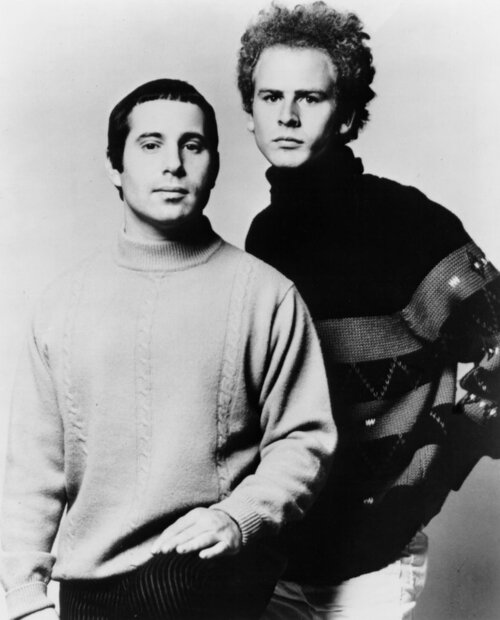
One group I did start to love was Paul Simon and Art Garfunkel. I remember buying Simon and Garfunkel’s LP Bookends and then started to try to obtain the other LP’s they had recorded earlier and I collected their subsequent recordings. Of course, I loved Sounds of Silence and Homeward Bound but often it was the one of the less popular cuts did it for me. So, my record number one would be Simon and Garfunkel’s For Emily whenever I may find her.

Simon and Garfunkel: For Emily whenever I may find her

That song tells of a dream of Emily and then waking up to find her right next to him. In my dreams I tend to experience the worse-case-scenario but when waking up it is never too bad!

Second Record.
Looking back and being more analytical in my old age, I realise that in my twenties I had become a fan of folk-rock music.

I remember dating Karen and driving home to Fish Hoek on a Saturday night after we had been to a movie or eaten out. I would drive to Fish Hoek listening to the English Service of the SABC which had on Saturday evenings 10pm to midnight, Malcolm Gooding with his programme, Going Gooding where he would play many folk-rock classics.

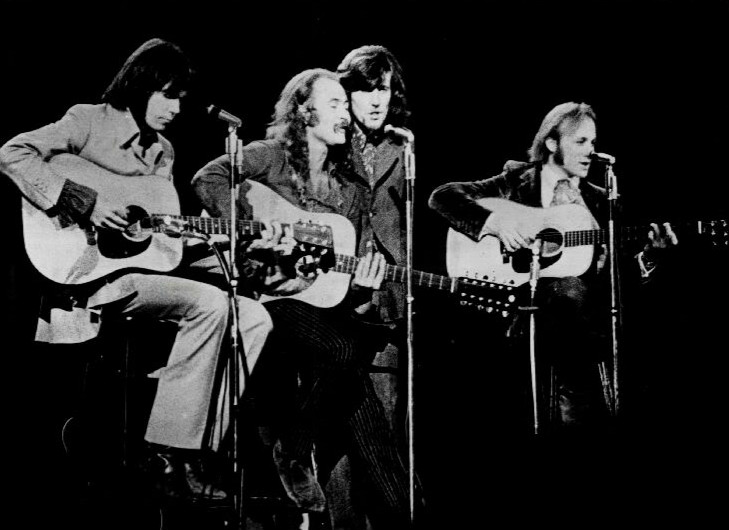
It was on this show that I first heard Crosby, Stills, Nash and Young. One song that I loved and is my second disc to take to the desert island, Suite: Judy blue-eyes. I was excited by it because it was much longer than most pop songs – 7 minutes 28 seconds long and as the title implied, it was a ‘suite’ of different section each expressing different things.

What I loved was the last section, at about 6’30” in the recording below, where the harmony-singers sing a simply do-do-do’s accompaniment to Stephen Still’s solo in Spanish.

Crosby Stills Nash and Young: Suite Judy Blue Eyes

Third Record.
Also while in my twenties and thirties I fell for Meatloaf and his ballads sung loudly and proudly. Bat out of Hell, I’ll do anything for love, Dead Ringer For Love all of which he sang with such passion.

In my fifties I was looking on Youtube for some of his music and I came across one that I hadn’t heard or seen before, Objects in the rear-view mirror may appear closer than they are. It was a video of a live performance but it really moved me. I later found the original music-video for the song. It tells of the singer’s life experience, the death of his best friend while he was still young, the abusive relationship he had with his father, the seeking of love with an older woman. I loved some of Jim Steinman’s images and metaphors in the lyrics – ‘If life is just a highway then the soul is just a car’ (love that – must be a sermon in it!), ‘She used her body as a bandage, she used my body like a wound.’

Meat Loaf Objects in the rear-view mirror may appear closer than they are.

Fourth Record.
So onto my classical musical choices.

At School I once gave an English oral on Gilbert and Sullivan and the English Master, Mr Alf Morris (‘The Kid’) suggested that I should listen to some other classical composers such as Beethoven or Brahms.

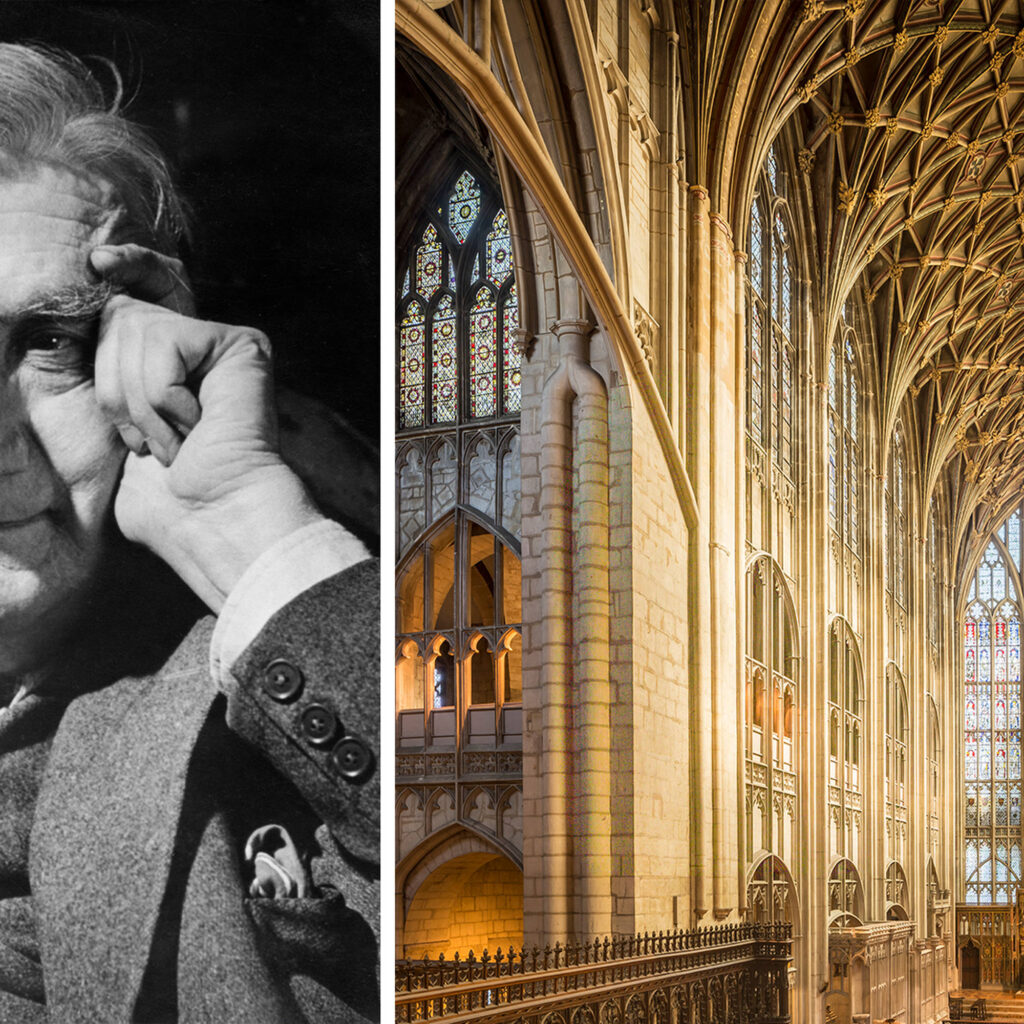
Later while in the church choir I discovered that the composer of my favourite hymn was Ralph Vaughan Williams and that he had written lots of symphonies as well as other non-Church music. One of those other orchestral pieces was Fantasia on a theme by Thomas Tallis. The theme Vaughan Williams used was in fact a hymn tune he had included in the English Hymnal (Tallis’s Third Mode Melody). So there was a connection to my church choir days.

This piece by Vaughan Williams is nearly always on the ‘Most Popular Classical Music’ List – perhaps not as high as his Lark Ascending but I loved its broad expansiveness. One record sleeve said that this piece was the embodiment of the English countryside. I disagree – I think it is the embodiment of the English Cathedral. The melodies soar up to the Gothic vaulting and echoes and re-echoes around the wonderful spaces that are the English Cathedrals.

Ralph Vaughan Williams: Fantasia on a Theme of Thomas Tallis Leonard Bernstein and the New York Philharmonic Orchestra

Fifth Record.
When I met Karen, she was already singing in the Cape Town Symphony Choir and she persuaded me to join. Every June, the last concert of the series, the CTSO played the Beethoven First and Ninth Symphonies. I had bought miniature full scores of both these and had great fun following from the Choir benches until the last movement when I felt obliged to use the vocal score like everyone else.

In the last movement the ‘Ode to Joy’ theme is first played by the cellos and then the violins take over the melody but the part I loved was the bassoon which seemed to go off on a walk-about playing a countermelody. I loved it but, on most recordings, it is hard to discern. In live concert I might have heard it more pronounced because the bassoonist sat just in front of us, the tenors in the Cape Town Symphony Choir.

I am not going to play the whole nearly 24 minutes of the last movement but merely the cellos with the melody and then the section I described above with the bassoon and its counter-melody.

Ludwig von Beethoven: an extract from the final movement from Symphony Nine in D minor Op125

Sixth Record.
As I sang in church choirs all my adult life my last three recordings are going to be church music or organ music. Even as a priest I would sneak off to the choir stalls to join the choir for the anthem.

I said earlier that my favourite hymn was by Ralph Vaughan Williams. It is ‘For all the Saints’ to RVW’s tune Sine Nomine. I even loved the name of the tune! Translated from the Latin it is ‘Without a Name’. I wanted to call my house Sine Nomine as a snub to people who give their houses cheesy title.

The hymn has eight verses, the first three in unison, the next three in harmony and then ending off triumphantly in glorious unison for the last two verses.

Hymn: ‘For all the Saints’ Words: Bishop W. Walsham How Tune: Sine Nomine Ralph Vaughan Williams sung by the Choir of Trinity College, Cambridge conducted by Richard Marlow.

Seventh Record.

Karen learnt the organ, obtaining a LRSM in organ performance so I soon learnt quite a bit about organ pieces. Although Karen says playing Bach’s organ music is very satisfying, my choice of organ music for my desert island is unusual. It is Frank Bridge’s Adagio in E major.

It starts quietly with quite a disjunct melody which is added to in a fugal pattern, gradually getting louder until it reaches a climax and then dies away again to that single melody line. [Update Easter Sunday 9 April 2023 at Salisbury Cathedral in the UK. They must have known I was in the congregation as the organist played this piece before the Festal Evensong.]

Frank Bridge Adagio in E major for Organ: Christopher Herrick

Eighth Record.

Besides hymns and Psalms, a church choir is called upon to sing anthems. One of the first anthems I learnt after joining the Choir at St Margaret’s Fish Hoek was S. S. Wesley’s Blessed be the God and Father. Wesley’s anthems were often large and comparable to Cantatas. Although shorter than his other long anthems can be divided into sections just like the others. It starts with a choral-like section for the whole choir. This is followed by a quasi-recitative for the men. Then comes a sublime soprano solo and response by all the sopranos. Another recitative for men is followed by a short triumphant fugal section with words ‘the word of the Lord endureth for ever’ which ends this anthem.

Samuel Sebastian Wesley: Blessed be the God and Father Choir of King’s College, Cabridge conducted by Daniel Hyde

A book and a luxury
On the BBC the guest is given the bible and the complete works of Shakespeare but can choose another book to take to the desert island.

I would be quite happy to lose the complete works of Shakespeare if I could have the Book of Common Prayer and my other book would be The Psalter pointed for Anglican chant and my luxury would be a book of chants by ancient and modern composers.

Usually, the guest is asked which recording they would keep if a wave should wash away the another seven. This is a tough one. I think t would be a toss up between the CSNY’s Suite: Judy Blue Eyes and Wesley’s Blessed be the God and Father.

What are the eight discs you would take to a desert island? Do comment below.

George Herbert: Christmas and ‘The Chord.’

Presently Karen is a member of the Cathedral Evensong Choir as well as the Cathedral Chamber Choir. This means that this Christmas season we have had the Carol Service at 5pm on Christmas Eve and the Orchestral Mass on Christmas Day morning at 10am. As with all choirs there is a last-minute warm-up and rehearsal. We arrive at the Cathedral an hour or more before the service and I am left in the car while she goes to rehearse

This means that I have an opportunity to read while waiting. As the service times approaches, I make my way into the Cathedral. Because of the large crowds at Christmas, I went in at least half-an-hour before the service. To read my ‘whodunnit’ crime thriller in the car park is one thing but to read it in the Cathedral seems inappropriate. So I took along with me two poetry books by well know spiritual poets. 

On Christmas Eve I read some of R. S. Thomas’s poems.  Once again, it was his poem In Church which touched me. I spoke about it before https://dappergeni.co.za/wp/2021/03/18/r-s-thomas-the-east-end-cross/ when I discussed the cross at the east end of St Margaret’s, Fish Hoek.

The next day I took a book edited by Philip Sheldrake, discussing George Herbert poetry. As it was Christmas Day I though it best to look up ‘Christmas’ in the index and found this poem:
The shepherds sing; and shall I silent be?
      My God, no hymn for Thee?
My soul’s a shepherd too; a flock it feeds
      Of thoughts, and words, and deeds.
The pasture is Thy word: the streams, Thy grace
      Enriching all the place.
Shepherd and flock shall sing, and all my powers
      Out sing the daylight hours.
Then will we chide the sun for letting night
      Take up his place and right:
We sing one common Lord; wherefore he should
      Himself the candle hold.
I will go searching, till I find a sun
      Shall stay, till we have done;
A willing shiner, that shall shine as gladly,
      As frost-nipped suns look sadly.
Then will we sing, and shine all our own day,
     And one another pay:
His beams shall cheer my breast, and both so twine,
Till ev’n His beams sing, and my music shine.

Herbert uses a typical conceit of his period as he compares his soul to the shepherds ‘watching their flocks by night.’ His soul shepherds his thoughts, words, and deeds.  His sheep are feed on God’s word and watered by God’s grace. Filled with this heavenly food and drink, both sheep and shepherd sing, out singing the daylight. Their musical theme is ‘one common Lord.’  Just as the winter sun looks dull and sad so Herbert’s singing of the light will outshine the very sun and God the Son’s light shall ‘twine’ with his light, his soul making God’s beam to sing and God’s light making Herbert’s music shine.

Having read that, I sat quietly in the Cathedral then had the privilege of hearing the wonderful Mozart “Spatzen” Mass in C (K220) sung in a liturgical setting.  And, of course, the hymn/carol ‘O Come all ye faithful’ with the wonderful CHORD in the last verse ‘Word of the Father, now in flesh appearing’ which cheered my breast and my music shine.

Footnote:
“The Chord” is an unexpected change of harmony in the organ accompaniment in the last verse of “O Come, All Ye Faithful,” corresponding to the line “Word of the Father.” In the language of music theorists, The Chord is a B half-diminished seventh.  Read more about it and Sir David Willcocks contribution to choral music at:

Sermon: 16 Oct 2022

Gospel Reading: Luke 18:1-8

“Knock-knock” “Whose there” ….

How many ESKOM executives does it take to change a light bulb? ….

An Englishman, an Irishman and a Scotsman go into a bar together

I’m sure you all recognise those phrases as the start of jokes.  But these sorts of jokes are not realistic, are they?  I mean, when someone knocks at our door, we don’t shout out, “Whose there?”, we go and open the door and see whose there.  Of course, regardless of what the joke says, it only takes one person to change a light bulb.  And would an Englishmen, Scotsman and Irishman really go into bars together?  Jokes are a bit like parables.  They are stories that are not meant to be completely realistic.  They are stories which help to get a message across.

Many of these starter line to jokes or catchlines are now very old fashioned and not used by stand-up comics these days.  I wonder if there were any catchlines to jokes in Jesus’s day?  Perhaps they started, ‘In a certain city there was a judge…’   Just like Jesus’ parable does this morning. So, am I saying that Jesus is telling a joke?  Well, one commentator I read said: “Enjoy the humour of the story and the colourful nature of the characters.” So maybe he is.  But isn’t this the nature of all of Jesus’ parables?  We must enjoy the story that Jesus tells, the same as we enjoy a joke and, as with all parables, we must not take them too literally.  They are told to us to teach us a deeper meaning for our lives and they tell us more about our faith. 

This morning gospel parable is one of Jesus’ most complex.  A widow comes to the judge for a legal decision against her opponent. She is a widow, and like all widows in Jesus’s time she would have been dependent on a son or possibly a brother for all her needs.  It appears that she owns some property — but someone else is laying claim to that property.  We are not told whether her claim or the other persons claim to the property was legal or right.  We only know that it is disputed by the widow and her unnamed opponent.  But the parable doesn’t require us to know the facts of the legal case.  We only need to know that she is widowed and that she has property to which someone else — we don’t know who — is laying claim.  And so she goes to the judge again and again to get a decision on the case in her favour.  The judge, however, doesn’t care one way or the other about this pestering widow.  At first, he puts up with her, but the woman simply will not stop.  She’s not important to the judge, but the trouble is, she won’t go away. She is annoying at first, but then simply a pain. She’s always there.  Our translation is polite when it says the woman keeps “bothering” the unjust judge.  In the original Greek, however, the word translated here as “bothering” literally means to give somebody a black eye.  Can you imagine a elderly widow giving a judge a black eye?  Well, finally the exacerbated judge thinks to himself that though he fears neither God nor does he respect anyone, this woman is so troublesome that the only way to get rid of her is to give her what she wants. Otherwise, she’ll just wear him out.  And so the judge resolves the case in her favour. Case solved.  Woman gone.  End of story!  Or is it?

You can see that this story is a bit like a joke – it is not realistic – I mean, a woman giving a judge a black eye?  A judge finding in the woman’s favour merely to get her to stop bothering him.  I mean, what about the law?  What about Justice?  These questions make us ask, ‘Why did Jesus tell this parable?  What did Jesus want to teach us from this parable?’

Well, he actually tells us at the begin of the reading. “Then Jesus told them a parable about their need to pray always and not to lose heart.” Need to pray always and not to lose heart.  Two things there… ‘need to pray always’ that is to be persistent in our praying to God.  And secondly, ‘not to lose heart’, in other words to remain sure, faithful, that God will answer our persistent prayers.  We could say that the message of the parable is, “If persistence can pay off with even a lousy corrupt human judge, how much more effective will persistence be when we pray to a perfectly just and loving God!?”  But notice, Jesus doesn’t quite say that at the end of the reading, does he?  Instead, he says “Listen to what the unjust judge says.”

But what are we supposed to learn from what the judge said, besides his sheer frustration, and it is self-centred frustration at the woman?  Is Jesus telling us that we are to make God frustrated by our persisted prayers?  Are we to imagine that even God worries about getting a black eye from us?  The judge had ‘no fear of God and no respect for anyone.’  Do we think that God is scared of losing his reputation and so will give in to us because of that? Surely not!

And what about when Jesus, speaking of God, asks “Will God delay long in helping those who are persistent in prayer?”  This question from Jesus doesn’t really need an answer from us, does it?  Because we know that God will answer our prayers.  That is our faith, that is what we believe.  But if that is the case, why doesn’t Jesus just say that flat out? That God will never delay in helping us when we pray to him.  But he uses the words “delay long” and that makes it sound as though God does sometimes delay a short time in answering our prayers.   Have you found that this to be the case?

But this Gospel passage makes it clear that in the end it’s not about whether, or to what extent or in what way, God will bring justice to the earth.  It’s not about whether there are times when for some mysterious reason God has to delay answering our prayers.  There are countless unknown variables in God’s ways.  What’s the famous say?… ‘Our ways are not God’s ways.’ We cannot see what God can see, so there are prayers that appear to us to go unanswered.  However, they are not unheeded, but unanswered in the sense that we are not receiving what we want or what we think is the best for us.  That kind of disappointment all too often leads us to begin wondering what God is up to, what is on God’s mind, what kind of a God is he?  Unfortunately, this can also lead to a loss of faith in God.

However, notice that in this parable Jesus turns the tables on us and puts the focus back on our faith.  We have to assume the best about our God’s goodness, our God’s love, our God’s justice, and our God’s mercy.  By faith we hang on to our belief, whether our prayers are answered at once or not.  What we have to worry about is not about the character of God but more about the strength and the persistence of our faith.  God may well be, as us Christians say, the most generous source of grace and light in the universe.  But if people stop praying to God, how can they ever show the might and wisdom of God and God’s hidden kingdom to the world out there?  How can those who will not pray, access and tap into the power and love of God?  As Jesus said at the end of the parable: “And yet, when the Son of Man comes, will he find faith on earth?”  Do you have that sort of persistent faith?

Oh yes… How many ESKOM executives does it take to change a light bulb?  Three one to hold the light bulb, one to turn the ladder and one to go and start up the generator because loadshedding has started.

Have faith my friends!

Sermon: 9 Oct 2022

On Sunday 9 Oct and 16 Oct 2022 the Rector of St Clare’s, Ocean View, Fr Ulrich Groenewald asked me to do the 8am Eucharists services. Here is the sermon I preached on Sunday 9 Oct 2022.

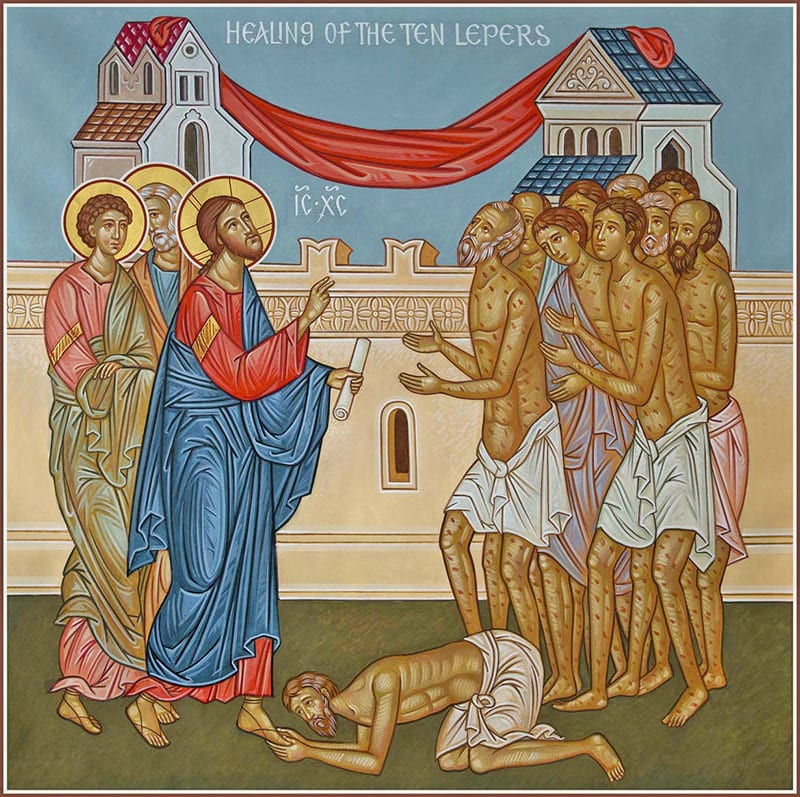
Jesus Healing the ten Lepers. Luke 17:11-19

In today’s Old Testament and Gospel readings we hear about leprosy being healed.  What is this leprosy we hear about in these readings?  Leprosy is a chronic infectious disease caused by a bacillus, Mycobacterium leprae. It mainly affects the skin, the peripheral nerves, mucosa of the upper respiratory tract, and the eyes.  It begins with skin lesions affecting the nerves so the person has no feeling in that area.  If left untreated, leprosy can cause progressive and permanent damage to the skin, nerves, limbs, and eyes.  Those living with untreated leprosy suffer from paralysis and crippling of hands and feet, with the shortening of toes and fingers due to re-absorption as well as nose disfiguration. 

Now, don’t for a moment think that leprosy is something from the past, only found in the pages of the Bible. Perhaps you do not know of anyone with leprosy today, but here in Cape Town I know of at least two sites where leprosy was treated in the 1800s and 1900s.  Robben Island, before it became a gaol for political prisoners, was both a psychiatric hospital as well as a hospital for lepers.  It was here that the Anglican monastic order, the Society of St John the Divine commonly known as SSJD or the Cowley Father’s ministered.  One of these father’s Fr Congreve, wrote in his biography about how he spent time on Robben Island and received communion in the Church of the Good Shepherd there.  He knelt down at the altar rail to receive, right next to person with advanced leprosy and Fr Congreve felt moved that as he lifted his hands to receive the Body of Jesus in the form of a communion wafer, the leper kneeling next to him lifted his damaged hands with shorten fingers to receive that same body of Christ.  ‘We who are many are one body for we all partake of the one bread.’

Some of you might have been to the Retreat Centre, St Raphael’s in Faure.  In the early 20th Century St Raphael was isolated from the city of Cape Town which now encircles it with suburbs, but in the early days the Anglican Church ran St Raphael’s as a leper hospital.  In the small chapel at St Raphael’s, you will see on the altar a picture of a leper saying to Jesus “Lord, if you are willing, you can make me clean.” This is from Mark’s Gospel and Mark tells us that Jesus reached out his hand and touched the man and said: “I am willing.”  When I was at St Raphael’s on my ordination retreat 26 years ago, I was greatly moved by these two statements.  “Lord, if you are willing, you can make me clean.” Jesus Christ reached out his hand and touched him. “I am willing,”   Isn’t it wonderful to have Jesus say to us… I am willing?

In our Gospel reading today there is not one but ten lepers that are healed.  They have gathered as a group outside a town.  They had to do that because the people of the town knew that leprosy was infectious and so they didn’t want those with leprosy, who they saw as being unclean, in their neighbourhood.  But these lepers had to live somehow, so as a group they stayed just outside the town to beg from those coming and going to and from the town.  On this day Jesus and his band of followers came that way and so they call out to him ‘Jesus, Master, have mercy on us!’.  When he saw them, he told them to go and show themselves to the priests.  This was because the Jewish people lived in what could be called a theocracy.  God was their ruler.  Because they could not see God, it had to be God’s intermediaries, the priest, who made decision on whether the lepers were clean and could re-enter society, go back and live in their town again. 

Now notice there was one among them one who was not a Jew.  He was a Samaritan.  Jews despised and even hated Samaritans.  Those other nine lepers, when they were rejected so was the non-Jew among them, the Samaritan.  As they had all been rejected, they were willing to have him in their group.  But now they were healed and hurrying to the priests to get the all clear.  That Samaritan man realised he was no longer acceptable to them.  He turns, not to the priest to get the all clear, but to the man who had healed him, Jesus Christ. Notice what Jesus said:  ‘Were not ten made clean? But the other nine, where are they? 18Was none of them found to return and give praise to God except this foreigner?’ Then he said ‘Get up and go on your way; your faith has made you well.’  What faith?  That Samaritan didn’t believe in the same God as the other nine Jews who were healed but that didn’t make any difference to Jesus.  ‘Get up and go on your way; your faith has made you well.’ 

What can we learn from the Gospel reading?  Is it merely that we have to say thank you?  I have a 3y old grandchild called Elias and when he asks for something I keep on saying to him, ‘Say please?’ and when I’ve given it to him, I ask him: ‘Do I hear a thank you?’  Please and thank you is what my mother drilled into me when I was young as I’m sure your mothers did too.  But does this story of healing carry a deeper teaching for us than just saying thank you?

I think it does.  You know we all have people with leprosy in our family, in our community and within our nations.  No, not the disease caused by that bacteria, but rather the way we treat others as if they had leprosy.  We chase them out of family, our community, our nation.  And if we can’t chase them away from us, we treat them as if they no longer exist.  Perhaps someone in your family who fell pregnant while still at school, or someone who is gay, basically anyone who is radically different from you.  You reject them and treat them as if they had leprosy.  And in the Ocean View Community, what about the gangsters and the drug-dealers?  In our nation, what about the foreigners?  Let each of us think for a moment of someone, some group we have treated as if they have leprosy………

How did Jesus respond to those with leprosy?  “‘Go and show yourselves to the priests.’ And as they went, they were made clean.”  What can you do to help people you reject to be made figuratively clean?  That is something between you and God but God has given you Jesus as the example.  What does he do?  Can you do the same?

I want to end by giving a personal story, a sort of testimony.  When I was rector of St Andrew’s in Steenberg I was on my way up Military Road to go to the Blue Route.  The railway crossing booms at Steenberg Station were down so I decided to sneak past the waiting traffic and make my way along the road that runs parallel to the Railway line and cross at White Road.  Unfortunately, as I tried to sneak past, I slightly scratched a bakkie in front of me which had a pile a young men in low-slung jeans and hoodies sitting in the back.  One leapt off and started cursing me in some choice language.  Realising I was at fault I nervously got out the car and the bakkie driver did the same.  He was tall, thickset man with a shaved head and to me had the typical look of a gang-leader.  He indicated to me the scratch on the bakkie, which I could barely see.  My car was fine but he said that I would have to pay R150 for his car to be repaired.  It was a small amount compared to most panel-beating quotes so I thought, ‘Let’s just pay this man and get it over with.’  Basically, I was treating him like those lepers outside the town we heard about in the gospel – I was just throwing money at him to get him out of my hair.  I said I didn’t have any cash on me then but if he came to my house in Bothma Street at 5pm I’d give it to him.  At first, he didn’t believe that any white people lived in Bothma Street but I told him I did because I was the Anglican priest at St Andrews.  So he agree to come at five.

At five the front door bell went and there he was.  I thought, ‘I’m not going to invite you in because you might check out my possessions and decide to come and burgle the house later’, so we chatted on the front door step. – See I’m still treating him as a leper.  After I had given him the money, he started talking about himself and his girlfriend and their son.  He would have liked to have his son baptised so that the son would have a better chance in life than he did.  I said to him that if he came to church on Sunday, I would enrol him in the Baptism Preparation classes and we could then talk about him and his girlfriend getting married.   Our conversation was taking so long my wife kept looking through the glass pane on the side of the door to make sure that I hadn’t been kidnapped or stabbed.  But I was quite safe talking to this gangster. 

I would love to tell you that the following Sunday he was in Church.  Unfortunately, he wasn’t but maybe because I was willing to listen to his story and encourage him, he felt less rejected, less like a leper.  Perhaps he came to church after I had moved on to my next parish and perhaps the priest who succeeded me, baptised his son and married him and his girlfriend.  And perhaps he then heard Jesus say: ‘Get up and go on your way; your faith has made you well.’

You, too, can make a difference.  To know how and to do what, will depend on your relationship with Jesus.  You must listen to what he is saying to you, through his word and through your prayers.

A Trio of Songs that Touched me.

I have copies of many of my own CDs as well as CD taken out of the local Library on my Laptop. While working on my laptop, I always have music playing. Occasionally I look for a specific composition, song, composer or genre but most often I just play the next album that comes up in my library on Windows Media Player. When I’ve reached the last of the albums starting with Z I go back to the top of the library and start again with those under A. That means I sometimes move from one album of esoteric classical music (like ‘Ballet music by Tchaikovsky’) to ‘Barbara Streisand’s Greatest Hits Volume Two’! Felt sorry for the others working in our house!

Being a type 5 on the Enneagram means that I don’t do emotions in real life and perhaps that is why I turn for emotional relief to movies and music. That way I can keep it more hidden and if someone says, ‘That music is a bit sentimental and emotional, isn’t it?’ I can response, ‘Yes. Definitely’ and quickly move on to play music which is less emotional.

Song 1: You don’t bring me flowers

I was thinking about this, today as I was listening to Barbara Streisand. There was a song where she sings a duet with Neil Diamond, You don’t bring me flowers’. What drew me to this song? What resonated within me when I heard it while busy working on my PC? Was it the words? Well, they are fairly sad. Marilyn Bergman, who wrote the song together with her husband Alan and Neil Diamond, said that this was a song about a couple drifting apart. The words are sad and nostalgic in nature. They seem speak directly to the listener as if the singers (usually Barbara Streisand and Neil Diamond) are addressing us, the listeners, directly. I must admit that I’ve never been a great bringer of flowers or singer of love-songs, but I don’t think it was that that made me stop typing on my pc and listen to the song. I think it was the actual melody and the harmonies that tugged at my heart strings.

The same night I watched a YouTube video where Stephan Fry and Alan Davies went to the Royal Opera House in London to watch the Verdi opera, Simon Bocchanegra. While they were watching they were wired up to different physiological measuring instruments to see how the music affected them. One of the scientists who was interviewed in the YouTube video said that 90% of people will say that they had been moved to tears by a piece of music. When it came to a painting or a piece of sculpture that number drops to 5%, while poetry – both read and heard is about mid-way between. So, music is very much an emotional art form.

What in the melody and harmony of You don’t bring me flowers moved me? Initially I thought it was the rising fifth on ‘flo-wer’ which made the opening phrase so poignant but I’m no musicologist. I found a web site which spoke about the emotional nature of music and gave the emotions one might feel when hearing certain intervals being played or sung. A rising perfect fifth, it told me, creates a feeling of cheerfulness and hope. I had felt anguish and sadness, not cheerfulness or hope, so it was not the perfect fifth in the melody that did it for me.

I found a version with melody and guitar chords online. This showed that the song in the key of C major moves to chord of G with C in the bass on the bar which has ‘flo-wers’ in it. The chord of G has a B in it, which creates a slight dissonance against the C in the bass. This is what presented a feeling of anguish. So perhaps it was that ‘crunch’ in the harmony, quickly resolved back to the tonic (via F/C to C), which attracted my ears attention.

The words are also telling. Streisand and Diamond sing of all the things they had learnt in their relationship together – to laugh, to cry, to love and they think they could ‘learn to say goodbye’. And that is where the song ends, with a chorus of ‘You don’t bring me flowers anymore’. We never learn whether they do say goodbye. This is perhaps typical of many long-term relationships. Things which draw a couple close together gradually disappear from their relationship. The need to say ‘you don’t say you need me’ seems superfluous because they both need each other. But maybe they do need to say it; sometime to stop the drifting apart. 

You don’t bring me flowers.  From Barbara Streisand’s Greatest Hits Vol 2. 
Barbara Streisand and Neil Diamond

You don’t bring me flowers.

1… You don’t bring me flowers, You don’t sing me love songs, You hardly talk to me anymore, When I come through the door at the end of the day … I remember when You couldn’t wait to love me, Used to hate to leave me.

2… Now after lovin’ me late at night, When it’s good for you, babe, And you’re feeling alright, Well, you just roll over and turn out the light, And you don’t bring me flowers anymore.

3 … It used to be so natural (used to be), Talk about forever, But used-to-bes don’t count anymore. They just lay on the floor ’til we sweep them away.


4… And baby, I remember, All the things you taught me, I learned how to laugh, And I learned how to cry, Well, I learned how to love, And I learned how to lie,

5… So you’d think I could learn how to tell you goodbye. (So you’d think I could learn how to tell you goodbye) You don’t bring me flowers anymore.

6… Well, you’d think I could learn how to tell you goodbye. Well, you don’t say you need me, And you don’t sing me love songs, You don’t bring me flowers anymore.

Source: LyricFind Songwriters: Alan Bergman / Marilyn Bergman / Neil Diamond

Song 2: Coney Island - Van Morrison

The second song was written and sung by Van Morrison off his album Avalon. I say ‘sung’ but in reality, it is a spoken piece over an orchestral accompaniment. In this song it was the words that touched me.

Only after researching it did I discover that it was not Coney Island in New York but Coney Island, in County Down, Northern Ireland. Morrison is a Northern Ireland singer-songwriter and I should have got the clues from the list of place names he incorporated in the words – Downpatrick, St. John’s Point, Strangford Lough, Shrigley, Killyleagh, Lecale District and Ardglass.

The song is described by Wikipedia as a ‘spoken-word song … [and] is accompanied by lush instrumentation which contrasts with Morrison’s thick Ulster brogue.’

The words of the song describe what he and his mother did as they motored down to Coney Island from Belfast. We have all been on holiday motor trips where, after a turn in the road, a new vista or town brings memories of previous holiday trips. Wonderful memories.  The last couple of lines express this exactly and express the desire for the eternal joy found in memories. 
I look at the side of your face as the sunlight comes streaming through the window in the autumn sunshine.
And all the time going to Coney Island I’m thinking, wouldn’t it be great if it was like this all the time.

After some of Van Morrison’s other music, it was the spoken rather than the sung words that made me stop and listen and be moved by Morrison’s nostalgic prose.

Coney Island

Coming down from Downpatrick, stopping off at St. John’s Point, out all day birdwatching, and the craic was good.
Stopped off at Strangford Lough, early in the morning, drove through Shrigley taking pictures, and on to Killyleagh.
Stopped off for Sunday papers at the Lecale District, just before Coney Island.
On and on, over the hill to Ardglass,in the jam jar, autumn sunshine, magnificent and all shining through.


Stop off at Ardglass for a couple of jars of Mussels and some potted herrings in case, we get famished before dinner.
On and on, over the hill and the craic is good heading towards Coney Island.

I look at the side of your face as the sunlight comes streaming through the window in the autumn sunshine, and all the time going to Coney Island I’m thinking, Wouldn’t it be great if it was like this all the time.

Source: LyricFind
Songwriter: Van Morrison

Song 3: Hello in there Bette Midler

The third song that moved me was one on Bette Midler’s album Jackpot: Bette’s Best entitled ‘Hello in there.’

In this song the songwriter, John Prine describes the complexity of an older couple’s life, two lovers who now find themselves wandering and adrift in their golden years. ‘We had an apartment in the city / Me and my husband liked living there / Well, it’d been years since the kids had grown, A life of their own left us alone / John and Linda live in Omaha / And Joe is somewhere on the road / We lost Davy in the Korean war / And I still don’t know what for, don’t matter anymore.’

Prine goes further by analysing how painful it is for the elderly to be felt invisible to the world. ‘Ya’ know that old trees just grow stronger / And old rivers grow wilder ev’ry day / Old people just grow lonesome / Waiting for someone to say, ‘Hello in there, hello.”’

Prine wrote the song when he was 22 and has been covered by many other singers. I found a few of versions on YouTube. One was by one of my folk-singer heroes, Joan Baez, but her version of Hello in there, I felt, was taken too fast and more in the folk or Country-&-Western genre style. There is also a duet version of Kris Kristofferson with Joan Baez in which they do take the song at a more leisurely pace. The couple in the lyrics are most definitely still in love with each other, so a duet is appropriate, but it’s Bette Midler’s version that had me nearly in tears.

Bette Midler does change the words to make it a song sung by a woman, changing ‘Loretta’ to ‘my husband’, her friend is now Judy not Rudy and, of course all the necessary pronouns are changed.

The message of the song is a call for people to acknowledge the elderly they might meet: ‘So if you’re walking down the street sometime/ And spot some hollow ancient eyes/ Please don’t just pass ’em by and stare/ As if you didn’t care, say, “Hello in there, hello”’.

What moved me in this song was the similarity the words have with my genealogical research. For example: I find a person in the 1851 Census just born a year or two before. In the 1861 Census the person is listed as ‘Scholar’ but still at home with parents. Frequently, by the 1871 census, the person had married in the previous decade and was now with their new spouse. Census 1881 has them now as parents of usually more than one child! By the 1901 Census a boy child might be away from home serving in the British Army in the Anglo-Boer War in South Africa. Perhaps like ‘Davy’ in the song, he will be lost in that war. By the 1921 Census, the parents have died and maybe a few of the other children served and died in the First world War. This song presents to me a typical family history scenario, summing up all our lives of being born living reproducing and dying – sad but a reality for us all.

‘Hello in there’ from Bette Midler’s album Jackpot: Bette’s Best

Hello in there
We had an apartment in the city,
Me and Loretta liked living there.
Well, it’d been years since the kids had grown.
A life of their own, left us alone.
John and Linda live in Omaha,
And Joe is somewhere on the road
We lost Davy in the Korean war,
And I still don’t know what for, don’t matter anymore.
You know that old trees just grow stronger
And old rivers grow wilder every day
Old people just grow lonesome
Waiting for someone to say, “Hello in there, hello”

Me and Loretta, we don’t talk much anymore.
She sits and stares through the back door screen.
And all the news just repeats itself,
Like some forgotten dream that we’ve both seen.
Someday I’ll go and call up Rudy,
We worked together at the factory.
What could I say if he asks “What’s new?” “Nothing, what’s with you? Nothing much to do”


You know that old trees just grow stronger
And old rivers grow wilder every day,
Old people just grow lonesome,
Waiting for someone to say,
“Hello in there, hello”

So if you’re walking down the street sometime
And spot some hollow ancient eyes
Please don’t just pass ’em by and stare
As if you didn’t care, say,
“Hello in there, hello”

Source: LyricFind
Songwriters: John Prine

So Why?

What made these three songs significant for me? Was it the sentimental words and musical imagery that enable me to let my deeply hidden romanticism and emotions flower? Was it just that I’m getting more nostalgic as I get older. Was it the realisation that I have less time left over in my life? I suspect it is a bit of all three but for me all music creates some sort of emotional response, sometimes sadness, sometimes nostalgia, sometimes joy and excitement. Thank God for music!


I hope you weren’t offended by this personal look at three songs that had moved me. If you enjoyed it, I’m thinking of doing a similar thing with a personal Desert Island Disc, choosing the eight discs I would take to a desert island, so keep a lookout for that.


On Active Service

I Need some help!

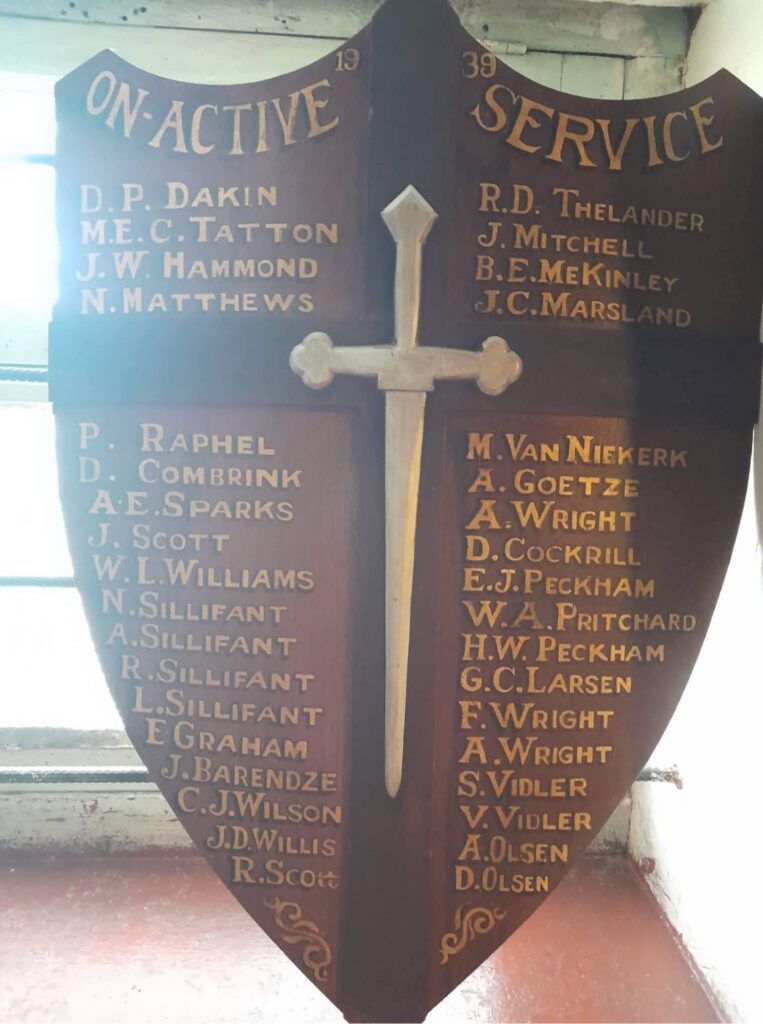
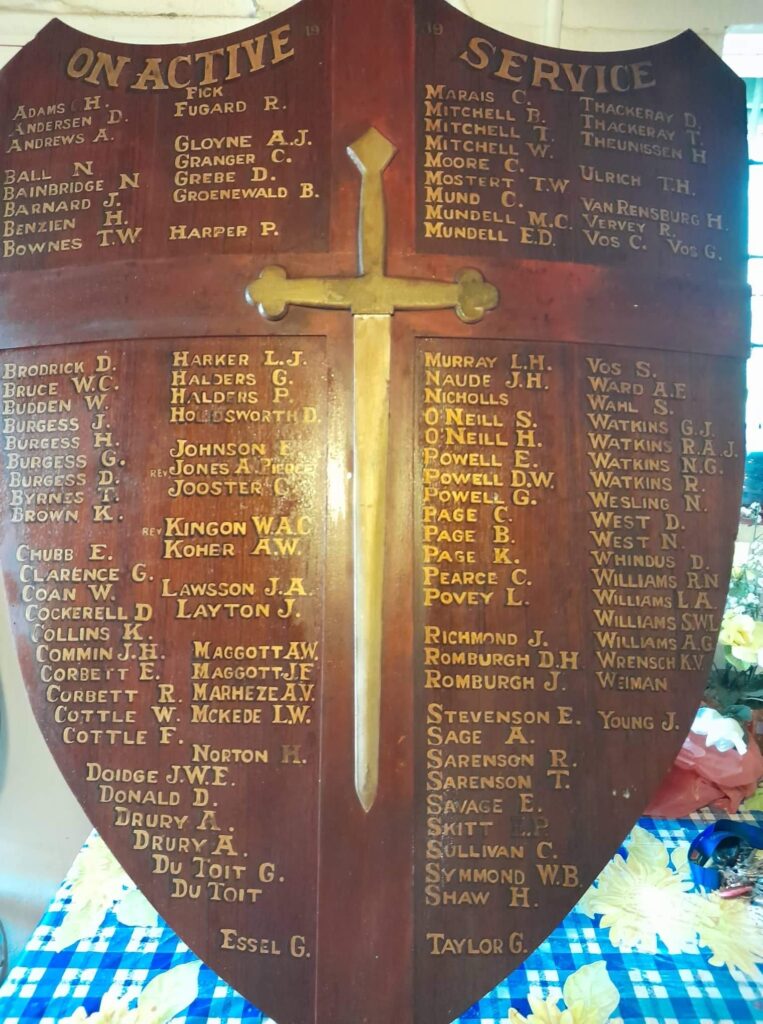
I was approached by the part-time secretary at All Saints’ Church in Roodebloem, Woodstock.  She was clearing out the church cellar and found the two shields pictured below.  They have 150 names on them and they both have a heading ‘On Active Service’ but one has the year 1939 on it.  I suspect that they were placed on the wall of the church so that worshippers could prayer for the safety of these men on active service.  The secretary asked me how she could find out more about these people.  Unfortunately, there are only initials and no first names and many of the surnames are quite common names like BROWN and WILLIAMS.  I have been doing some searches for the less common names and found quite a few who were baptised and married in All Saints Church but others I could find no entries on www.familysearch.org , www.gendatabase.com and NAAIRS.

I am wondering if anyone can help.  If you recognise a name and you know they had a Woodstock connection do let me know – especially if you have their first names.


I’ve Found My Grandad!

In January 2022 at the zoom meeting of the Cape Town Family History Society I gave a talk on the 1921 UK Census and how it seemed to give me a new paternal grandfather.  You can watch the whole talk at

Basically, the widowed Sarah BOARDMAN born PARISH married Charles PRATT on 21 June 1919.  On the 26 Sep 1919, my father, Thomas PRATT was born.  All I knew about my grandfather was that he was called Charles, was aged (according to the marriage certificate) 49 years, was living at a hostel for working men, Rawton House, and that his father was a mechanical engineer called Thomas PRATT and was deceased.  I also obtained Charles PRATT’s death certificate from 18 May 1924 (less than 5 years after my father was born).  His age is given as 54 years which matches the age on the marriage certificate. 

Charles PRATT was only part of my family from 1919 and had died by 1924 so it was hard to find definitive data on him.  I presumed (wrongly) that he must have come from Birmingham or the Midlands as ‘people, especially poor people, didn’t move about much in those days.’  I found a Charles PRATT from Birmingham whose birth year approximately matched that on Sarah BOARDMAN’s marriage certificate of 1919.  However, there was always a nagging doubt that I had the wrong man.  It was with eager anticipation that I looked forward to the 1921 Census, as this could tell me whether he was born in Birmingham or not.

The 1921 Census blew my paternal family tree wide open as it told me Charles PRATT was born in Bradford, Yorkshire and not Birmingham.  This meant starting my search for my grandfather from scratch.  I duly found a Charlie [sic] PRATT born about 1871 whose father was a ‘Steam Engine fitter’ which I suppose could be called an engineer as on the marriage certificate.  So was this the right Charles PRATT?

Following this Charles or Charley or Charlie PRATT through, I found he married a Mary Ann WILSON in July 1891.  By the 1901 Census they had three children, two girls (Annie PRATT 9y and Elizabeth PRATT 7y) and a son (Harold PRATT 5y).  I also found that Charlie PRATT was a drinker and assaulted his wife for which he appeared in court.  This assault must have made Mary Anne PRATT born WILSON decide to leave him and make her way to Philadelphia in the USA, taking the three children with her.

I then researched her and the children in the USA and found that she married Frank REGAN.  I also found Harold Thomas PRATT growing up, serving in the US forces in WW1 and marrying a Jessie KYNOCH in 1922.  They only had one son, Harold James PRATT.  He married Maria Madelaine WINTERBERGER in 1948 and had five children including another Harold, HAROLD ALAN PRATT.

I had asked someone in this family that I found if any had had a DNA test done.  He didn’t respond so I left it until a few weeks ago when I decided to delete from my family tree the other Charles PRATT from BIRMINGHAM and take a chance and enter Charles PRATT from Bradford as my grandfather.  While doing that I went to www.findagrave.com to get Harold Thomas PRATT’s date of death.  There I found that in 2018 a Harold PRATT had left digital flowers at his digital grave.  When one does this, there is a hyperlink to the person’s email.  As 2018 was relatively recent I thought the Harold Pratt who had left flowers would still be alive so I emailed him.

After some to-ing and fro-ing of emails, Harold said that he had done DNA via Ancestry.  I had done mine via Family Tree DNA (FTDNA) and thus could not upload it to Ancestry but he could download the raw data and upload it to Gedmatch.com where I had placed my DNA too.  This he kindly did.

On Sunday 22 May 2022 I check out my possible matches of DNA and to my joy I found the following


This shows that Harold Pratt (Hap) and I have 233.6 cM of matching DNA, the largest string being 54.5

The two other entries on this screen-shot are from my maternal side.  Jennifer KENNERLEY has only 97.2 cM in common with me and her daughter Julia 89.7 cM.   They are my Third Cousin (3C) and Third Cousin Once Removed (3C1R) respectively.

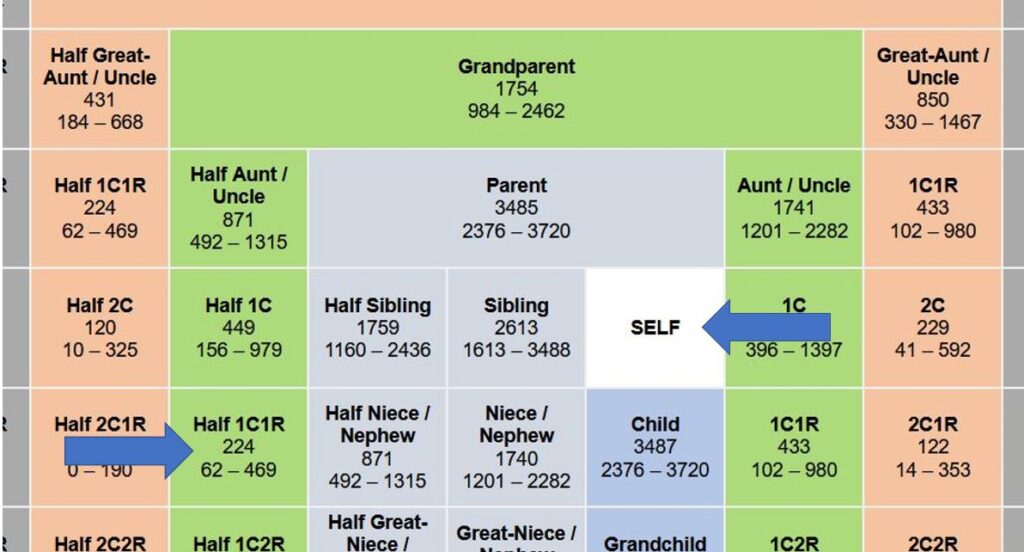
I worked out Hal PRATT’s relationship to me using https://dnapainter.com tool of projecting cM similarity.


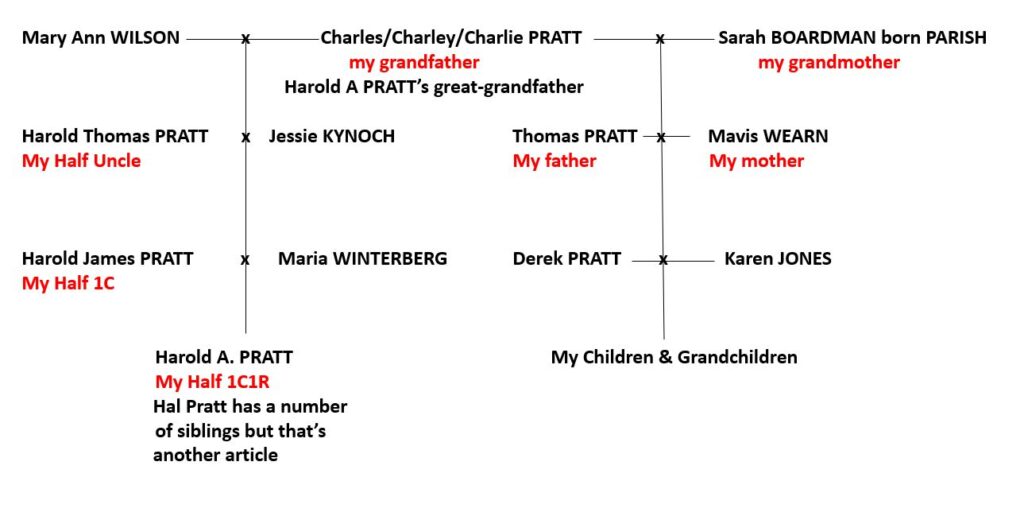
Self is me (Derek Pratt) and Half 1C1R is Half First Cousin Once Removed.  My Parent is my father (Thomas PRATT b. 1919), my Grandparent is Charles PRATT (1871-1924).  Then my half Uncle is Harold Thomas PRATT, my Half First Cousin is Harold James. His son is Harold Alan PRATT who is my Half First Cousin once removed.  Or to make it more visual 

Hal Pratt doesn’t have pictures of my granddad, Charles PRATT and nor do I.  He did comment that his great-grandmother Charles’s first wife, Mary Ann PRATT born WILSON later REGAN would get all upset when Charles name was even mentioned. 

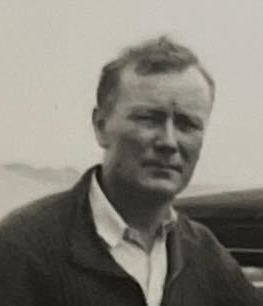
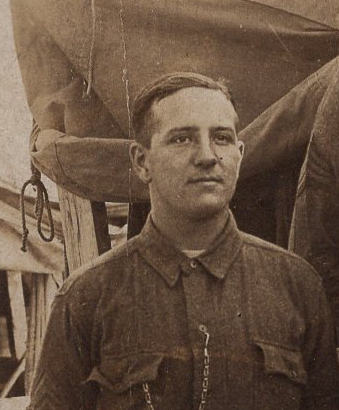
Hal kindly sent me a picture of his grandfather Harold Thomas PRATT when he joined the US Army in WW1.  I’ll put that alongside an early picture of my father.  Can you see any likeness between these two half-brothers?  Their age gap was twenty-three years.

Thomas PRATT, my father        Harold Thomas PRATT, my father’s half-brother

A New Commandment

Sermon 5 Sunday of Easter preached at St Clare’s. Ocean View.

Each Sunday we have a set of readings.  In these Sundays after Easter we have a reading from the Book of the Acts of the Apostles, a psalm and a reading from a Gospel.  Have you ever wondered how they decide which reading should go on which Sunday and how reading fit together?  I think what they do is try to find a theme in the Gospel reading and then find the other readings to fit into that theme.  Then the same message is given in each reading.  Any guesses what the message is in today’s readings? Well, I’ve spent the last few days thinking about this, I’ve come to the conclusion that the theme in today’s readings is the wideness of grace and salvation offered by God.  Okay I’ve just said two theologically loaded words, so let me explain: grace is God’s free gift to us.  And what is that free gift?  Salvation.  God saves us.  Yes, God does save us.  But is the salvation and grace offered by God restricted to a small group of people only?  Or are the gates of salvation wide open for all?  

I’m afraid to say that often we believe that God will only save people like us.  Only save good Anglicans, who have been confirmed and come to church regularly.  I’m also afraid to say that our faith is often xenophobic – we don’t want to worship with people foreign to us or different from our way of life.  We make it worst by saying that our brand of spirituality and church is the only way to God.  We say to ourselves that our culture, our ethnicity, our traditions, and all that we hold dear spiritually is the only thing God accepts.  Well I’m here today to say that if we think like that, we are wrong.  God is generous with grace and salvation.  God reveals God-self and saves all who turn to God.  You see, our ways of thinking are not God’s ways.  There is that wonderful hymn that says that there is a “wideness in God’s mercy”, a wideness that far exceeds our own.

So, do our readings today show us this wideness of God’s mercy to all? Let’s have a quick look.

In the 1st reading from the Book of Acts, Peter defends breaking down the barriers between Jews and Gentiles.  The Gentiles were considered inferior and unworthy of receiving the early church’s message and being offered the salvation of God.  Peter tells of his encounter with Cornelius and he proclaims that all are chosen, not just one nationality or one way of worship and one sort of lifestyle.

Now this wasn’t just because Peter was a liberal or he just felt like saying it.  It was the result of what God did.  God gave Cornelius and his family a full portion of the Holy Spirit and so Peter affirmed those former “outsiders” as full-fledged members of the new emerging Christian movement, that we now call the Church.  Their acceptance was grounded in God’s blessing.  The early Church was acknowledging that diversity was and still is a gift of God and that God will be revealed in a variety of ways, according to culture, ethnicity, and personal experience.   The Church today must do the same. 

[Omit at 8am. Who are in the confirmation class?  Put up your hands.  Congregation, look around you at these young people.  Are they diverse in their culture, their ethnicity and their personal experience?  Yes they are and so we must welcome them as fully fledged members of our Christian movement, our Church.]

After every sermon you hear, you should be asking yourself, “What does that mean for me?”  So, what is my sermon today saying to you?  It is saying that we should be open to the different ways of God’s revelation to us and to others around us.  We should be welcoming those who are different from us with hospitality and not with fear.  We should be willing to expand our faith through meeting and interacting with others.  The church must embrace diversity, embrace those who are ethnically, racially, theologically, or sexually different from us.   But let me hasten to say that embracing the diversity of others does not always mean acceptance of all behaviours and opinions of other, but it means being open to the experience of others.  If we believe God is everywhere and God is active in all things then there is no place where God isn’t revealed to us.  Our faith will grow when we seek God in all everything.   What do I mean by that?  You see a movie or a TV show – have you thought about seeking God in those?  Have you asked yourself:  What is God saying to me in this TV drama?  When you read scripture you ask yourself that, why not ask yourself that in everything you see or do? What is God telling me in this?

And this leads into this morning’s psalm 148, because that is what the writer of the Psalm asked as he or she proclaimed a world filled with praise.   For the psalm-writer everything praises God.  We must look at our world with that attitude:  the beauty of a sunset, the sound of birds in the trees, the grasshopper sitting on a flower in our yard, our Muslim neighbour bowing in prayer, our friend, a faithful Roman Catholic praying with her rosary, your rector spending time studying God’s word, and even young children playing with toys.  All things, at their deepest, praise God by their very being.   

Thomas Merton a great spiritual writer once said that a tree, just simply growing in a field is praising God because it is doing what God created it to do.  The tree wasn’t doing anything special; it was just a tree in the middle of a field but it was doing what God created it to do- to just be a tree.   The tree praises God and God praises it.  In the same way God praises us in and through doing what we were created to do.  And what we are created to do?  We are called to “love one another”.

And that leads us into our Gospel reading.  Did you hear Jesus’ command in today’s Gospel reading?  He told his followers, and tells us, to “Love one another.”   The “one another” that Jesus mentioned is not just fellow followers of Jesus but all people and in fact, also all creation, beginning where we are and expanding to include all human beings and the whole of our planet.

Love is hard work and challenging, even among people we love – just ask your partner or your teenage children.  Yes, there is going to be some conflict.  In the course of our lives, we may even participate in forms of destruction, in order to survive, but we need to minimize our destructive behaviour towards others and towards the environment that we live in.   

Do we have an example we can follow in order to live this way? Yes, our love must mirror God’s love for us.  And our love must also reflect God’s love for all creation in its diversity.  Our love must show the same all-encompassing love, albeit from our own limited and imperfect point of view.

Do today’s readings help us see the wideness in God’s mercy?  I would say they do.  They invite us to play a role in saving, by loving others – those who are Christians and those who might not be.  By loving our planet we will save our planet and we will contribute to God’s world-saving quest.